Sultan Murad IV, wary of the growing …
Years: 1633 - 1633
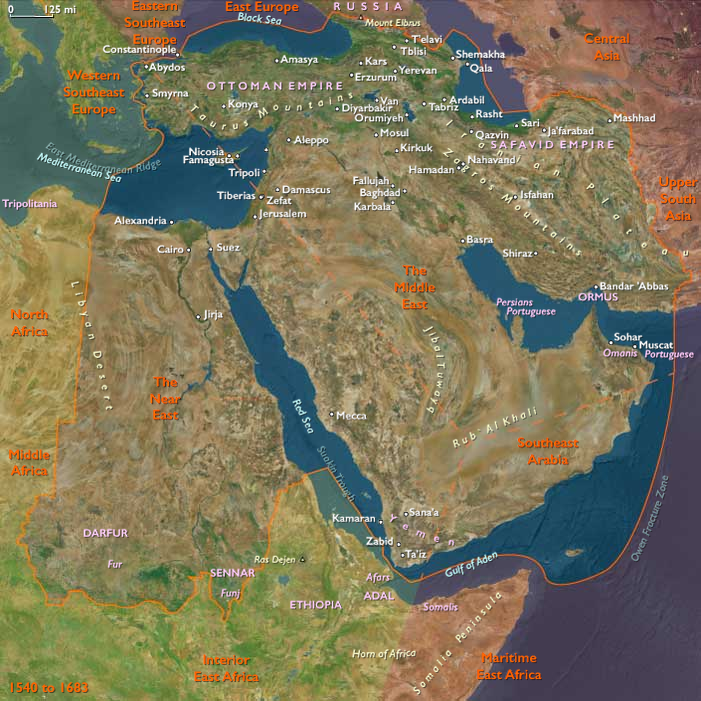
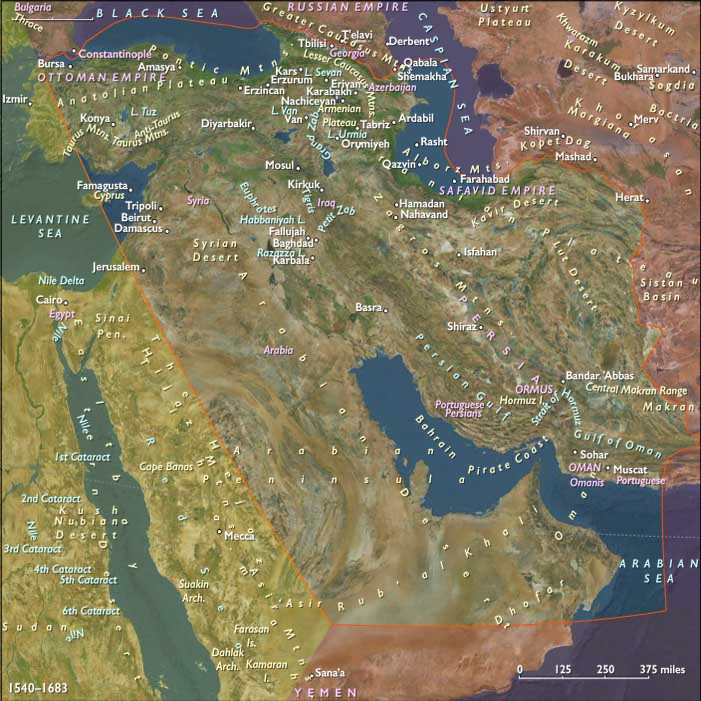
Sultan Murad IV, wary of the growing power of Fakhr ad-Din, and planning yet another campaign against Persia, doubts the allegiance of the Druze (who might support the Persians in Syria and Mesopotamia) and in 1633 orders Kutshuk, governor of Damascus, to mount a land and sea expedition against Fakhr.
While the Ottoman navy blockades the Lebanese coast, a Turkish (Syrian-Egyptian) eighty-thousand-man army encounters and defeats twenty-five thousand Druze, Maronite, and mercenary troops led by Fakhr, who flees to the Lebanon Mountains.
One of his sons is captured and executed.
Locations
People
Groups
Topics
Subjects
Regions
Subregions
Related Events
Filter results
Showing 10 events out of 32511 total
The Great Synagogue of Vilna is built between 1630-1633 after permission had been granted to construct a synagogue from stone at the end of Jewish Street.
Standing on the spot of an existing synagogue built in 1572, the site had first been used to house a Jewish house of prayer in 1440.
At the time of its building, ecclesiastical regulations all through Europe specify that a synagogue cannot be built higher than a church.
To obey the law, and yet create the necessary interior height, it is customary to dig a foundation deep enough for the synagogue’s floor level to be well below that of the street.
Outside, the synagogue looks to be about three stories tall, but inside it soars to over five stories.
Another entrance with a vestibule and the “pillory” is located on the northern side of the building.
According to legend it was so magnificent and impressive, Napoleon, who stood on the threshold of this synagogue in 1812 and gazed at the interior, was speechless with admiration.
Fort Kochi, the first European colonial settlement in India, has been ruled by Portugal since 1633.
Located on the Malabar coast in the present day state of Kerala, India, Kochi hosts the grave of Vasco da Gama, the first European explorer to set sail for India, who had been buried at St. Francis Church until his remains were returned to Portugal in 1539.
This period had been a harrowing time for the Jews living in the region, as the Inquisition had been active in Portuguese India.
Portuguese rule is followed in 1633 by that of the Dutch, who ally with the Saamoothiri, or Zamorins, the Eradi Nair rulers of Kozhikode (Nediyirippu Swarūpam), to conquer Kochi.
Fasilides, on hearing that the Portuguese had bombarded Mombasa, assumes that the prelate Mendes had been behind the act, and banishes the remaining Jesuits from his lands.
Mendes and most of his followers make their way back to Goa, being robbed or imprisoned several times on the way.
Construction had begun on Santa Maria della Salute in 1631.
Substantially complete by 1633, the Salute is a vast, octagonal building with two domes and a pair of picturesque bell-towers at the back.
Built on a platform made of one hundred thousand wooden piles, it is constructed of Istrian stone and marmorino (brick covered with marble dust).
At the apex of the pediment stands a statue of the Virgin Mary who presides over the church erected in her honor.
The façade is decorated with figures of Saint George, Saint Theodore, the Evangelists, the Prophets, Judith with the head of Holofernes.
While its external decoration and location capture the eye, the internal design itself is quite remarkable.
The octagonal church, while ringed by a classic vocabulary, hearkens to Byzantine designs such as the Basilica of San Vitale.
The interior has its architectural elements demarcated by the coloration of the material, and the central nave with its ring of saints atop a balustrade is a novel design.
It is full of Marian symbolism -– the great dome represents her crown, the cavernous interior her womb, the eight sides the eight points on her symbolic star.
An important addition to the Venice skyline, the church has a large influence on contemporary architects immediately after its completion, and will soon became emblematic of the city.
The main entrance, modeled on the Roman triumphal arch, will later be copied in successive churches and cathedrals, in Venice and elsewhere.
Today, this two-domed church on the peninsula between the Grand Canal and the Zattere is one of the city's best-known landmarks.
Pope Urban VIII had earlier asked Galileo personally to give arguments for and against heliocentrism in the book, and to be careful not to advocate heliocentrism.
He had made another request, that his own views on the matter be included in Galileo's book.
Only the latter of those requests was fulfilled by Galileo.
Simplicio, the defender of the Aristotelian Geocentric view in Dialogue Concerning the Two Chief World Systems, is often caught in his own errors and sometimes comes across as a fool.
Indeed, although Galileo states in the preface of his book that the character is named after a famous Aristotelian philosopher (Simplicius in Latin, Simplicio in Italian), the name "Simplicio" in Italian also has the connotation of "simpleton."
This portrayal of Simplicio made Dialogue Concerning the Two Chief World Systems appear as an advocacy book: an attack on Aristotelian geocentrism and defense of the Copernican theory.
Unfortunately for his relationship with the Pope, Galileo put the words of Urban VIII into the mouth of Simplicio.
Most historians agree Galileo did not act out of malice and felt blindsided by the reaction to his book.
However, the Pope does not take the suspected public ridicule lightly, nor the Copernican advocacy.
Galileo has alienated one of his biggest and most powerful supporters, the Pope, and is called to Rome to defend his writings.
With the loss of many of his defenders in Rome because of Dialogue Concerning the Two Chief World Systems, Galileo is ordered to stand trial on suspicion of heresy in 1633.
The sentence of the Inquisition was in three essential parts:
* Galileo is found "vehemently suspect of heresy," namely of having held the opinions that the Sun lies motionless at the center of the universe, that the Earth is not at its center and moves, and that one may hold and defend an opinion as probable after it has been declared contrary to Holy Scripture; he is required to "abjure, curse and detest" those opinions.
* He is sentenced to formal imprisonment at the pleasure of the Inquisition; on the following day this is commuted to house arrest, under which he will remained for the rest of his life.
* His offending Dialogue is banned; and in an action not announced at the trial, publication of any of his works is forbidden, including any he might write in the future.

Philip's domestic policies are by the 1630s increasingly being impacted by the financial pressures of the Thirty Years War, and in particular the growing war with France.
The costs of the war are huge, and while they have largely fallen upon Castile, the ability of the crown to raise more funds and men from this source is increasingly limited.
Philip and his government are desperately trying to reduce the responsibilities of central government in response to the overstretch of the war, and various reform ideas that might have been pursued during the 1620s are rejected on this basis.
Financial restraints and higher taxes are put in place, but Philip is increasingly selling off regalian and feudal rights, along with much of the royal estate to fund the conflict.
It has been argued that the fiscal stringencies of the 1630s, combined with the strength and role of Olivares and the juntas, effectively cut Philip off from the three traditional pillars of support for the monarchy -- the grandees, the Church and the Council of Castile.
Bernini completes work on the Palazzo Barberini by 1633.
The palazzo is disposed around a forecourt centered on Bernini's grand two-story hall backed by an oval salone, with an extended wing dominating the piazza, which lies on a lower level.
At the rear, a long wing protects the giardino segreto ("secret garden"), from the piazza below, above which it rises from a rusticated basement that is slightly battered like a military bastion.
The main block presents three tiers of great arch-headed windows, like glazed arcades, a formula that is more Venetian than Roman.
On the uppermost floor, Borromini's windows are set in a false perspective that suggests extra depth, a feature that will be copied into the twentieth century.
Flanking the hall, two sets of stairs lead to the piano nobile, a large squared staircase by Bernini to the left and a smaller oval, or helicoidal, staircase by Borromini to the right.
Aside from Borromini's false-perspective window reveals, among the other influential aspects of Palazzo Barberini, ones that will be repeated throughout Europe, are the unit of a central two-story hall backed by an oval salone and the symmetrical wings that extended forward from the main block to create a cour d'honneur.
The Salon ceiling is graced by Pietro da Cortona's masterpiece, the Baroque fresco of the Allegory of Divine Providence and Barberini Power.
This vast panegyric allegory is to become highly influential in guiding decoration for palatial and church ceilings; its influence can be seen in other panoramic scenes such as the frescoed ceilings at Sant'Ignazio (by Pozzo); or those at Villa Pisani at Stra, the throne room of the Royal Palace of Madrid, and the Ca' Rezzonico in Venice (by Tiepolo).
Also in the palace is a masterpiece of Andrea Sacchi, a contemporary critic of the Cortona style, Divine Wisdom.
Today Palazzo Barberini houses the Galleria Nazionale d'Arte Antica, one of the most important painting collections in Italy, and is home also to the Italian Institute of Numismatics.
Recently found hidden in the cellars of the rear part of the building is a Mithraeum, dating probably from the second century CE.
Rembrand, seeking to emulate the baroque style of Rubens during his early years in Amsterdam (1632–1636), begins to paint dramatic biblical and mythological scenes in high contrast and of large format.
With the occasional help of assistants in Uylenburgh's workshop, he paints numerous portrait commissions both small (Jacob de Gheyn III) and large (Portrait of the Shipbuilder Jan Rijcksen and his Wife, 1633, Anatomy Lesson of Dr. Nicolaes Tulp, 1632).
In The Anatomy Lesson of Dr. Nicolaes Tulp, Dr. Nicolaes Tulp is pictured explaining the musculature of the arm to medical professionals.
The corpse is that of the criminal Aris Kindt, strangled earlier that day for armed robbery.
Some of the spectators are various doctors who paid commissions to be included in the painting.
The event can be dated to January 16, 1632: the Amsterdam Guild of Surgeons, of which Tulp is official City Anatomist, permits only one public dissection a year, and the body would have to be that of an executed criminal.
Anatomy lessons are a social event in the seventeenth century, taking place in lecture rooms that are actual theaters, with students, colleagues and the general public being permitted to attend on payment of an entrance fee.
The spectators are appropriately dressed for a solemn social occasion.
It is thought that, with the exception of the figures to the rear and left, these people were added to the picture later.
Rubens will spend his last decade in and around Antwerp.
Major works for foreign patrons still occupy him, such as the ceiling paintings for the Banqueting House at Inigo Jones's Palace of Whitehall, but he also explores more personal artistic directions.
The fifty-three-year-old painter in 1630, four years after the death of his first wife, had married sixteen-year-old Hélène Fourment.
Hélène inspires the voluptuous figures in many of his paintings from the 1630s, including The Feast of Venus (Kunsthistorisches Museum, Vienna), The Three Graces (Prado, Madrid) and The Judgment of Paris (Prado, Madrid).
In the latter painting, which is made for the Spanish court, the artist's young wife will be recognized by viewers in the figure of Venus.
In an intimate portrait of her, Hélène Fourment in a Fur Wrap, also known as Het Pelsken (illustrated right), Rubens's wife is even partially modeled after classical sculptures of the Venus Pudica, such as the Medici Venus.
Judith Leyster was born in Haarlem as the eighth child of Jan Willemsz Leyster, a local brewer and clothmaker.
While the details of her training are uncertain, in her teens she was well enough known to be mentioned in a Dutch book by Samuel Ampzing titled Beschrijvinge ende lof der stadt Haerlem, originally written in 1621, revised in 1626-27, and published in 1628.
She is by 1633 a member of the Haarlem Guild of St. Luke, the second woman to be registered here (the first women registered was Sara van Baalbergen in 1631, who like Leyster, was not a member of an established artist family in Haarlem, and she also married another painter; Barent van Eysen).
There are more women active at this time as painters in Haarlem, but since they work in family workshops they do not need the professional qualifications necessary to be able to sign works or run a workshop.The most notable example of this in Leyster's case was Maria de Grebber, the sister of Pieter de Grebber, who is seven years older than Leyster and already active as a painter in her father's workshop in 1628.
She possibly studied with Leyster as a pupil of her father, and her daughter Isabelle will later marry the painter Gabriel Metsu.
Within two years of her entry into the guild, Leyster has taken on three male apprentices.
Records show that Leyster sued Frans Hals for stealing one of her students who had left her workshop for that of Hals, not three days after he arrived.
The student's mother paid Leyster four guilders in punitive damages, only half of what Leyster asked for, and, instead of returning her apprentice, Hals settled the due by paying a three guilder fine.
Leyster was also fined for not having registered the apprentice with the Guild.