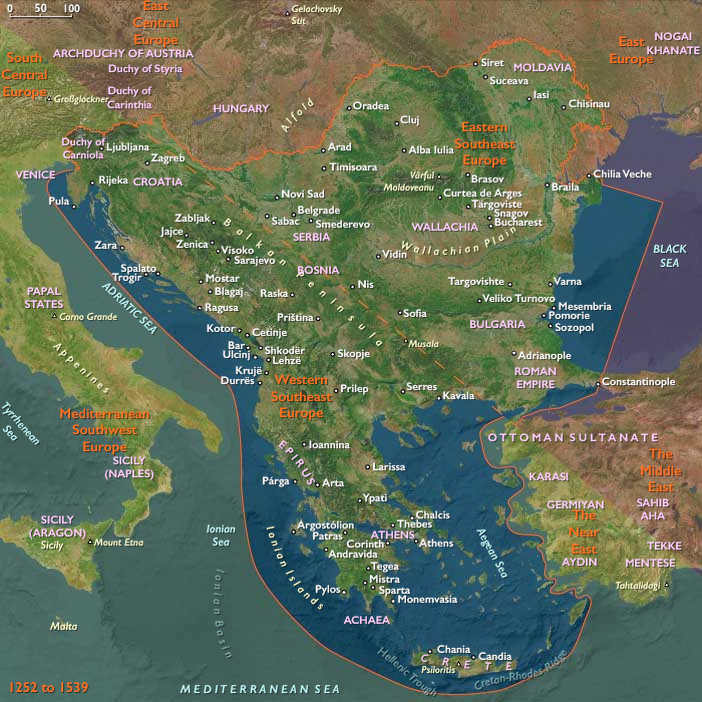
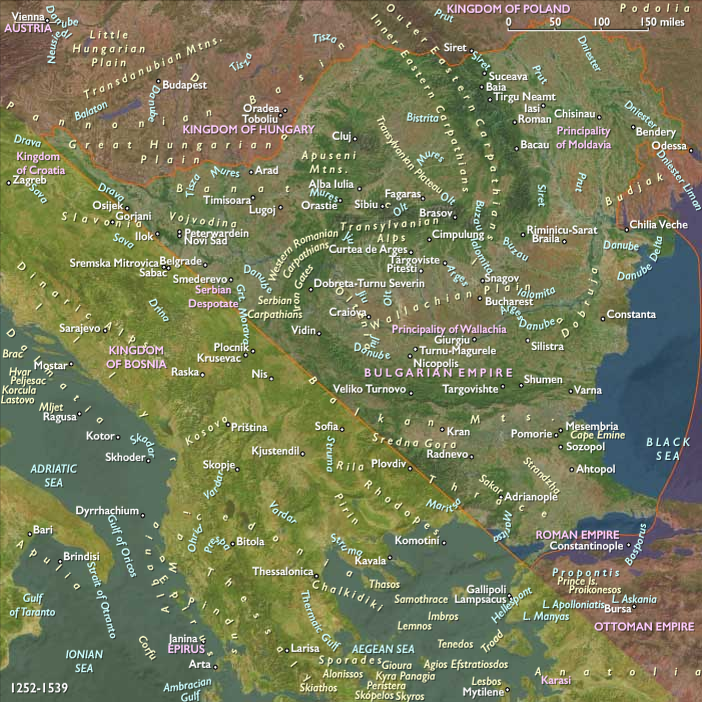
Murad II retakes control of Bosnia and …
Years: 1445 - 1445
Murad II retakes control of Bosnia and Serbia in 1445.
Locations
People
Groups
- Papal States (Republic of St. Peter)
- Venice, (Most Serene) Republic of
- Hungary, Kingdom of
- Karamanids
- Rumelia Eyalet
- Bosnia, Kingdom of
- Poland of the Jagiellonians, Kingdom of
- Macedonia, Ottoman Vardar
- Wallachia, Principality of
- Ottoman Empire
- Serbian Despotate
Topics
Commodoties
Subjects
Regions
Subregions
Related Events
Filter results
Showing 10 events out of 41663 total
The Chinese forces, having regrouped, invaded again in the following year.
On November 3, 1445, the Burmese troops evacuate Bhamo.
The causes of the Muscovite Civil War waged in the second quarter of the fifteenth century are still disputed.
However, Dmitri Donskoi's will ran contrary to Rurikid dynastic custom, whereby the throne would pass from an elder brother to a younger one (lateral inheritance), rather than from father to son (linear succession).
The testament had provided for the accession of his son, Vasily I, which was still in keeping with the tradition of lateral succession, since Vasily was the eldest of his generation.
In the event of Vasily having no surviving son at his death, his brother, Dmitry's second son, Yury of Zvenigorod, was to succeed as grand prince in Moscow.
Upon Vasily I's death, however, Yury had refused to come to Moscow and swear allegiance to his nephew, Vasily II, and claimed the throne himself in accordance with his right under the long-held custom of lateral inheritance.
(He further claimed it was provided for in Dmitry's testament—but this ignored the provision that voided Yury's succession in the event of Vasily I producing a son).
Yury's son, Dmitry Shemyaka, had actively participated in all of his father's incursions against Moscow, culminating in Yury's capture of Moscow and accession as grand prince in 1433.
Yury of Zvenigorod had died in Moscow in 1434.
After Yury's death, Shemyaka continued to press his branch's claim to the grand princely throne, and was seldom at peace with Vasily II.
Initially, Dmitry and his younger brother Dmitry Krasnyi had concluded an alliance with Vasily against their elder brother Vasily Kosoy, who had proclaimed himself grand prince.
They had succeeded in driving Kosoy from Moscow and were rewarded with the towns of Uglich and Rzhev.
The following year, Shemyaka had come to Moscow in order to invite Vasily II to his impending wedding with a princess of Yaroslavl, but was accused of siding with Kosoy and taken prisoner.
Released several months later, he was sent by Vasily II to defend Belyov against a small army of the Kazan Khan Olugh Mokhammad but had been defeated.
Thereupon he refused to support Vasily in his hostilities against the khan, and only the mediation of a hegumen from the Trinity Lavra of St. Sergius monastery forestalled a new civil war between the cousins.
The two men had maintained an uneasy peace for much of the next decade until 1445, when Vasily II is taken prisoner by Olugh Mokhammad after the Muscovite forces are surprised by the Tatar prince outside Suzdal.
The Tatar khan also expropriates boyar estates.
Shemyaka seizes Moscow, has the recently released Vasily blinded and proclaims himself the Grand Prince of Vladimir.
He can claim this by right of lateral inheritance since, his father had sat on the throne.
(A prince is excluded from the succession (izgoi) if his father had not sat on the throne before him.)

Mircea, an able military commander, successfully recaptures the fortress of Giurgiu in 1445.
However, in yet another treaty with the Ottomans, his father, Vlad, allows the Ottomans to again have control of the fortress in an effort to retain their support of his having the throne, and in an effort to keep his two captive sons safe.
The Ottomans had begun their conquest of the Balkans and Greece in the late fourteenth and early fifteenth centuries.
Ottoman-occupied Thessaly is recaptured in 144 by future emperor Constantine XI Palaiologos, at this time despot of Mystras, but there is little he can do against most of the other Ottoman territories.
Papal recognition from Pope Eugene IV of the University of Catania had arrived on April 18,1444, ten years after its founding by Alfonso V of Aragon, who with this gesture had wanted to compensate the city (in which there had been recently established the Royal Court) for moving the Sicilian capital from Catania to Palermo.
The activity of the Atheneum actually starts a year later, in 1445, with six professors and ten students.
The first four faculties are Medicine, Philosophy, Canon and Civil Law and Theology.
Lessons are initially held in a building in Piazza del Duomo, next to the Cathedral of St. Agatha, and will eventually move to the Palazzo dell'Università in the late 1690s.
This building remains the seat of the university to this day.
Afonso, First Duke of Braganza: Power, Politics, and Rivalry in 15th-Century Portugal
Afonso of Braganza, the illegitimate son of King John I of Portugal and Inês Pires, played a pivotal role in Portuguese aristocratic politics during the mid-15th century. A powerful noble, Afonso became the founder of the House of Braganza, which would eventually rule Portugal.
Early Life and Marriage
- Born in Veiros, Estremoz, Alentejo, Afonso was raised in the royal court despite his illegitimacy.
- He married Beatriz Pereira de Alvim, the daughter of Nuno Álvares Pereira, the kingdom’s greatest military commander and wealthiest noble.
- This marriage made him one of the richest men in Portugal, securing his influence among the aristocracy.
Military and Political Rise
- Afonso was present in the 1415 conquest of Ceuta, Portugal’s first overseas expansion, proving his military prowess.
- Under King John I and his legitimate half-brothers, he remained a trusted nobleman, growing in status and landholdings.
The Regency Crisis After King Edward’s Death (1438–1439)
- After King Edward I died in 1438, his son Afonso V was still an infant, requiring a regency.
- The Queen Mother, Eleonor of Aragon, was chosen as regent, but she was deeply unpopular, particularly among the merchant class and lower nobility.
- The Portuguese Cortes of 1439, convened by John, Lord of Reguengos de Monsaraz, awarded the regency to Infante Peter, Duke of Coimbra (Afonso’s half-brother and uncle to the young king).
- The commoners and bourgeoisie supported Peter, while Afonso and the higher nobility preferred Eleonor, seeing Peter’s reformist tendencies as a threat to noble privileges.
Afonso vs. Peter: A Struggle for Influence Over Afonso V
- Over time, Afonso outmaneuvered Peter and became Afonso V’s favored uncle.
- In 1443, Peter attempted reconciliation by granting Afonso the title of "Duke of Braganza," making him the first duke in Portugal.
- For a time, their relations appeared stable, but tensions resurfaced in 1445 when:
- Afonso was offended that Afonso V was to marry Isabella of Coimbra, Peter’s daughter, instead of one of his own granddaughters.
- This marriage solidified Peter’s influence over the young king, further alienating Afonso.
The Growing Divide and the Fall of Peter
- While Peter focused on governing efficiently, Afonso cultivated influence over Afonso V.
- In 1448, when Afonso V came of age, he ended Peter’s regency and fully assumed the throne.
- Under Afonso’s manipulation, Afonso V turned against Peter, leading to the Battle of Alfarrobeira (1449), where Peter was killed.
- Afonso, Duke of Braganza, emerged victorious, securing his family’s dominance over the Portuguese nobility.
Legacy: The Rise of the House of Braganza
- Afonso’s dynasty, the House of Braganza, became the wealthiest and most powerful in Portugal, rivaling even the monarchy.
- His descendants would later challenge royal authority, and in 1640, the 8th Duke of Braganza, John IV, would overthrow Spanish rule and become King of Portugal, establishing the Braganza dynasty, which ruled until 1910.
Thus, Afonso’s maneuvering and rivalry with Peter shaped Portuguese history, cementing the Braganzas as the leading noble family and ultimately paving the way for their ascent to the throne.
Charles VII's Military and Administrative Reforms after the Treaty of Tours (1444–1445)
Following the Treaty of Tours in 1444, King Charles VII of France capitalized on the temporary pause in hostilities to strengthen and reorganize French military capabilities significantly. Recognizing the opportunity presented by peace, Charles VII systematically reformed the kingdom’s administrative structures and rebuilt its financial resources, echoing the successful reforms implemented nearly a century earlier during the 1360s.
In 1445, these efforts culminated in the creation of a permanent standing army—a major innovation marking a decisive break from reliance on mercenary companies and feudal levies. This permanent military force allowed Charles VII to maintain a disciplined, well-equipped, and reliably funded army, drastically improving France's strategic readiness.
In contrast, England, hampered by the weak and indecisive leadership of King Henry VI, struggled to maintain cohesion and effectiveness. Although the Treaty of Tours had allowed England to retain considerable French territory initially, the English administration and military became increasingly fragmented and vulnerable.
Charles VII’s reforms fundamentally altered the balance of power. The establishment of a permanent French army—financed by improved taxation and overseen by a centralized royal administration—enabled the kingdom to swiftly regain the upper hand. These actions laid the essential foundations for France’s decisive victories in the closing stages of the Hundred Years’ War, setting the stage for the eventual complete recovery of territories previously lost to England.
The First Recorded Money-Prize Lotteries in the Low Countries (1445)
In the mid-fifteenth century, towns in the Low Countries introduced the earliest documented public lotteries in European history, in which tickets were sold publicly, and monetary prizes were awarded. These lotteries served practical civic purposes, notably financing urban infrastructure projects such as fortifications and city walls, essential for defense and civic pride amid ongoing regional conflicts.
A notable example occurred in 1445 at L'Ecluse (now Sluis, Netherlands), where a documented lottery was held explicitly to finance the construction and strengthening of the town’s fortifications. This lottery involved the sale of 4,304 tickets, offering monetary prizes totaling 1,737 florins—an amount roughly equivalent to approximately 170,000 US dollars in contemporary value. This lottery represents one of the earliest known instances of organized monetary prize lotteries in Europe.
The emergence of lotteries in the Low Countries reflected broader patterns of economic innovation and civic organization characteristic of the region during the fifteenth century. They also mark a significant moment in social and financial history, signaling an early shift toward public financing mechanisms that would later spread throughout Europe and beyond. Town lotteries quickly became an accepted and efficient method of raising funds for public works and charitable causes, laying important groundwork for modern state and municipal finance systems.
The Treaty of Ensisheim and French Withdrawal from Alsace (1445)
On October 28, 1444, the Dauphin Louis (later King Louis XI of France) formally concluded peace with the Swiss Confederacy and the city of Basel through the Treaty of Ensisheim. This agreement marked the end of French military intervention in Alsace, initiated primarily as a strategic measure to occupy restless Armagnac mercenaries who posed a risk of internal unrest within France.
Following this agreement, French forces withdrew entirely from Alsace by the spring of 1445. The intervention itself had not been undertaken based on a formal diplomatic arrangement with the Holy Roman Emperor, nor was it clearly aligned with the Swiss-Imperial conflict known as the Old Zürich War. As a result, historians debate whether the French incursion and subsequent withdrawal had a decisive impact on the war’s overall outcome. Rather, the campaign appears to have been motivated largely by internal French considerations—specifically, the necessity of diverting and pacifying Armagnac forces, which were destabilizing the kingdom.
The Treaty of Ensisheim thus highlights a complex moment in mid-15th-century diplomacy, underscoring the intricate interplay of internal and external factors influencing French foreign policy. While it resolved immediate tensions between France, Basel, and the Swiss Confederacy, its broader implications for the Old Zürich War remain uncertain. Nonetheless, the French withdrawal allowed Alsace and the surrounding regions a respite from foreign intervention, temporarily stabilizing political conditions in the region.
The Vietnamese, or Annamese, to the north of Champa, invade once again in 1446 and seize the Cham capital of Vijaya (Binh Dinh).
The Chams, refusing assistance from the Chinese, manage to recapture their capital, but civil strife increasingly weakens their kingdom.
Years: 1445 - 1445
Locations
People
Groups
- Papal States (Republic of St. Peter)
- Venice, (Most Serene) Republic of
- Hungary, Kingdom of
- Karamanids
- Rumelia Eyalet
- Bosnia, Kingdom of
- Poland of the Jagiellonians, Kingdom of
- Macedonia, Ottoman Vardar
- Wallachia, Principality of
- Ottoman Empire
- Serbian Despotate