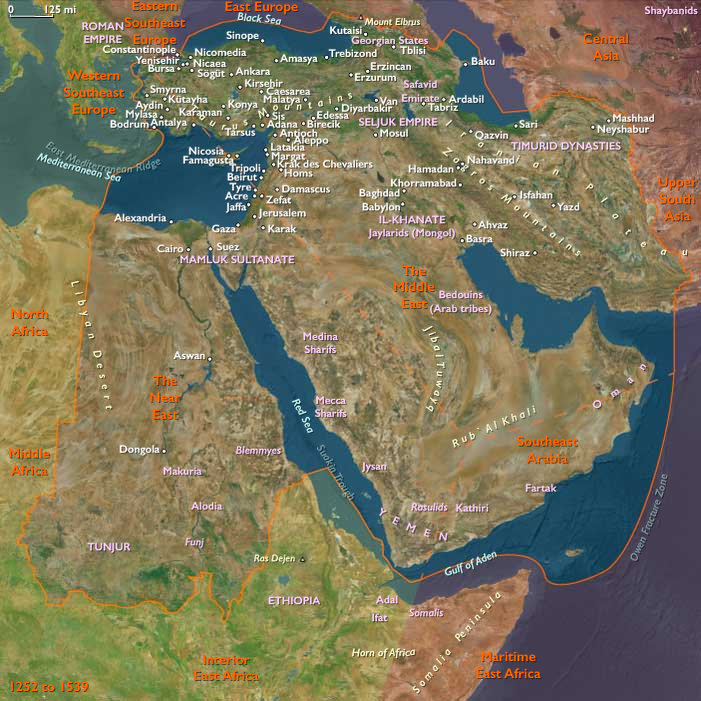
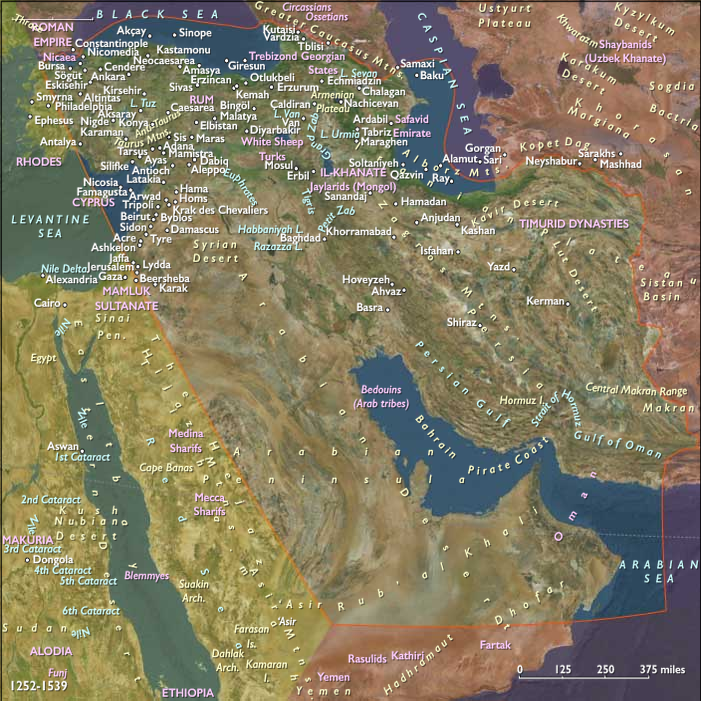
Murad has forced all of the Anatolian …
Years: 1451 - 1451
Murad has forced all of the Anatolian Timurid principalities into vassalage by 1451, excepting Karaman and …
Locations
People
Groups
Topics
Commodoties
Subjects
Regions
Subregions
Related Events
Filter results
Showing 10 events out of 41520 total
An insurrection against Ayutthayan rule erupts in 1451 in the former Sukhothai kingdom, and the Sawankhalok town leader and others request Chiang Mai’s King Sri Sutham Tilok to aid them in their effort to regain independence.
Chiang Mai forces oblige by invading Sukhothai, but are forced to withdraw.
Abdallah Mirza is a great-grandson of Timur, a grandson of Shahrukh Mirza and a son of Sultan Ibrahim Mirza.
Granted the governorship of Fars by his grandfather, Abdallah Mirza had found his position threatened by his cousin Sultan Muhammad bin Baysonqor during the 1447 succession crisis which followed Shah Rukh's death, and was forced to abandon the province.
As a supporter of Ulugh Beg, he had been imprisoned by 'Abd al-Latif following the latter's rise to power.
When 'Abd al-Latif was murdered, Abdallah had been released and made ruler of Samarkand, for which he has been forced to lavish money upon the troops that support him.
Despite this, he does not enjoy widespread popularity.
During his relatively brief reign, a revolt created by Sultan Muhammad's brother Ala-ud-Daulah Mirza bin Baysonqor did not seriously threaten him, but a rising initiated by Abu Sa'id Mirza, whose home base, at the time, was in Bukhara, proves to be fatal.
Abū Saʿīd Mirza, the great-grandson of Timur, the grandson of Miran Shah, and the nephew of Ulugh Beg, is the grandfather of Babur, by his son Umar Sheikh Mirza, who will found of the Mughal Empire in South Asia.
As a young man, his ancestry makes him a principal in the century long struggle for the remnants of Timur's empire waged between Timur's descendants, the Black Sheep Turkmens, and the White Sheep Turkmens (1405–1510).
He had raised an army but failed to gain a foothold in Samarkand or Bukhara (1448–1449); establishing his base at Yasi, he had conquered much of Turkestan in 1450.
Marching from Tashkent in June 1451, he captures Samarkand with the aid of the Uzbek Turks under Abūl-Khayr Khān, thus securing rulership of the eastern part of Timur's Empire, Transoxiana.
Abu Sa'id Mirza executes Abdallah in 1451, taking his place on the throne, then quickly moves his forces into the city and locks the gates, leaving Abu'l-Khayr and the Uzbeks outside.
To avoid reprisal, Abu Sa'id presents the Uzbeks with many presents and riches.

The Muscovites, subjected 1444 and 1451 to particularly fierce Tatar assaults on Moscow, have, with difficulty, repulsed the invaders from the city walls each time.
John of Capistrano is the principal force in the founding of the Franciscan Observants, a severely ascetic group of friars who separated from the more liberal Conventuals.
Pope Nicholas V sends him in 1451 as a legate to Germany, Bohemia, Moravia, and Silesia, with the special mission to preach against the Hussites and other heretical teachings and to subdue “the disbelieving Jews”, in accordance with the resolutions adopted at the council of Basel held from 1431 to 1443.
John repeats the old charges of ritual murder and host desecration.
His admirers call him “the scourge of the Judeans”.
Henry XVI, Duke of Bavaria, had died in July 1450, and his son, Louis IX (called the Rich) had succeeded.
About this time Bavaria begins to recover some of its former importance.
Influenced by Capistrano, Louis IX expels the Jews from his duchy, increases the security of traders, and improved both the administration of justice and the condition of the finances.
Slovakian Hussite leader John Jiskra of Brandýs, a member of the Moravian branch of the noble family Páni z Brandýsa (Lords of Brandýs), is possibly a son of Alšík z Brandýsa.
Jiskra had spent his youth in Bohemia and partially also in Italy, where he—according to several sources—attended the battles of the Republic of Venice.
In the Czech lands, he had become familiar with the Hussite war strategies.
Following the Battle of Lipany, which had virtually ended the Hussite Wars, Jiskra, together with other Hussite soldiers, had joined the army of the Emperor Sigismund of Luxembourg and fought with Turkish troops in the region of Belgrade.
Following the 1444 death, in battle against the Turks, of Polish king Wladyslaw III (or VI), who also ruled Bohemia as Uladislas I, his capable Hungarian general, John Hunyadi, had declared himself overseer of Slovakia.
Jiskra opposes Hunyadi’s attempts to govern, defeating him in battle several times, most notably at Lucenec in 1451, after a which the warring factions conclude a truce that permits Jiskra to control most of Slovakia.
George of Podébrady, after becoming the leader of the moderate Hussites (Utraquists) in 1444, represents the main source of stability in Bohemia during the minority of Ladislav V “Posthumous” of Hungary, the Habsburg party’s prospective candidate for the Bohenian throne and a ward of Germany’s King Frederick III.
The twenty-eight-year-old George, having risen to power with the help of other nationalists, had seized Prague in 1448 and, with the reluctant consent of the defeated Habsburgs, had become the administrator of Bohemia.
Late in 1451, Frederick meekly settles Bohemian claims for Ladislas by allowing the diet to name George regent governor of Bohemia.
Murad dies on February 3, 1451, and Mehmed II ascends the throne for the second time in Edirne.
Mehmed now directs all his resources to the capture of Constantinople.
The Europeans, remembering his former reign, are now not concerned much about his plans.
Neither is his authority firmly established within the Ottoman Empire empire.
However, Mehmed soon shows his stature by severely punishing the Janissaries who had dared to threaten him over the delay of the customary gift of accession, yet he reinforces this military organization, composed of young Christians recruited through the “devshirme” system, who are given salaries rather than fiefdoms to keep them loyal to and dependent on the sultan.
The Janissary infantry corps is destined to be the instrument of his future conquests.
…Candar, which maintain their autonomy.
Babur soon recovers, takes Sultan Muhammad prisoner, and executes him.
He then marches to Shiraz to take control of Sultan Muhammad's lands.
At this point, Jahan Shah of the Black Sheep Turkmen ends his loyalty to the Timurids.
He quickly puts Qum and Sava to siege.
Babur begins to march against him but is forced to return to Herat, due to the overwhelming superiority of the Black Sheep's armies and a plot hatched against him by 'Ala' al-Daula.
The Timurid Lodi dynasty, gathering strength in the Punjab in the 1440s, begins pushing eastward into Jaunpur-controlled territory, superseding the dominance of the weak Sayyid dynasty by 1451, deposing Sultan 'Alauddin Alam Shah and elevating Bahlul Lodi to the throne of the Delhi sultanate, now reduced to only the city of Delhi and its surroundings.