
Edvard Munch's massive output of graphic art—consisting …
Years: 1894 - 1894
Edvard Munch's massive output of graphic art—consisting of etchings, drypoints, lithographs, and woodcuts—begins in 1894.
The principal attraction to him of printmaking is that it enables him to communicate his message to a much larger number of people, but it also affords him exciting opportunities for experimentation.
His lack of formal training in any graphic medium is no doubt a factor in pushing him toward extremely innovative techniques.
Like many of his contemporaries, he is influenced by the Japanese tradition in his use of the woodcut, but he radically simplifies the process by, for example, printing from a single block of wood sawed into a number of small pieces.
Munch's use of the actual grain of the wood for expressive purposes proves an especially successful experiment (and it will greatly influence later artists.)
He also frequently combines different media or overlays one medium on top of another.
Munch's prints closely resemble his paintings in both style and subject matter.
Continuing his exploration of the theme of suffering caused by love, he completes one of his most pessimistic paintings, Ashes (1894; Nasjonalgalleriet, Oslo) another of the works that form the Frieze.
The principal attraction to him of printmaking is that it enables him to communicate his message to a much larger number of people, but it also affords him exciting opportunities for experimentation.
His lack of formal training in any graphic medium is no doubt a factor in pushing him toward extremely innovative techniques.
Like many of his contemporaries, he is influenced by the Japanese tradition in his use of the woodcut, but he radically simplifies the process by, for example, printing from a single block of wood sawed into a number of small pieces.
Munch's use of the actual grain of the wood for expressive purposes proves an especially successful experiment (and it will greatly influence later artists.)
He also frequently combines different media or overlays one medium on top of another.
Munch's prints closely resemble his paintings in both style and subject matter.
Continuing his exploration of the theme of suffering caused by love, he completes one of his most pessimistic paintings, Ashes (1894; Nasjonalgalleriet, Oslo) another of the works that form the Frieze.
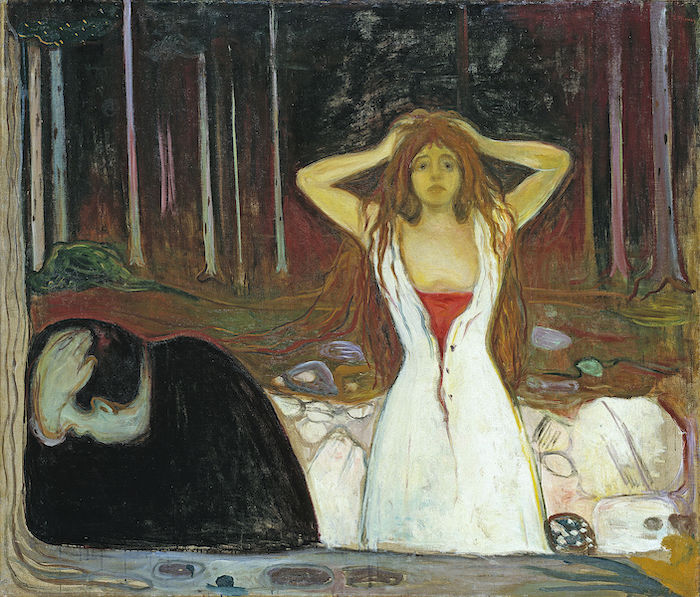
Edvard Munch: Ashes (1894) 120.5 cm (47.4 ″); Width: 141 cm (55.5 ″); National Gallery of Norway.
Locations
People
Topics
Subjects
Regions
Subregions
Related Events
Showing 10 events out of 9441 total
Years: 1894 - 1894
Edvard Munch: Ashes (1894) 120.5 cm (47.4 ″); Width: 141 cm (55.5 ″); National Gallery of Norway.
Locations
People
Topics
Subjects
Regions
Subregions