
Muhammad confronts 'Abd Allah ibn Ubayy, who …
Years: 627 - 627
Muhammad confronts 'Abd Allah ibn Ubayy, who had joined in spreading slanders about Muhammad's wife Aishah, in spring 627.
'Abd Allah, it turns out, has little support in Yathrib, so becomes reconciled to Muhammad.
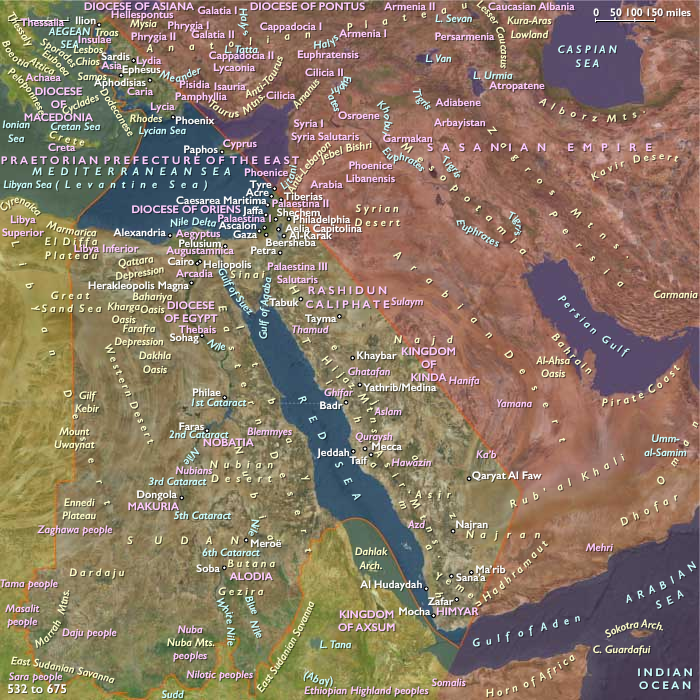
The expected confrontation with the Meccans occurs in April 627 when Abu Sufyan leads a great confederacy of ten thousand men against Yathrib's three thousand defenders.
On Muhammad's orders, the crops have already been harvested and a trench dug to defend the main part of the oasis from the Meccan cavalry.
The confederates besiege the Muslims for two weeks but fail in their attempts to cross the trench and run low on fodder for the horses.
Meanwhile, Muhammad's agents among the attackers foment potential dissensions.
After a night of wind and rain, the Meccans, recognizing their inability to dislodge Muhammad, abandon the siege and return to Mecca.
After the siege of Yathrib, one of the city's remaining Jewish clans, the Banu Qurayzah, is accused of plotting against Muhammad; when they surrender, his followers did a trench around the market, round up the clan's six-hundred-plus men and tie their hands behind them.
After spending the night in prayer, the Jews are led to the trench one by one and forced to kneel, then offered the opportunity to convert to Islam.
Upon their refusal, they are beheaded, their bodies piled in the trench.
Reportedly, only three or four agree to conversion.
The Muslims then sell into slavery all of the clan's women and children, except Rayhana bint Amr.
According to Ibn Ishaq, Muhammad took Rayhana as a maiden slave and offered her the status of becoming his wife if she accepted Islam, but she refused.
According to his account, even though Rayhana is said to have later converted to Islam, she died as a slave.
Ibn Sa'd writes and quotes Waqidi that she was manumitted but later married by Muhammad.
According to Al-Halabi, Muhammad married and appointed a dowry for her.
It is further narrated that, upon marriage, she refused to wear the hijab, causing a rift between her and Muhammad.
The couple later reconciled.
She died young, shortly after Muhammad's hajj and was buried in Jannat al-Baqi cemetery.
Ibn Hajar quotes a description of the house that Muhammad gave to Rayhana after their marriage from Muhammad Ibn al-Hassam's History of Medina.
In another version, Hafiz Ibn Minda writes that Muhammad set Rayhana free, and she went back to live with her own people.
This version is also supported as the most likely by nineteenth-century Muslim scholar, Shibli Nomani.
Not much is known about Rayhana; she will die a year before Muhammad.
Locations
People
Groups
Topics
Commodoties
Subjects
Regions

Subregions
Years: 627 - 627
Locations
People
Groups
Topics
Commodoties
Subjects
Regions
Subregions