Moulay Ismail finally retakes the port of …
Years: 1689 - 1689
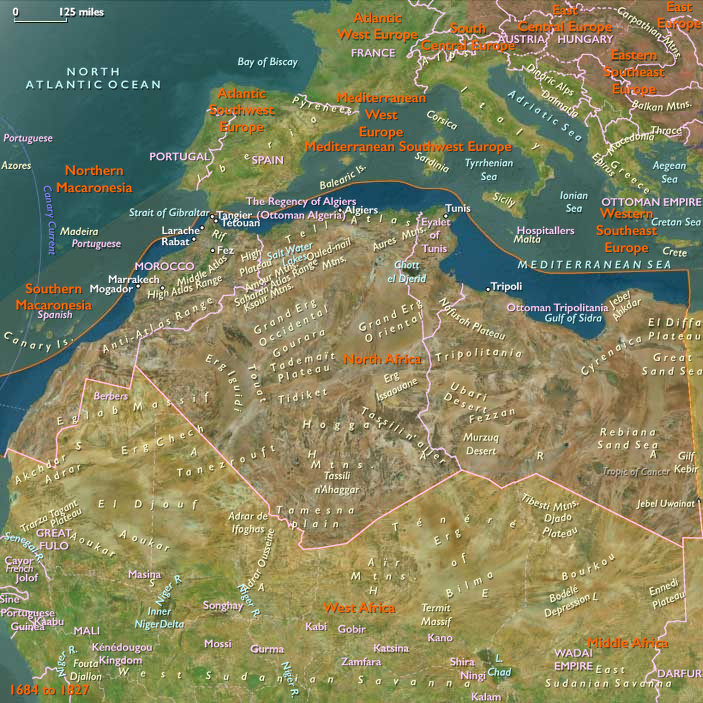
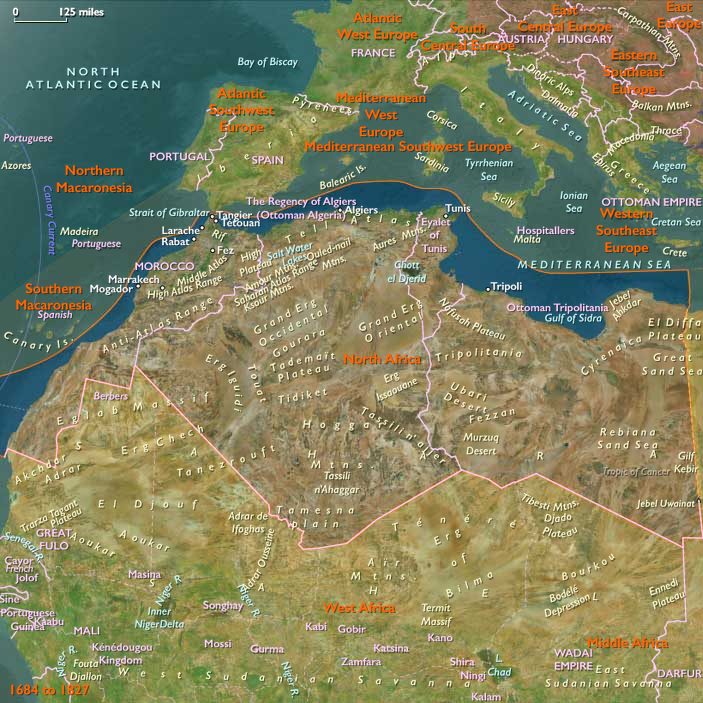
Moulay Ismail finally retakes the port of Larache from the Spanish in 1689.
Locations
People
Groups
- Spain, Habsburg Kingdom of
- England, (Stewart, Restored) Kingdom of
- Morocco, 'Alawi (Filali) Sultanate of
Topics
Commodoties
Subjects
Regions
Subregions
Related Events
Filter results
Showing 10 events out of 29345 total
The Khalkha royal families and the first Jebtsundamba Khutughtu, having crossed the Gobi Desert to seek help from the Qing Dynasty, submit to the emperor.
Galdan's nephew Tsewang Rabtan seizes the Dzungarian throne while his uncle is fighting in Eastern Mongolia.
Galdan approaches near the Great Wall fter a series of successful battles in the Khangai mountains, at Lake Olgoi and Ulahui river.
The Dzungar and the Qing Empire clash at the battle of Ulaan Butun in Inner Mongolia, during which the Qing army is severely mauled by Galdan.
The Khalkha leaders retreat to Inner Mongolia with their troops and the Khalkha territory falls under Galdan's rule.
The Dzungars’ horse-archer empire, the last of its kind, is to last until the middle eighteenth century.
At its peak, Dzungaria will stretch from the Great Wall of China to present-day eastern Kazakhstan, and from the present-day northern Kyrgyzstan to southern Siberia.
The Qing Dynasty had been the victors in a fight with the Russian Empire along the Sahaliyan ula (Amur, or Heilongjiang) Valley region in the 1650s, but the Russians have invaded the northern frontier again.
After series of battles and negotiations, Russian-Manchu border conflicts over the region of Priamurye, centered around the Russian outpost of Albazin, are settled by the Treaty of Nerchinsk, the first treaty between Russia and the Qing Empire, signed in Nerchinsk on August 27, 1689, by Songgotu on behalf of the Qing Emperor and Fyodor Golovin on behalf of the Russian tsars Peter I and Ivan V. According to this treaty, Russia gives up its hopes of gaining access to the Sea of Japan, but establishes trade relations with the China’s Qing Dynasty.
Albazin, which had been a source of conflict between China and Russia, is to be abandoned and destroyed.
The border between Russia and China is traced along the Stanovoy Ridge and the Argun River.
Prince Vasily Galitzine has made two failed attempts (1687–89) to subdue the Khanate of the Crimea, the last fragment of the the Golden Horde, but the khanate survives to stage raids on Russia.
The regent Sophia had sponsored two disastrous military campaigns, led by Galitzine, against the Crimean Tatars, who are Turkish vassals, in 1687 and 1689.
Her government has also concluded the favorable Treaty of Nerchinsk with China, setting Russia's eastern border at the Amur River, but Galitzine's failures reinforce the increasing dissatisfaction among both the Naryshkins and the general population with her rule.
Her half-brother Peter turns seventeen years of age, upon which his Naryshkin relatives demand that Sophia step down.
Army chief Fyodor Shaklovityi advises Sophia to proclaim herself tsarina in response, and attempts to induce the Streltsy, the units of Russian guardsmen armed with firearms, to a new uprising.
Most of the Streltsy units, however, desert downtown Moscow for the suburb of Preobrazhenskoye and later for the Troitse-Sergiyeva Lavra, where the young tsar is living.
Sophia, feeling the power slipping from her hands, sends the boyars and the Patriarch to Peter, asking him to join her in the Kremlin.
He flatly refuses her overtures, demanding Shaklovityi's execution and Galitzine's exile.
Sophia agrees to surrender her senior boyars, and is put under house arrest and forced to withdraw into the Novodevichy Convent without formally taking the veil.
Peter rewards Golovin, on his return to Moscow from a diplomatic mission to the Amur River region, with the rank of boyar (next in rank below the ruling princes).

Aurangzeb accidentally captures Sambhaji and other leaders; he executes them barbarously after severe torture.
Maratha resistance proves stubborn, however, and the war continues under Sambhaji’s brother Rajaram.
An organized, large scale influx of Huguenots to the Cape of Good Hope takes place during 1688 and 1689, notable for the emigration of Huguenots from La Motte d'Aigues in Provence, France.
Many of these settlers have choses as their home an area called Franschhoek, Dutch for "French corner", in the present day Western Cape province of South Africa.
French Huguenot refugeess, many of whom are given land by the Dutch government in 1688, form the original settlers of the valley called Olifantshoek ("Elephant's corner"), so named because of the vast herds of elephants that roam the area.
The name of the area would soon change to Franschhoek, with many of the settlers naming their new farms after the areas in France from which they have come.
La Motte, La Cotte, Cabriere, Provence, Chamonix, Dieu Donne and La Dauphine are among some of the first established farms — most of which still retain their original farm houses today.
These farms have grown into renowned wineries, such as Boschendal, which is one of the oldest wine estates in South Africa.
The estate's first owner, Jean de Long, is one of the party of two hundred French Huguenot refugees granted land in the Cape of Good Hope by the Dutch East India Company in 1688.
Meindert Hobbema, one of the most important Baroque landscapists of the Dutch school, paints The Avenue, Middelharnis in 1689, late in his career.
Aphra Behn had published Love Letters Between a Nobleman and His Sister in 1684 as the first part of a three-volume roman à clef playing with events of the Monmouth Rebellion and exploring the genre of the epistolary novel.
Love Letters From a Noble Man to his Sister, Part Two, was published in 1685; the third installment was published in 1687 as The Amours of Philander and Silvia.
Behn in 1688 published Oroonoko, a short novel concerning the tragic love of its hero, an enslaved African in Surinam in the 1660s, and the author's own experiences in the new South American colony.
It is generally claimed (most famously by Virginia Woolf) that Aphra Behn was the first professional female author in English, living entirely by her own earnings.
While this is not entirely true, Behn was the first professional female dramatist, as well as one of the first English novelists, male or female.
Although she had written at least one novel previously, Behn's Oroonoko is both one of the earliest English novels and one of the earliest by a woman.
She dies at forty-eight on April 16, 1689, and is buried in Westminster Abbey.
Below the inscription on her tombstone read the words: "Here lies a Proof that Wit can never be / Defence enough against Mortality."
Years: 1689 - 1689
Locations
People
Groups
- Spain, Habsburg Kingdom of
- England, (Stewart, Restored) Kingdom of
- Morocco, 'Alawi (Filali) Sultanate of