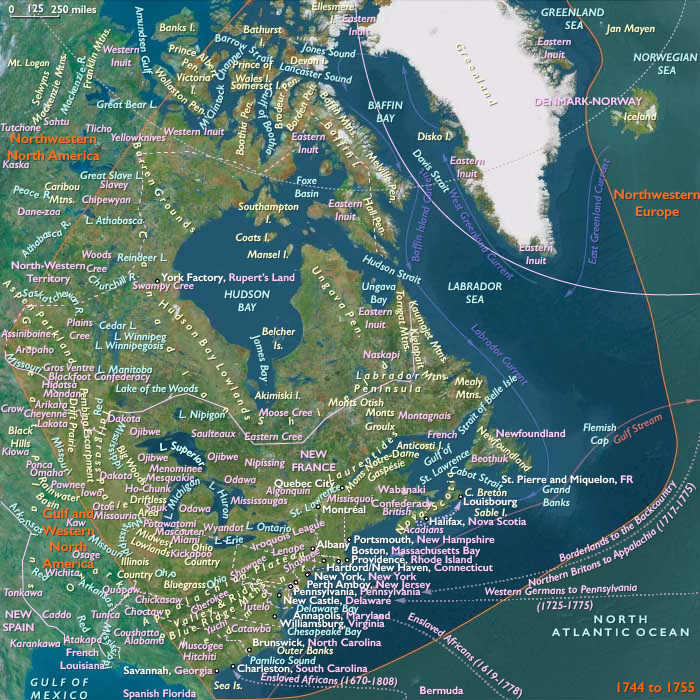
The Gros Ventres acquire horses in the …
Years: 1754 - 1754
The Gros Ventres acquire horses in the mid-eighteenth century.
The earliest known contact of Gros Ventres with people of European origin is around 1754, between the north and south forks of the Saskatchewan River.
Groups
Topics
Commodoties
Subjects
Regions
Subregions
Related Events
Filter results
Showing 10 events out of 26905 total
Ivan Shuvalov and Mikhail Lomonosov have promoted the idea of a university in Moscow, and Russian Empress Elizabeth decrees its establishment on January 25 [O.S. January 12], 1755.
The first lectures are given on April 26th.
Russians still celebrate January 25th as Students' Day.
View Event
The first lectures are given on April 26th.
Russians still celebrate January 25th as Students' Day.
Sultan Mahmud dies on December 13, 1754, and is succeeded by his cousin as Osman III.
The second Carnatic war ends with the Treaty of Pondicherry, signed in 1754 and recognizing Muhammed Ali Khan Wallajah as the Nawab of Arcot.
The French governor-general, Dupleix, is asked to return to France.
His political ambitions, which have led to immense financial loss to the French East India Company, have greatly displeased its directors.
Army commissioner Charles Godeheu assumes the post.
Exposure to smallpox severely reduces the numbers of the Gros Ventre people about this time.
View Event
What is today Columbia University is officially founded on October 31, 1754, as King's College by royal charter of King George II, making it the oldest institution of higher learning in the state of New York and the fifth oldest in the United States.
Discussions regarding the founding of a college in the Province of New York had begun as early as 1704, at which time Colonel Lewis Morris wrote to the Society for the Propagation of the Gospel in Foreign Parts, the missionary arm of the Church of England, persuading the society that New York City was an ideal community in which to establish a college; however, not until the founding of Princeton University across the Hudson River in New Jersey had the City of New York seriously considered founding a college.
An act had been passed in 1746 by the general assembly of New York to raise funds for the foundation of a new college.
In 1751, the assembly had appointed a commission of ten New York residents, seven of whom were members of the Church of England, to direct the funds accrued by the state lottery towards the foundation of a college.
Classes are initially held in July 1754 and are presided over by the college's first president, Dr. Samuel Johnson.
Dr. Johnson is the only instructor of the college's first class, which consists of only eight students.
Instruction is held in a new schoolhouse adjoining Trinity Church, located on what is now lower Broadway in Manhattan.
View Event
Discussions regarding the founding of a college in the Province of New York had begun as early as 1704, at which time Colonel Lewis Morris wrote to the Society for the Propagation of the Gospel in Foreign Parts, the missionary arm of the Church of England, persuading the society that New York City was an ideal community in which to establish a college; however, not until the founding of Princeton University across the Hudson River in New Jersey had the City of New York seriously considered founding a college.
An act had been passed in 1746 by the general assembly of New York to raise funds for the foundation of a new college.
In 1751, the assembly had appointed a commission of ten New York residents, seven of whom were members of the Church of England, to direct the funds accrued by the state lottery towards the foundation of a college.
Classes are initially held in July 1754 and are presided over by the college's first president, Dr. Samuel Johnson.
Dr. Johnson is the only instructor of the college's first class, which consists of only eight students.
Instruction is held in a new schoolhouse adjoining Trinity Church, located on what is now lower Broadway in Manhattan.
The Albany Congress is the first time in the eighteenth century that colonial representatives meet to discuss some manner of formal union.
In the seventeenth century, some New England colonies had formed a loose association called the New England Confederation, principally for purposes of defense, as raiding by French and allied native tribes was frequent.
In the 1680s, the British Government created the Dominion of New England as a unifying government on the colonies between the Delaware River and Penobscot Bay; it was dissolved in 1689.
The following year, Jacob Leisler had summoned an intercolonial congress, which met in New York on 1, May 1690, to plan concerted action against the French and the natives.
Because of differences in threat, he had attracted only the colonies as far south as Maryland.
The Albany delegates spend most of their time debating Benjamin Franklin's Albany Plan of union to create a unified level of colonial government.
The delegates vote approval of a plan that call for a union of eleven colonies, with a president appointed by the British Crown.
Each colonial assembly is to send two to seven delegates to a "grand council," which is to have legislative powers.
The Union is to have jurisdiction over Native affairs.
The plan is rejected by the colonies' legislatures, which are jealous of their powers, and by the Colonial Office, which wants a military command.
Much of the elements of the plan will later be the basis for the American governments established by the Articles of Confederation of 1777 and the Constitution of 1787.
Benjamin Franklin will later speculate that the colonial separation from England might not have happened so soon had the 1754 plan been adopted.
View Event
In the seventeenth century, some New England colonies had formed a loose association called the New England Confederation, principally for purposes of defense, as raiding by French and allied native tribes was frequent.
In the 1680s, the British Government created the Dominion of New England as a unifying government on the colonies between the Delaware River and Penobscot Bay; it was dissolved in 1689.
The following year, Jacob Leisler had summoned an intercolonial congress, which met in New York on 1, May 1690, to plan concerted action against the French and the natives.
Because of differences in threat, he had attracted only the colonies as far south as Maryland.
The Albany delegates spend most of their time debating Benjamin Franklin's Albany Plan of union to create a unified level of colonial government.
The delegates vote approval of a plan that call for a union of eleven colonies, with a president appointed by the British Crown.
Each colonial assembly is to send two to seven delegates to a "grand council," which is to have legislative powers.
The Union is to have jurisdiction over Native affairs.
The plan is rejected by the colonies' legislatures, which are jealous of their powers, and by the Colonial Office, which wants a military command.
Much of the elements of the plan will later be the basis for the American governments established by the Articles of Confederation of 1777 and the Constitution of 1787.
Benjamin Franklin will later speculate that the colonial separation from England might not have happened so soon had the 1754 plan been adopted.
A new mission, Mission Rosario, established in 1754, is in constant fear of revolt by the natives in the mission and often appeals to La Bahía for military aid.
Overall, it is extremely ineffective as a spiritual and "civilizing" center.
The Karankawa flee when subjected to any corporal punishment, and continue to enjoy the resources provided by the Spanish without being dependent on them.
View Event
Overall, it is extremely ineffective as a spiritual and "civilizing" center.
The Karankawa flee when subjected to any corporal punishment, and continue to enjoy the resources provided by the Spanish without being dependent on them.
...as far north as Momgmit.
View Event
Bago, despite repeated setbacks, still does not send in reinforcements even as Alaungpaya consolidates his gains throughout Upper Burma.
Konbaung forces retake Ava on January 3, 1754.
Alaungpaya now receives homage from the nearer Shan States ...
View Event
Konbaung forces retake Ava on January 3, 1754.
Alaungpaya now receives homage from the nearer Shan States ...
The Jewish Naturalisation Act 1753 is an Act of Parliament (26 Geo. 2, c. 26) of the Parliament of Great Britain, which had received royal assent on July 7, 1753 but is repealed in 1754 (27 Geo 2, c. 1) due to widespread opposition to its provisions.
The Jews had shown particular loyalty to the government during the Jacobite rising of 1745.
Their chief financier, Sampson Gideon, had strengthened the stock market, and several of the younger members had volunteered in the corps raised to defend London.
Possibly as a reward, Henry Pelham in 1753 had brought in the Jew Bill of 1753, which allowed Jews to become naturalized by application to Parliament.
It had passed the Lords without much opposition, but on being brought down to the House of Commons, the Tories made protest against what they deemed an "abandonment of Christianity."
The Whigs, however, had persisted in carrying out at least one part of their general policy of religious toleration, and the bill had been passed and received royal assent (26 Geo. II., cap. 26).
The public had reacted with an enormous outburst of anti-Jewish vitriol, and the Bill is repealed in the next sitting of Parliament, in 1754.
While the Sephardim chiefly congregate in London as the center of international commerce, Jews immigrating from Germany and Poland settle for the most part in the seaports of the south and west, such as Falmouth, Plymouth, Liverpool, Bristol, etc., as pawnbrokers and small dealers.
From these centers it has become their custom to send out hawkers every Monday with packs to the neighboring villages, whereby connections are made with some of the inland towns, where they have begun to settle, such as Canterbury, Chatham, and Cambridge, Manchester, and Birmingham.
Traders of this type, while not of such prominence as the larger merchants of the capital, come in closer contact with ordinary English people and may have helped to allay some of the prejudice which had been manifested so strongly in 1753.
The Marriage Act 1753, full title "An Act for the Better Preventing of Clandestine Marriage", popularly known as Lord Hardwicke's Marriage Act (citation 26 Geo. II. c. 33), is the first statutory legislation in England and Wales to require a formal ceremony of marriage.
It comes into force on March 24, 1754.
The Act has been precipitated by a dispute about the validity of a Scottish marriage, although pressure to address the problem of clandestine marriage had been growing for some time.
View Event

The Jews had shown particular loyalty to the government during the Jacobite rising of 1745.
Their chief financier, Sampson Gideon, had strengthened the stock market, and several of the younger members had volunteered in the corps raised to defend London.
Possibly as a reward, Henry Pelham in 1753 had brought in the Jew Bill of 1753, which allowed Jews to become naturalized by application to Parliament.
It had passed the Lords without much opposition, but on being brought down to the House of Commons, the Tories made protest against what they deemed an "abandonment of Christianity."
The Whigs, however, had persisted in carrying out at least one part of their general policy of religious toleration, and the bill had been passed and received royal assent (26 Geo. II., cap. 26).
The public had reacted with an enormous outburst of anti-Jewish vitriol, and the Bill is repealed in the next sitting of Parliament, in 1754.
While the Sephardim chiefly congregate in London as the center of international commerce, Jews immigrating from Germany and Poland settle for the most part in the seaports of the south and west, such as Falmouth, Plymouth, Liverpool, Bristol, etc., as pawnbrokers and small dealers.
From these centers it has become their custom to send out hawkers every Monday with packs to the neighboring villages, whereby connections are made with some of the inland towns, where they have begun to settle, such as Canterbury, Chatham, and Cambridge, Manchester, and Birmingham.
Traders of this type, while not of such prominence as the larger merchants of the capital, come in closer contact with ordinary English people and may have helped to allay some of the prejudice which had been manifested so strongly in 1753.
The Marriage Act 1753, full title "An Act for the Better Preventing of Clandestine Marriage", popularly known as Lord Hardwicke's Marriage Act (citation 26 Geo. II. c. 33), is the first statutory legislation in England and Wales to require a formal ceremony of marriage.
It comes into force on March 24, 1754.
The Act has been precipitated by a dispute about the validity of a Scottish marriage, although pressure to address the problem of clandestine marriage had been growing for some time.
Loading...