
Most of the fresco cycles so numerous …
Years: 1639 - 1639
Most of the fresco cycles so numerous in early seventeenth century-Rome represent framed episodes imitating canvases such as found in the Sistine Chapel ceiling or in Carraccis' The Loves of the Gods in the Farnese gallery, completed in 1601.
Pope Urban VIII (Maffeo Barberini) had in 1633 commissioned Pietro da Cortona to paint a fresco cycle for the ceiling of their family palace.
The huge Allegory of Divine Providence and Barberini Power, completed six years later, marks a watershed in Baroque painting.
Containing endless number of heraldic symbols and subthemes, the fresco is an illusion with the central field apparently open to the sky and scores of figures seen 'al di sotto in su' apparently coming into the room itself or floating above it.
By this time recognized among the top artists of his generation, Cortona had been elected during 1634-38 as director of Rome's Academy of St. Luke.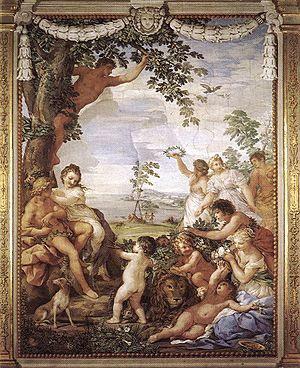
Pietro da Cortona: The Golden Age
Locations
People
Groups
Topics
Subjects
Regions
Subregions
Related Events
Showing 10 events out of 32235 total
Years: 1639 - 1639
Pietro da Cortona: The Golden Age
Locations
People
Groups
Topics
Subjects
Regions
Subregions