
Most of Japan’s provinces are overseen by …
Years: 1051 - 1051
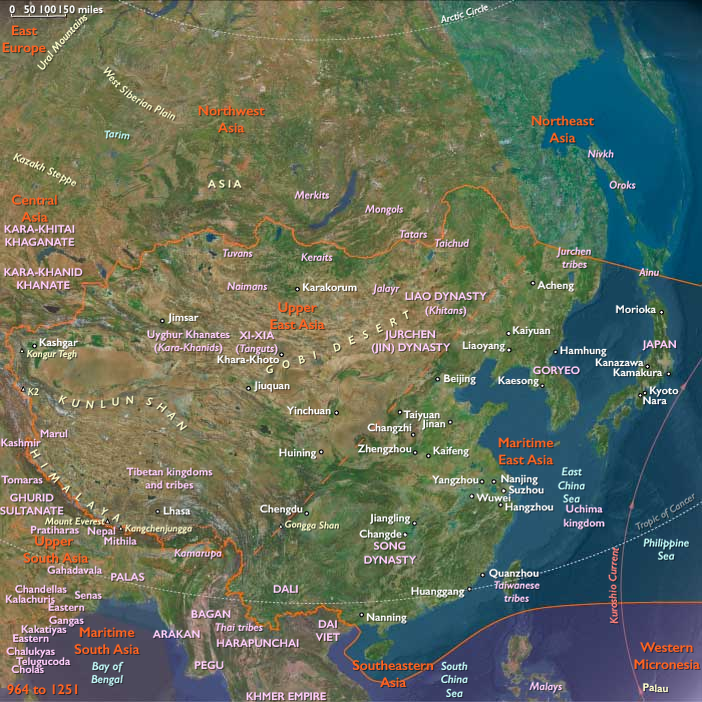
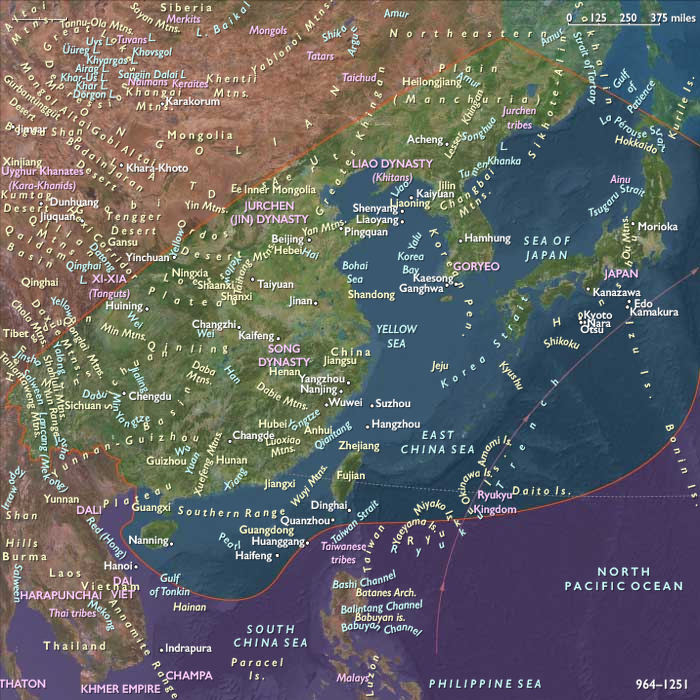
Most of Japan’s provinces are overseen by just a governor, but Mutsu province, in what is now the Tohoku region, has a military general in charge of controlling the Emishi natives, thought to be related to the Ainu, who had been subjugated in the ninth century when the Japanese took over the area.
Historically, this post has always been held by a member of the Abe clan, and there have been many conflicts between the Abe general and the Governor over administrative control of the province.
Abe no Yoritoki, the general overseeing the Ainu in 1050, had levied taxes and confiscated property on his own, rarely paying any heed to the wishes of the province's governor.
The governors of Mutsu and Dewaz provinces join forces against the Abe and march against them in 1051, but the Abe defeat their army and force their withdrawal.
The Governor had sent word to the capital in Kyoto asking for help, and as a result Minamoto no Yoriyoshi is appointed both Governor and commander-in-chief over controlling the natives.
He is sent with his son Yoshiie, then age fifteen, to stop Abe.
The fighting will last for twelve years, or nine if one subtracts short periods of ceasefire and peace.
Locations
People
Groups
Topics
Commodoties
Subjects
Regions
Subregions
Related Events
Filter results
Showing 10 events out of 51182 total
The southern Khmer, supported by Champa and led by either a Khmer vassal or a Cham chieftain, take advantage of the turmoil caused by the Cham strike against the Khmer empire to seize the empire’s southern portion.
The Khmer empire dispatches armies under their best generals, but meet no success until their most celebrated general decisively crushes the revolt in late 1051.
The rebel leader takes refuge in Champa, and the triumphant Khmers donate their war plunder to an Isvaran temple at Rajatirtha.
The Kiev Pechersk Lavra, or Kiev Monastery of the Caves, is established in 1051 when, according to the Primary Chronicle, Anthony, an Orthodox monk from Esphigmenon monastery on Mount Athos, originally from Liubech of the Principality of Chernihiv, returns to Rus' and settles in Kiev as a missionary of monastic tradition to Kievan Rus'.
He chooses a cave at the Berestov Mount that overlooks the Dnieper River and a community of disciples soon grows.
Henry undertakes a third Hungarian campaign in 1051 but fails to achieve anything lasting.
The Seljuqs, having captured Isfahan, in 1051 make it their capital of their rapidly expanding empire.
Pope Leo IX, at a synod in Benevento in July 1051, beseeches Guaimar and Drogo to stop the Norman incursions on church lands.
Soon Drogo is assassinated, probably by a conspiracy engineered by Constantinople.
Pope Leo returns to Rome in time for a third Easter synod, at which the question of the reordination of those who had been ordained by simonists is considered.
Renewed Unrest in Lower Lorraine and the Restoration of Godfrey the Bearded (1051)
In 1051, Lower Lorraine once again became a source of turmoil for Emperor Henry III, as local nobles, particularly Lambert, Count of Louvain, and Richildis of Hainaut, stirred conflict. To address the instability, Henry III released Godfrey the Bearded from captivity and restored him to power in Lower Lorraine, hoping that he could maintain the fragile peace established in 1049.
The Rebellion of Lambert of Louvain and Richildis of Hainaut
- Lambert, Count of Louvain, had long been a rival of the imperial presence in Lower Lorraine, resisting Henry III’s attempts to consolidate control over the duchy.
- Richildis of Hainaut, the widow of Herman of Mons, had recently married Baldwin VI of Flanders (Baldwin of Antwerp), further strengthening the anti-imperial faction in the region.
- Together, these nobles challenged imperial authority, seeking to expand their influence at the expense of Henry III’s rule in Lorraine.
Henry III’s Response: The Return of Godfrey the Bearded
- Rather than continuing direct military intervention, Henry III made a strategic decision to restore Godfrey the Bearded as Duke of Lower Lorraine, entrusting him with maintaining order in the duchy.
- This move was unexpected, as Godfrey had been imprisoned for his earlier rebellion against Henry III.
- However, Henry hoped that Godfrey’s local influence and military strength would be sufficient to contain the ambitions of Lambert and Baldwin VI.
A Fragile Peace and Continued Tensions
- Godfrey’s restoration temporarily stabilized Lower Lorraine, as it provided a strong and experienced rulerto counterbalance Lambert’s aggression and the ambitions of Baldwin VI and Richildis.
- Despite this, tensions remained high, and the region would continue to be a battleground for competing factions within the empire.
Significance and Consequences
- Henry III’s decision to reinstate Godfrey the Bearded reflected a pragmatic approach to imperial rule, prioritizing regional stability over personal grievances.
- The ongoing strife in Lower Lorraine highlighted the challenges of governing the empire’s frontier regions, where powerful noble families often acted independently of imperial authority.
- The involvement of Baldwin VI of Flanders foreshadowed future conflicts between the empire and the House of Flanders, which would later play a major role in imperial-French struggles.
Though Henry III restored Godfrey to power in 1051, the unrest in Lower Lorraine was far from over, as competing noble factions continued to vie for control, keeping the region in a state of near-constant turmoil.
William of Normandy and King Henry I of France's Campaign Against Geoffrey Martel (1052–1053)
As Geoffrey Martel, Count of Anjou, continued to expand his power in northern and western France, Duke William of Normandy and King Henry I of France recognized him as a common threat. In what would be their last known military cooperation, William and Henry launched a joint campaign against Geoffrey Martel, but their efforts yielded limited results.
The Growing Angevin Threat
- Geoffrey Martel, having inherited Anjou from his father Fulk III Nerra, was an ambitious and skilled military leader, known for his tactical acumen and relentless expansionism.
- By the early 1050s, Geoffrey had extended his influence into Maine, Touraine, and parts of western Normandy, bringing him into direct conflict with both William and King Henry.
- Anjou’s growing power posed a significant challenge to both Capetian and Norman interests, as Geoffrey sought to undermine both the French monarchy and Norman ducal authority.
The Joint Campaign of William and Henry (1052–1053)
- In response, William of Normandy and King Henry I joined forces, marking their final military collaboration before their relationship deteriorated into hostility.
- The joint army invaded Angevin territory, targeting fortified strongholds controlled by Geoffrey Martel.
- They succeeded in capturing one of Geoffrey’s fortresses, but this minor victory did little to halt Geoffrey’s influence.
- Ultimately, the campaign failed to produce any decisive results, as Geoffrey remained firmly in control of Anjou and his growing sphere of influence.
Aftermath and Consequences
- Despite their initial cooperation, William and Henry's alliance soon fell apart, as Henry increasingly viewed William as a greater threat than Geoffrey.
- Geoffrey Martel remained a dominant figure in western France, continuing his rivalry with both Normandy and the French crown.
- The failure of this campaign foreshadowed the later conflicts between Normandy, Anjou, and the Capetians, which would culminate in larger power struggles in the decades to come.
Legacy
- The joint campaign against Geoffrey Martel was one of the last instances of Capetian-Norman cooperation before the Capetian-Norman Wars.
- Though William and Henry failed to weaken Geoffrey Martel significantly, their failed alliance pushed William and Henry into direct conflict, setting the stage for Henry’s later campaigns against Normandy.
- Geoffrey Martel’s continued rise in power influenced the strategic landscape of northern France, ultimately playing a role in the later Angevin-Norman struggles of the late 11th and 12th centuries.
Though William and Henry’s campaign managed to capture an Angevin fortress, it did little to curb Geoffrey Martel’s power, marking the end of Capetian-Norman cooperation and the beginning of a new phase of rivalry and conflict.
The Struggle for Maine: Geoffrey Martel vs. William of Normandy and King Henry I (1051–1053)
Following the death of Hugh IV of Maine in 1051, Geoffrey Martel, Count of Anjou, sought to expand his control over the county of Maine. His occupation of Le Mans, the county’s capital, brought him into direct conflict with Duke William of Normandy and King Henry I of France, leading to a complex three-way power struggle.
At the heart of this conflict was the strategically positioned Bellême family, whose holdings along the Maine–Normandy–Anjou frontier allowed them to manipulate their competing overlords and maintain de facto independence.
Geoffrey Martel’s Initial Success in Maine (1051–1052)
- Upon Hugh IV’s death, the citizens of Le Mans welcomed the Angevins, allowing Geoffrey Martel to occupy the city without resistance.
- Maine was of critical strategic importance, serving as a buffer state between Normandy, Anjou, and the French crown.
- Geoffrey’s expansion into Maine posed a serious threat to both Normandy and Capetian France, prompting William and King Henry to intervene.
The Role of the Bellême Family
- The Bellême family held key strongholds on the border of Maine and Normandy, including:
- Bellême, their ancestral seat, under the overlordship of the King of France.
- Domfort, under the overlordship of Geoffrey Martel of Anjou.
- Alençon, which was under William of Normandy’s suzerainty.
- Given their complex allegiances, the Bellêmes skillfully played their three overlords against one another, ensuring their own autonomy in the region.
- However, as the war over Maine escalated, they were eventually forced to align with one side—and William took advantage of this.
William and King Henry’s Counteroffensive (1052–1053)
- Recognizing the strategic necessity of preventing Angevin expansion, William and King Henry joined forces once more to expel Geoffrey Martel from Maine.
- In the course of their campaign, William was able to secure the Bellême family’s strongholds at Alençon and Domfort, reinforcing Norman influence on the Maine border.
- By asserting direct overlordship over the Bellême family, William eliminated a major source of instabilityand brought the key border fortresses firmly under Norman control.
Outcome and Aftermath
- Though William succeeded in taking key strongholds on the Maine–Normandy border, Geoffrey Martel retained effective control over most of the county of Maine.
- The conflict weakened Geoffrey Martel’s position, as he now had to contend with Norman expansion along his frontier while maintaining control of Maine’s rebellious nobility.
- The capture of Alençon and Domfort was a major victory for William, further consolidating Norman influence in the region and preparing the way for a future full-scale Norman invasion of Maine.
- The Bellême family, once an unpredictable force, was now compelled to act in Norman interests, removing a major source of instability on Normandy’s southern border.
Legacy and Significance
- The Norman-Angevin rivalry for Maine would continue for years, shaping the balance of power in northern France.
- William’s ability to gain control over the Bellême family strongholds demonstrated his growing influence and furthered his reputation as a military strategist.
- This victory solidified Normandy’s position as the dominant force in northern France, setting the stage for future campaigns into Maine and beyond.
Though Anjou still held much of Maine, William’s success in securing the Bellême fortresses and asserting control over key border regions was a critical step in his rise to power, proving his ability to outmaneuver rival lords and expand Norman authority.
The Marriage of King Henry I of France and Anna of Kiev (1051)
After the death of his first wife, Matilda of Frisia, King Henry I of France faced significant difficulty in finding a suitable bride. The European noble courts were densely intermarried, and the Church’s strict consanguinity lawsmade it nearly impossible to locate a non-related princess within legal degrees of kinship.
Ultimately, Henry turned to the Kievan Rus', sending an embassy to Kiev, which returned with Anna (or Agnes) of Kiev, daughter of Grand Prince Yaroslav the Wise. Their marriage, which took place on May 19, 1051, at the Cathedral of Reims, was a historic union that bridged Western and Eastern Europe.
The Wedding and Coronation of Anna of Kiev
- The wedding and coronation ceremony were conducted by Archbishop Guy de Châtillon at Reims Cathedral, the traditional site for French royal anointings.
- During the ceremony, Anna swore her oath by placing her hand on a Gospel she had brought from Kiev, written in Old Church Slavonic.
- This sacred text would go on to be used in the coronation ceremonies of French kings, with the tradition lasting until Charles X in 1824.
Anna's Impressions of France
- Anna of Kiev was highly educated, able to read and write in at least five languages, including Greek and Latin.
- She was shocked by the lack of literacy at the French court, where even Henry I and his nobles were illiterate, signing their names with simple crosses.
- In a letter to her father, Grand Prince Yaroslav, she described France as a barbaric country, complaining that:
- The houses were dark and gloomy.
- The churches were crude and lacked the grandeur of Kievan cathedrals.
- The French aristocracy lacked proper hygiene and did not bathe regularly.
- At her wedding banquet, Anna was shocked by the simplicity of the French court, having only three dishes at the feast, whereas in Kievan Rus', she was accustomed to five different dinner dishes every day.
Significance of the Marriage
- Anna’s arrival brought cultural and intellectual influences from Kievan Rus’, one of the most sophisticated and literate courts of medieval Europe.
- As Queen of France, she played an important role in royal administration, signing charters in her own name, something uncommon for medieval queens.
- Her marriage strengthened ties between France and Kievan Rus', showing the expanding diplomatic reach of both realms.
Legacy
- The Gospel of Reims, used at Anna’s coronation, remained a symbolic artifact in French royal ceremonies for centuries.
- Anna's shock at the state of France reflected the cultural divide between the Slavic East and the Latin West, highlighting how Kievan Rus' was, in many ways, more advanced than 11th-century France.
- She would go on to become one of the most influential queens of her time, playing a key role in the Capetian court and securing her son Philip I’s succession.
Though initially unimpressed by her new home, Anna of Kiev left a lasting mark on France, bringing literacy, diplomacy, and cultural refinement to the early Capetian monarchy.
