
The Swazi kings of Eswatini date back …
Years: 1840 - 1851
The Swazi kings of Eswatini date back to some considerable time to when the Royal line of Dlamini lived in the vicinity of Delagoa Bay.
The Swazi people as a nation were originally formed by sixteen clans known as bemdzabuko ("true Swazi" ) who had accompanied the Dlamini kings in the early days.
The fifteen founding clans were Dlamini, Nhlabathi, Hlophe, Kunene, Mabuza, Madvonsela, Mamba, Matsebula, Mdluli, Motsa, Ngwenya, Shongwe, Sukati, Tsabedze, Tfwala and Zwane.
Other Swazi clans are the Emakhandzambili clans ("those found ahead", e.g. the Gamedze, Fakudze, Ngcamphalala and Magagula), meaning that they were on the land prior to Dlamini immigration and conquest.
The Emafikemuva ("those who came behind") join the kingdom later.
The Swazi settlers, known as the Ngwane (or bakaNgwane) before entering present Eswatini, had been settled on the banks of the Pongola River.
Before that, they had been settled in the area of the Tembe River near present-day Maputo, Mozambique.
Continuing conflict with the Ndwandwe people had pushed them further north, with Ngwane III establishing his capital at Shiselweni at the foot of the Mhlosheni hills.
Under Sobhuza I, the Ngwane people eventually established their capital at Zombodze in the heartland of present-day Eswatini.
In this process, they conquered and incorporated the long-established clans of the country known to the Swazi as Emakhandzambili.
Eswatini derives its name from a later king named Mswati II.
KaNgwane, named for Ngwane III, is an alternative name for Eswatini, the surname of whose royal house remains Nkhosi Dlamini.
Nkhosi literally means "king".
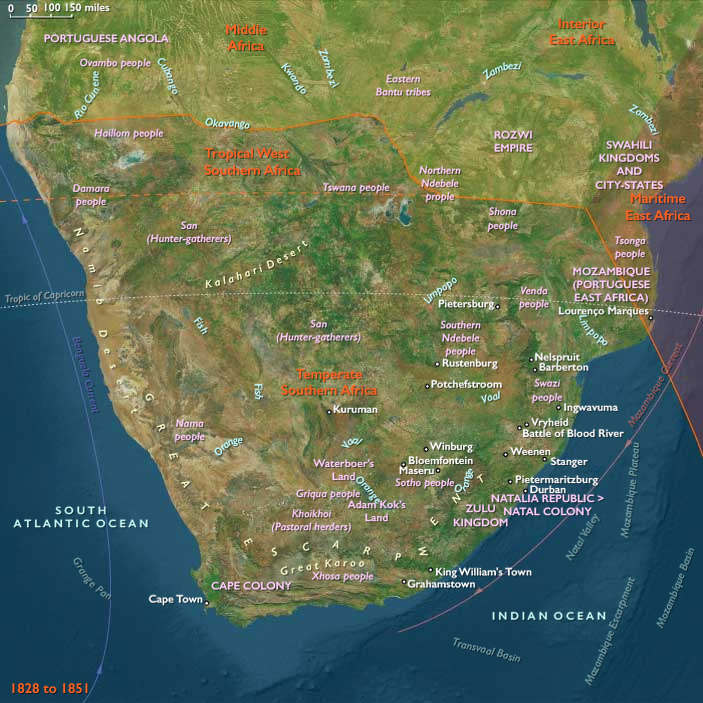
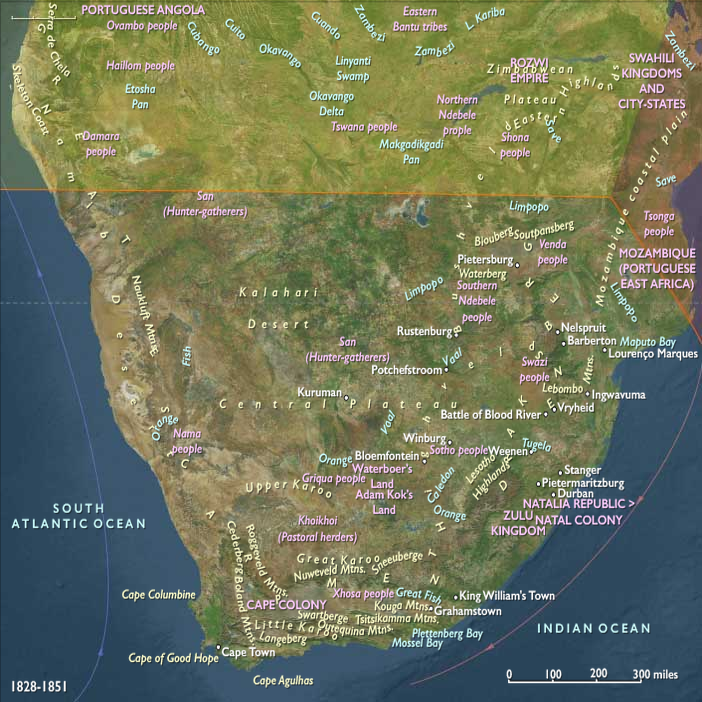
In the late 1830s, initial contact occurred with the Boers, who had defeated the Zulus at the Battle of Blood River, and were settling in the territory that would become the South African Republic.
To establish a peaceful coexistence, a substantial portion of Swazi territory is ceded to the Transvaal Boers who are settled around the Lydenburg area in the 1840s.
The territory of Swaziland and its king, Mswati II, are recognized by both the Transvaal and by Britain.
Locations
People
Groups
- Swazi
- Boers
- Britain (United Kingdom of Great Britain and Ireland)
- Cape Colony, British
- South African Republic (the Transvaal)
- Swaziland, Kingdom of
- Swaziland, Kingdom of
Topics
Subjects
Regions
Subregions
Related Events
Showing 10 events out of 18028 total
Years: 1840 - 1851
Locations
People
Groups
- Swazi
- Boers
- Britain (United Kingdom of Great Britain and Ireland)
- Cape Colony, British
- South African Republic (the Transvaal)
- Swaziland, Kingdom of
- Swaziland, Kingdom of
Topics
Subjects
Regions
Subregions