More naval detachments occupy a long line …
Years: 31BCE - 31BCE
July
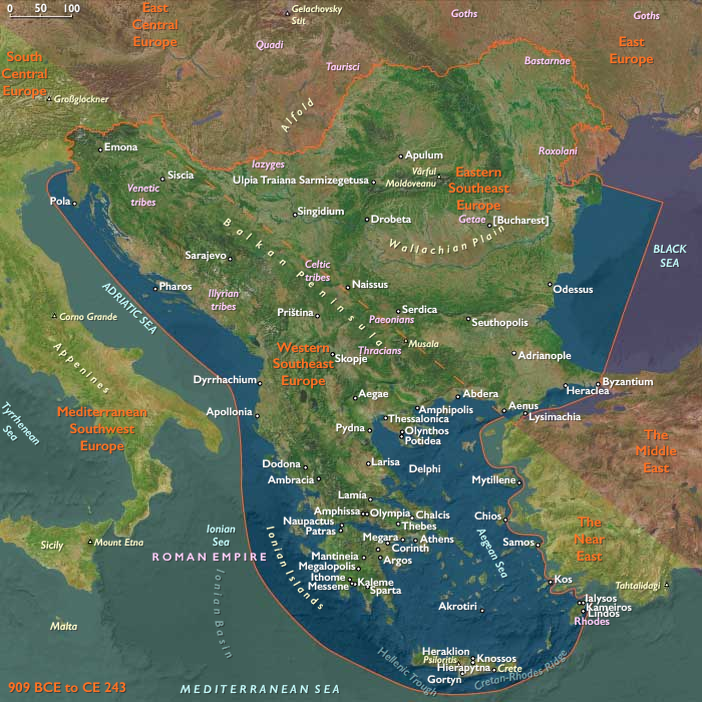
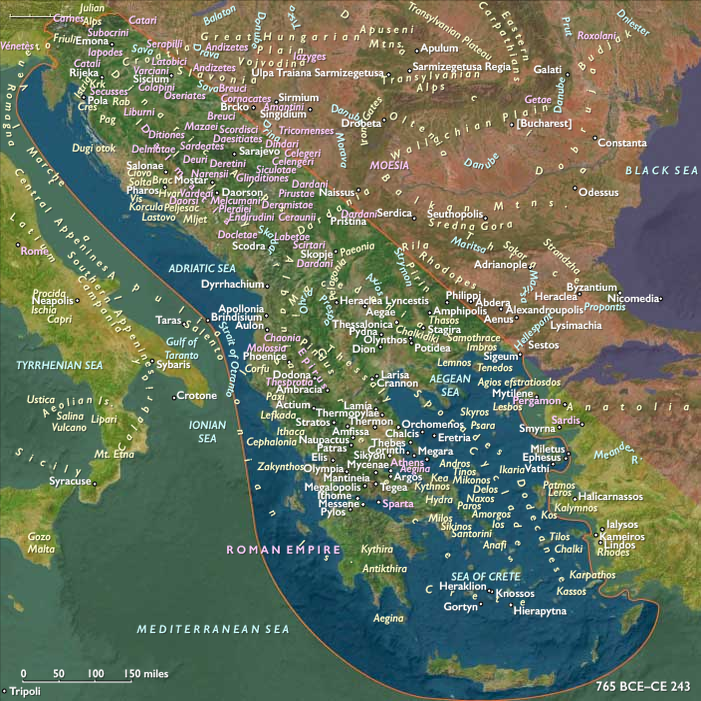
More naval detachments occupy a long line of posts along the west coast of Greece.
Locations
People
Groups
Topics
- Classical antiquity
- Roman Age Optimum
- Roman Civil War of 44-31 BCE
- Roman Republic, Final War of the
- Actium, Battle of
Commodoties
Subjects
Regions
Subregions
Related Events
Filter results
Showing 10 events out of 62235 total
Cleopatra and Herod, the Roman client king of Judea, own a monopoly over the extraction of asphalt from the Dead Sea, which is used in ship building.
Following Herod’s return from Rome, construction had begun on a new fortress on the rock of Masada (which, according to Josephus, a first-century Jewish Roman historian, Herod fortified between 37 and 31 BCE as a refuge for himself in the event of a revolt).
The cliffs on the east edge of Masada are about thirteen hundred feet high and the cliffs on the west are about three hundred feet high; the natural approaches to the cliff top are very difficult.
Herod has surrounded Masada’s upper plateau with a wall with three gateways and thirty-eight white plastered towers.
He constructs the northern palace, containing colonnades and a small bath, on three rock terraces in a position commanding splendid views.
Three parts comprise the sizable western palace complex: the king's residence, a workshop block with servants' quarters, and a series of storerooms.
In the king's residence is a throne room entered by a large hall bearing a multicolored floor mosaic depicting geometric and floral motifs.
Rows of enormous cisterns feed a large bath house based on Roman designs.
An aqueduct extends from the wadis north and south of the rock to twelve large reservoirs in the cliff face from which the water is delivered to cisterns cut into the summit.
Herod’s second wife, Mariamne I, has borne him two sons, Alexandros (b. 35 BCE) and Aristobulus (b. 31 BCE), and two daughters, Salampsio and Cypros.
Mariamne's father, Alexander of Judaea, the son of Aristobulus II, had married his cousin Alexandra, daughter of his uncle Hyrcanus II, in order to cement the line of inheritance from Hyrcanus and Aristobulus, but the inheritance had soon continued the blood feud of previous generations, and eventually led to the downfall of the Hasmonean line.
Mariamne, by virtue of her parents' union, claims Hasmonean royalty on both sides of her family lineage.
Josephus writes that it was because of Mariamne's vehement insistence that her husband, Herod, had made her brother, Aristobulos III, High Priest.
Within a year of his appointment, Aristobulos, who was not yet eighteen, had in 36 BCE drowned at a party in Jericho; Alexandra, his mother, blamed Herod.
Alexandra had written to Cleopatra, begging her assistance in avenging the boy's murder.
Cleopatra in turn had urged Mark Antony to punish Herod for the crime and Antony had sent for him to make his defense.
Herod left his young wife in the care of his uncle Joseph, along with the instructions that if Antony should kill him, Joseph should kill Mariamne.
Herod apparently believed his wife to be so beautiful that she would become engaged to another man after his death and that his great love for Mariamne prevented him from enduring a separation from her, even in death.
Joseph became familiar with the Queen and eventually divulged this information to her and the other women of the household, which did not have the hoped-for effect of proving Herod's devotion to his wife.
Rumors soon circulated that Herod had been killed by Antony, and Alexandra had persuaded Joseph to take Mariamne and her to the Roman legions for protection.
However, Herod was released by Antony and had returned home, only to be informed of Alexandra's plan by his mother and sister, Salome.
Salome also accused Mariamne of committing adultery with Joseph, a charge which Herod initially dismissed after discussing it with his wife.
After Herod forgave her, Mariamne inquired about the order given to Joseph to kill her should Herod be killed, and Herod then became convinced of her infidelity, saying that Joseph would only have confided that to her were the two of them intimate.
He gave orders for Joseph to be executed and for Alexandra to be confined, but did not punish his wife.

The flourishing settlement of Qumran is destroyed by an earthquake in 31 BCE; its inhabitants begin rebuilding the complex.
The site is best known as the settlement nearest to the caves in which the Dead Sea Scrolls are hidden, caves in the sheer desert cliffs and beneath, in the marl terrace.
The war begins very early in 31 BCE, while Antony and Cleopatra are temporarily stationed in Greece.
Octavian gains a preliminary victory when the navy under the command the loyal and talented Marcus Agrippa successfully ferries troops across the Adriatic Sea and captures the Greek city and naval port of Methone, loyal to Antony, at the southwestern tip of Greece.
Octavian’s enormous popularity with the legions secures the defection of the provinces of Cyrenaica and Greece to his side.
Agrippa, with combined land and naval forces about equal to those assembled by Antony and Cleopatra, captures decisive points all along the line, cutting off Antony and Cleopatra's main force from their supply routes at sea.
Octavian, leaving his Etruscan friend and adviser Maecenas in charge of Italy, in the late spring of 31 BCE lands on the mainland opposite the island of Corcyra (modern Corfu) and marches south.
Antony moves his headquarters at the beginning of 31 BCE from Ephesus to Athens and …
…marshals his principal fleet in the gulf of Ambracia (northwestern Greece).
Antony moves his headquarters from Athens to Patras.
As he loses more ground, the morale of his advisers and fighting forces deteriorates, a process aided by Cleopatra's insistence on being present at his headquarters against the wishes of many of his leading Roman supporters, thus providing Octavian with fresh propaganda fuel.
Because of this lack of unity and the inexperience of Antony's crews, the decisive battle is lost before it ever begins.
With five hundred ships and seventy thousand infantry, Antony makes his camp at Actium, which lies on the southern side of a strait leading from the Ionian Sea into the Ambracian Gulf.
Octavian, with four hundred ships and eighty thousand infantry, arrives from the north and, by occupying Patrae and Corinth, manages to cut Antony's southward communications with Egypt via the Peloponnese.
Antony's army is trapped on land and sea. Deserters flee to Octavian's side daily while Octavian's forces are comfortable enough to make preparations.
Many of the soldiers, disgusted with Antony’s conduct, offer the command to the consul Ahenobarbus, but he prefers to desert the party altogether, and defects to Octavian shortly before the Battle of Actium.
Suffering from a fever, he takes a small boat to Octavian's side.
Antony is greatly upset by this defection, but he nevertheless sends Ahenobarbus him all his gear, his friends and his attendants.
Ahenobarbus is not, however, present at the battle itself, as he dies a few days after joining Augustus.
Plutarch suggests that his death was due to "the shame of his disloyalty and treachery being exposed."
Suetonius says that he was the best of his family.
Desertions by some of his allies and a lack of provisions soon force Antony on September 2, 31 BCE to take action.
Either hoping to win at sea because he is outmaneuvered on land or making a desperate attempt to break free of the naval blockade, he draws up his ships outside the bay, facing west, with Cleopatra's squadron behind.
Sailing his fleet through the bay of Actium on the western coast of Greece, Antony fleet faces the much larger fleet of smaller, more maneuverable ships under commanders Agrippa and Gaius Sosius.
In the ensuing naval contest, each side's squadrons try to outflank the other until Cleopatra, by prearranged plan rather than treachery, takes her sixty Egyptian galleys (carrying her and Antony's treasury) and flees the battle.
Antony then breaks off and with a few ships manages to follow her.
The remainder of his fleet becomes disheartened and surrenders to Octavian; Antony's land forces surrender one week later.
Octavian has previously shown little mercy to military combatants and acted in ways that have proven unpopular with the Roman people, yet he is given credit for pardoning many of his opponents after the Battle of Actium.
Octavian's victory, because Antony had based his land forces in Greece, makes the Greek world an integral and permanent part of the Roman Empire.
Octavian builds Nicopolis ("City of Victory"), near present Préveza to commemorate his victory at Actium, symbolically representing his successful unification of the Roman Empire under one administration and, geographically, a major transportation and communications point linking the eastern and western halves of the Mediterranean.
On the spot where Octavian's own tent had been pitched, he builds a monument adorned with the beaks of the captured galleys; and in further celebration of his victory he institutes the so-called Aktian games, to be held every five years in honor of Apollo Aktios.
He also enlarges the existing temple of Apollo at Actium.
The new polis is given the territories of southern Epiros including Ambrakia, most of Akarnania, and western Aetolia.
Many inhabitants of the surrounding areas—Kassopaia, Ambrakia, parts of Akarnania (including Leukas, Palairos, Amphilochikon, Calydon, and Lysimachia) and western Aetolia—are forced to relocate to the new city.
The exact legal status of Nikopolis is the subject of some dispute, having the characteristics of civitas libera, civitas foederata, and as colonia, implying that Roman military veterans also settle here.
The city will prove highly successful, and it is considered the capital of southern Epirus and Akarnania.
Among other things, it obtains the right to send five representatives to the Amphictyonic Council.
Years: 31BCE - 31BCE
July
Locations
People
Groups
Topics
- Classical antiquity
- Roman Age Optimum
- Roman Civil War of 44-31 BCE
- Roman Republic, Final War of the
- Actium, Battle of