
Montanus, aided by two women, Maximilla and …
Years: 160 - 171
Montanus, aided by two women, Maximilla and Priscilla (or Prisca), has established an apocalyptic sect, whose enthusiastic followers preach the imminent end of the world, austere morality, and severe penitential discipline.
The Montanists, as the sect comes to be called, prohibit second marriages, deny the divine nature of the church, and refuse forgiveness for sins that persons commit after baptism.
The Montanists apparently seek renewal of the church from within through a rebirth of the religious enthusiasm that had characterized early Christianity.
Montanus preaches that revelation and prophecy has not ended with Jesus’ death.
The Church, threatened by this belief and the growing expectation of Christ’s Second Coming, excommunicates many Montanists.
Locations
Groups
- Asia (Roman province)
- Christians, Jewish
- Christians, Early
- Roman Empire (Rome): Nerva-Antonine dynasty
- Montanism
Topics
Commodoties
Subjects
- Commerce
- Environment
- Labor and Service
- Conflict
- Faith
- Government
- Technology
- Prophecy
- Movements
- Christology
Regions
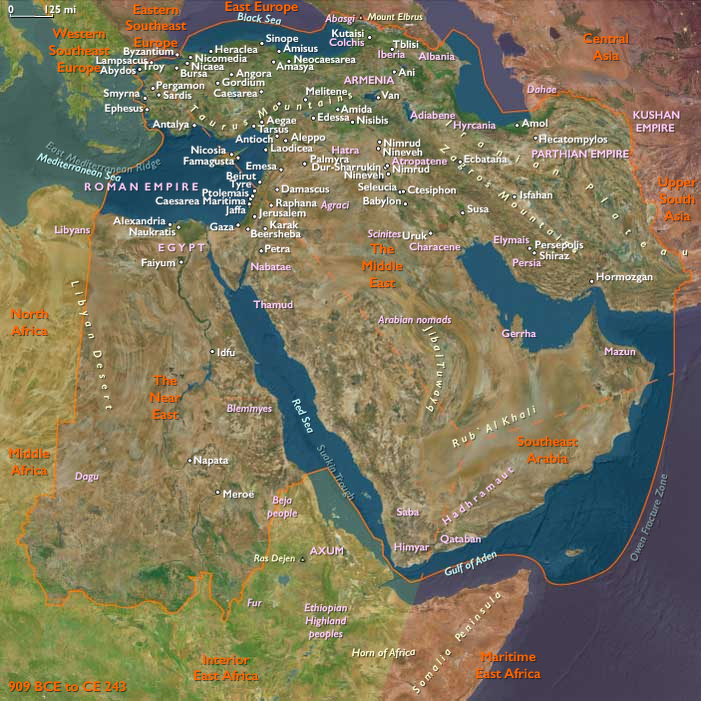
Subregions
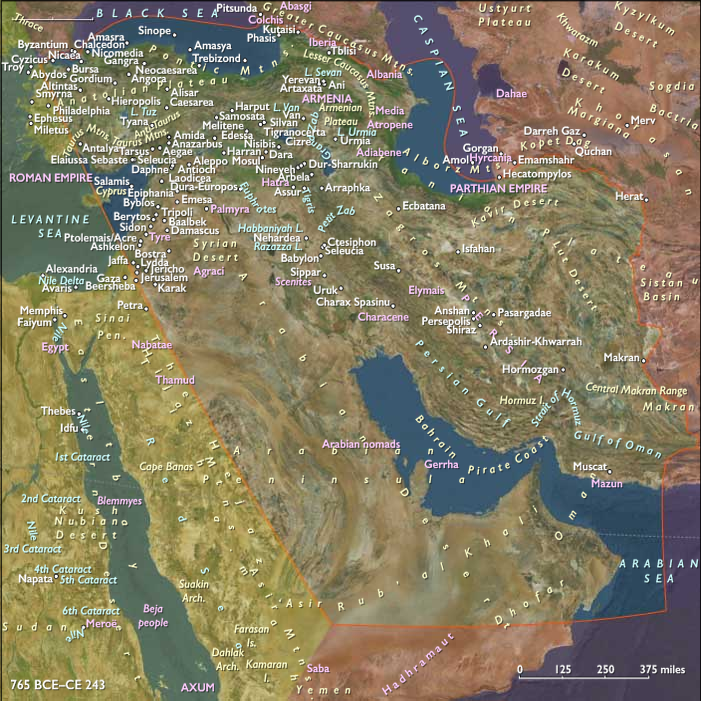
Related Events
Filter results
Showing 10 events out of 61044 total
The Disasters of Partisan Prohibitions refers to two incidents in China in which a number of Confucian scholars who serve as officials in the Han imperial government and opposed to powerful eunuchs, and the university students in the capital, Luoyang, who support them (collectively referred to by the eunuchs as “partisans") are imprisoned.
Some are executed; some are released but lose their civil rights.
The first incident (in 166) is largely bloodless, but the second incident (in 169), which comes after the Confucian scholars Dou Wu (the father of Empress Dowager Dou) and Chen Fan are defeated by eunuchs in a physical confrontation, see a large number of the partisans lose their lives.
The restrictions on civil liberties imposed on the surviving partisans will not be lifted until 184, when Emperor Ling grows concerned that the partisans will join the Yellow Turban Rebellion.
The Antonine Plague is a pandemic believed to be either of smallpox or measles, and will ultimately claim the lives of two Roman emperors—Lucius Verus and Marcus Aurelius, whose family name, Antoninus, is given to the epidemic.
The disease will break out again nine years later, according to the Roman historian Dio Cassius, and cause up to two thousand deaths a day at Rome, one quarter of those infected.
Total deaths have been estimated at five million.
The Marcomannic Wars, a series of wars lasting over a dozen years beginning about 166, pit the Roman Empire against, principally, the Germanic Marcomanni and Quadi and the Sarmatian Iazyges; related conflicts occur with several other barbarian peoples along both sides of the whole length of the River Danube, the Roman empire's northeastern European border.
The Early Movements of the Great Migrations and Germanic Pressure on Rome (3rd Century CE)
During the 3rd century CE, the first major movements of the Great Migrations began, as the Goths migrated westward, displacing and pressuring Germanic tribes in Central and Eastern Europe. This triggered a chain reaction, forcing various tribes and nomadic groups to move toward the Roman Empire, launching raids along Rome’s northern borders.
1. The Gothic Migrations and Their Impact
- The Goths, originally from Scandinavia and the Baltic region, began moving westward and southward into the Pontic Steppe and Central Europe.
- This displaced other Germanic tribes, pushing them toward Roman frontiers in search of new lands and resources.
- The Gothic advance weakened Roman border defenses, forcing Rome to increase military expenditures and fortify key regions.
2. Raids into Gaul and Across the Danube
- Germanic tribes, particularly the Franks, Alamanni, and Vandals, intensified raids into Gaul, exploiting Rome’s internal instability during the Crisis of the Third Century (235–284 CE).
- The Goths, Gepids, and other steppe tribes crossed the Danube, raiding deep into Moesia, Thrace, and even Greece.
- These incursions strained Rome’s resources, forcing emperors to mobilize defensive campaigns and recruit more Germanic auxiliaries into the Roman army.
3. The Broader Impact on the Roman Empire
- The increased pressure on Rome’s frontiers exposed the empire’s vulnerability, requiring more permanent military garrisons along the Rhine and Danube.
- The instability of the Roman economy made it harder to fund border defenses, leading to occasional provincial collapses.
- The pattern of Germanic and steppe incursions foreshadowed the larger-scale invasions of the 4th and 5th centuries, culminating in the fall of the Western Roman Empire.
Conclusion: The Prelude to the Great Migration Period
The early movements of Germanic tribes and Gothic incursions in the 3rd century CE set the stage for the full-scale Great Migrations of the 4th and 5th centuries. These pressures on Rome’s northern borders contributed to the empire’s long-term decline, demonstrating the shifting balance of power between Rome and the Germanic world.
A major offensive against the Marcomanni is postponed until 169 because of a shortage of imperial troops.
East Central Europe (160–171 CE): From Antonine Stability to Growing Frontier Tensions
Between 160 and 171 CE, East Central Europe—encompassing Poland, Czechia, Slovakia, Hungary, and those portions of Germany and Austria lying east of 10°E and north of a line stretching from roughly 48.2°N at 10°E southeastward to the Austro-Slovenian border near 46.7°N, 15.4°E—transitioned from a sustained era of stability under Emperor Antoninus Pius into a period of growing tension during the early reign of Emperor Marcus Aurelius. Increasingly strained relations with Germanic tribes, particularly the Marcomanni, Quadi, and the Sarmatian Iazyges, foreshadowed imminent conflict and disruption along the Roman frontier.
Political and Military Developments
Final Years of Antonine Stability
-
The last year of Emperor Antoninus Pius’s reign (160–161 CE) saw continued frontier stability along the Danube, sustained by the well-established Roman defensive system.
Accession of Marcus Aurelius and Early Frontier Challenges
-
Upon Emperor Marcus Aurelius’s accession (161 CE), Roman provinces of Pannonia Superior, Pannonia Inferior, and Noricum faced increased tension from neighboring Germanic and Sarmatian tribes.
-
Early signs of unrest and dissatisfaction emerged, particularly among the Marcomanni, Quadi, and Iazyges, driven by population pressures, economic disparities, and shifting tribal alliances.
Increased Frontier Military Activity
-
Between 166 and 171 CE, initial raids and skirmishes along the Danube frontier increased noticeably, prompting a stronger Roman military presence and preparations for a larger-scale confrontation.
Economic and Technological Developments
Economic Pressures and Shifting Trade
-
Growing frontier tensions slightly disrupted trade routes between Roman provinces and tribal territories. Despite this, economic activity—trading Roman manufactured goods for Germanic and Sarmatian resources—continued, though with increased risks.
Continued Technological Exchange
-
Even amidst growing political and military uncertainty, technological exchanges persisted. Roman metallurgical and agricultural methods continued to influence regional tribes, maintaining productivity despite rising tensions.
Cultural and Artistic Developments
Cultural Continuity Amid Rising Uncertainty
-
The era still witnessed a vibrant hybrid cultural environment along the frontier, with artifacts and material culture reflecting Roman-Germanic interactions.
-
However, the increasing tensions began subtly influencing regional art and craftsmanship, with artifacts increasingly emphasizing military and defensive motifs.
Settlement and Urban Development
Frontier Fortifications Strengthened
-
Anticipating further conflicts, the Romans reinforced frontier fortifications significantly, particularly at key strategic settlements (Carnuntum, Vindobona, Aquincum).
-
This defensive buildup reshaped local urban and military landscapes, preparing the provinces for potential conflict.
Increased Germanic Defensive Settlement Patterns
-
Germanic tribes, particularly the Marcomanni and Quadi, began strengthening their settlements and adopting more defensive structures in anticipation of increased hostilities.
Social and Religious Developments
Tribal Leadership Under Pressure
-
Tribal leadership among the Marcomanni, Quadi, and Iazyges experienced mounting pressure from population growth, economic challenges, and Roman diplomatic maneuvers.
-
Military elites and warrior chieftains gained influence as defensive considerations became increasingly critical.
Religious Practices and Growing Anxiety
-
Traditional Germanic religious practices persisted strongly, but the growing uncertainty and impending conflict likely intensified ritual practices emphasizing war, protection, and tribal solidarity.
Long-Term Consequences and Historical Significance
The period from 160 to 171 CE marked a critical turning point in East Central Europe, transitioning from peaceful frontier stability toward growing conflict and instability. Initial tensions experienced under Marcus Aurelius laid the foundations for the subsequent major conflicts—collectively known as the Marcomannic Wars (166–180 CE)—that would dramatically alter the regional balance of power, reshaping relationships between Roman provinces and surrounding Germanic and Sarmatian tribal societies.
The Vandals are divided in two tribal groups, the Silingi and the Hasdingi.
At the time of the Marcomannic Wars (166–180) the Silingi live in an area recorded by Tacitus as Magna Germania.
The Hasdingi move south in the second century, and first attack the Romans in the lower Danube area.
The Antonine Plague and Its Impact on Rome’s Northern Frontier (165–180 CE)
As the Antonine Plague spread northward toward the Rhine frontier, it not only ravaged Roman populations but also infected Germanic and Gallic tribes outside the empire's borders. The epidemic weakened both Rome and its adversaries, but the consequences were particularly severe for Roman frontier defenses.
1. The Spread of the Plague Beyond Roman Borders
- The Roman military campaigns along the Rhine and Danube facilitated the spread of disease to Germanic and Gallic tribes.
- These tribes, already pressing southward for more fertile lands, suffered heavy losses, disrupting their population growth and expansion efforts.
- However, despite their own losses, they were not as dependent on complex urban infrastructure as the Romans, meaning they could recover more easily.
2. The Weakening of Rome’s Defenses
- Roman armies, severely reduced in numbers, struggled to defend the northern frontiers.
- The traditional cycle of recruiting and replenishing legions was disrupted, leaving gaps in border security.
- The empire’s reliance on local auxiliaries and barbarian foederati increased as native Roman populations declined.
3. Increased Germanic Pressure on the Empire
- The Germanic and Gallic tribes, despite their own losses, took advantage of Rome’s weakened state to increase raids and incursions into imperial territory.
- The Romans, unable to push back these invasions effectively, saw a gradual erosion of control along the Rhine and Danube frontiers.
- This period of instability set the stage for later large-scale migrations and conflicts between Rome and Germanic peoples, culminating in the Marcomannic Wars (166–180 CE).
4. Long-Term Consequences
- The Antonine Plague's devastation played a key role in reducing Rome’s ability to defend its frontiers, forcing later emperors to rely more heavily on diplomacy and fortifications.
- The weakened military set a precedent for later barbarian pressures, foreshadowing the migrations and invasions of the 3rd and 4th centuries CE.
- This epidemic was one of the first major factors in Rome’s long-term decline, demonstrating how disease, population loss, and military strain could weaken even the mightiest empire.
The Roman Empire survived the Antonine Plague, but it emerged significantly weakened, its frontiers permanently more vulnerable to external threats.
The Devastation of the Antonine Plague (165–180 CE)
The Antonine Plague, which struck the Roman Empire between 165 and 180 CE, was one of the deadliest pandemics of antiquity, causing widespread depopulation. According to the fifth-century Spanish historian Paulus Orosius, many towns and villages in the Italian Peninsula and across the European provinces were completely abandoned due to the sheer number of deaths.
Impact on the Roman Empire
-
Massive depopulation:
- The plague is estimated to have killed between 5 and 10 million people, including one-quarter to one-third of the population in some areas.
- Many rural villages and urban centers were left deserted, severely impacting agriculture and trade.
-
Spread of the disease:
- Likely introduced by Roman soldiers returning from campaigns in the East, the plague spread rapidly along trade routes.
- Major cities such as Rome, Alexandria, and Lugdunum (Lyon) suffered severe outbreaks.
-
Impact on the Roman military and economy:
- Legions stationed on the frontiers were decimated, weakening Rome’s ability to defend against Germanic and Parthian incursions.
- The economic system suffered due to a shortage of laborers, declining tax revenues, and inflation.
Long-Term Consequences
- Weakened Roman defenses: The loss of manpower in the military contributed to border instability.
- Economic strain: The plague exacerbated existing financial pressures, leading to increased taxation and reliance on mercenary forces.
- Precedent for future pandemics: The Antonine Plague was one of the first major epidemics in Roman history, later followed by the Cyprian Plague (249–270 CE) and the Justinian Plague (541–542 CE).
Conclusion: A Turning Point in Roman Stability
The Antonine Plague marked a critical moment in Roman history, signaling the beginning of long-term demographic and economic decline. Although Rome recovered militarily, the loss of population and shaken stability foreshadowed the challenges the empire would face in the coming centuries.
Years: 160 - 171
Locations
Groups
- Asia (Roman province)
- Christians, Jewish
- Christians, Early
- Roman Empire (Rome): Nerva-Antonine dynasty
- Montanism
Topics
Commodoties
Subjects
- Commerce
- Environment
- Labor and Service
- Conflict
- Faith
- Government
- Technology
- Prophecy
- Movements
- Christology
