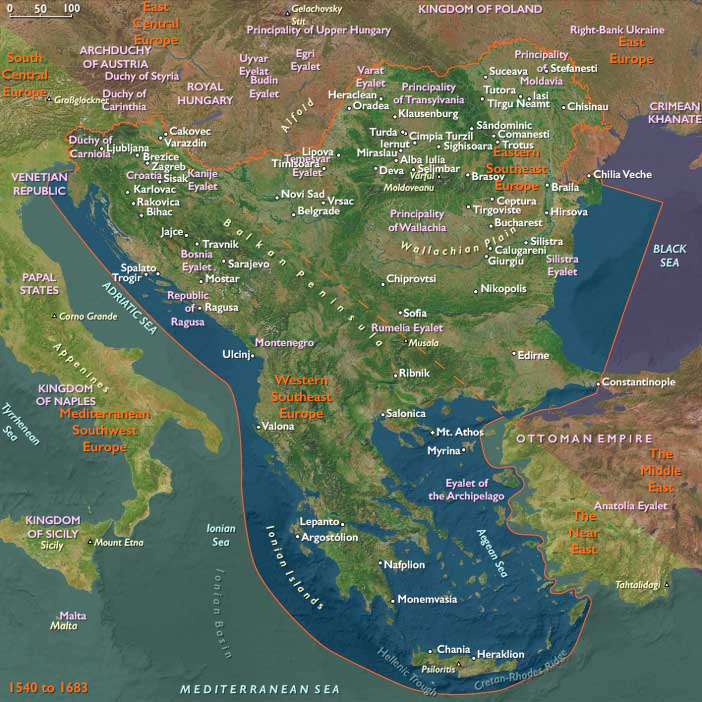
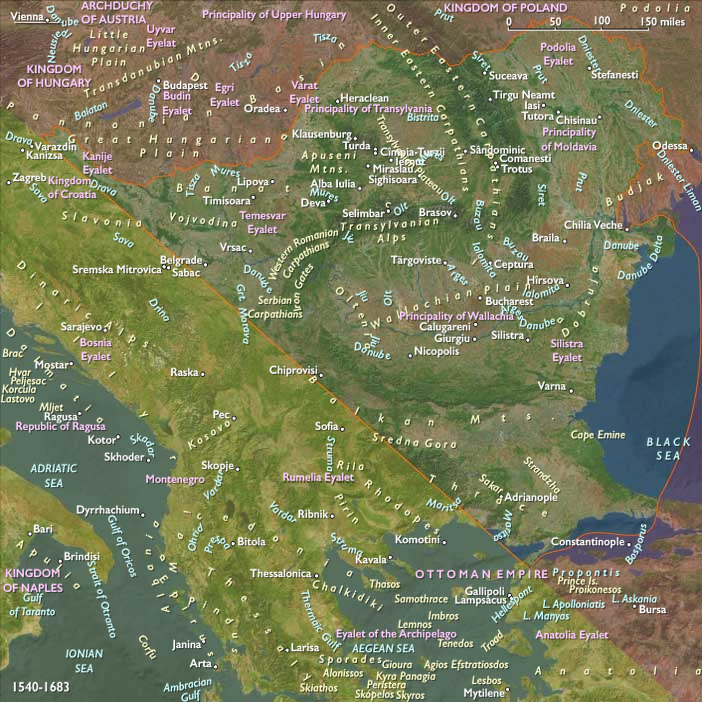
Moldavia’s Prince Vasile Lupu, coveting the richer …
Years: 1654 - 1654
Moldavia’s Prince Vasile Lupu, coveting the richer Wallachian throne, attacks Basarab, but the latter's forces rout the Moldavians, and in 1654 a group of Moldavian boyars ousts Vasile.
Locations
People
Groups
Commodoties
Subjects
Regions
Subregions
Related Events
Filter results
Showing 10 events out of 31628 total
Russian patriarch Nikon, who has become a close friend of Tsar Alexis, promotes his firmly held belief that the priesthood is above political authority and claims that, as patriarch, he has the right to control imperial policies and demand fealty from the tsar.
When, in 1654, Nikon authorizes necessary revisions to liturgical texts, he decrees that the revision be made in accordance with Greek liturgical books, which differ in details from the Russian texts.
The reforms include the obligation to follow the Greek practice of making the sign of the cross with three fingers instead of two, and minor revisions to the texts.
These reforms are mostly intended to bring the Russian Church into line with the other Orthodox Churches of Eastern Europe and Middle East.
The Duchers is the Russian name for the people populating the shores of the middle course of the Amur River, approximately from the mouth of the Zeya down to the mouth of the Ussury, and possibly even somewhat further downstream.
Their ethnic identity is not known with certainty, but it is usually assumed that they were a Tungusic people, related to the Jurchens and/or the Nanais.
The total number of Duchers (including other related Manchu groups, but not the Daurs or Evens) of the Amur Valley at the time of the appearance of the Russian explorers in the region around 1650 has been estimated by modern scholars at fourteen thousand.
According to the Russian explorers of the time, the Duchers, as well as the related groups, the Goguls, and their northwestern neighbors, the Daurs, are agriculturalists.
They grow rye, wheat, barley, millet, oats, peas, and hemp, as well as a number of vegetables.
The Duchers have horses and cattle; pigs ware a particularly important source of meat.
They do some hunting and fishing as well.
According to the seventeenth-century Cossacks' reports, the Duchers live in fortified villages with sixty and more houses in each.
The predecessor of the Qing fortress Aigun (which was originally located on the left—now Russian—bank of the Amur, opposite to its later location) is a Ducher town, currently known to the archaeologists as the Grodekovo site, after the nearby village of Grodekovo.
It is located south of the city of Blagoveshchensk and the fall of the Zeya into the Amur.
Yerofey Khabarov had reported the existence of this town (which he calls Aytyun) to the Yakutsk voivode D. Frantsbekov in 1652.
According to archaeologists, this fortress was first built around the end of the first or beginning of the second millennium CE.
The "tribute" of furs, grain, and livestock, collected (or looted, as the case may be) by the Cossacks from the Daurs and the Duchers is the main economic benefit derived by the Russians from their expansion in the region in the early 1650s, and, in order to deny it to them, the Qing government, starting in 1654, resettles the Ducher farmers from the Amur valley to the Sungari and Hurka Rivers further south.
The Daurs are resettled (to the Nenjiang River Valley) as well.
Prince Janusz Radziwiłł of Trąby (also known as Janusz the Second or Janusz the Younger, a notable Polish–Lithuanian noble and magnate, has throughout his life occupied a number of posts in the state administration, including that of Court Chamberlain of Lithuania (from 1633) and Field Hetman of Lithuania (from 1654).
He is also a voivode of Vilna Voivodeship, as well as a starost of Samogitia, Kamieniec, Kazimierz and Sejwy.
Often described as a de facto ruler of the entire Grand Duchy of Lithuania, his palace has been under construction from 1635 until 1653 in the Old Town of Vilnius.
It is likely that the wooden mansion of his ancestor, Mikołaj "the Black" Radziwill’, was on the same site as the current building.
Constructed according to the design by Jan Ullrich.
It has features of the Netherlands Renaissance as well as Manneristic decorations native to the Lithuanian Renaissance architecture.
Its original layout and symmetry of structural elements is distinctive to the palaces of the Late French Renaissance, resembling that of Château de Fontainebleau and Luxembourg Palace in Paris.
Parchevich also meets Pope Innocent X and visits Germany, Hungary, Transylvania and Wallachia after 1651, but the failure of these missions, as well as the reluctance of Austria and Poland to head an anti-Ottoman coalition, again frustrates the planned uprising of Bulgarian Christians.
Spain’s Renewed Effort Against Portugal and the Strain of War (1650s)
By the 1650s, Spain was once again preparing to direct its military efforts against Portugal, having secured peace in Europe with the Treaty of Westphalia (1648) and ended the Reapers’ War in Catalonia (1652). However, despite its ambitions to reclaim Portugal, Spain faced severe limitations in manpower, resources, and effective military leadership.
The Financial and Military Burden on Spain
- The war against Portugal was proving exceptionally costly:
- Between 1649 and 1654, over six million ducats—about 29% of Spain’s total defense spending—was directed toward fighting Portugal.
- By the 1650s, Spain maintained over 20,000 troops in Extremadura alone, nearly matching the 27,000 troops stationed in Flanders, a region that had long been Spain’s military priority.
- Despite these efforts, Spain struggled with:
- Recruitment shortages—its armies were spread too thin.
- Economic hardship—Spain’s declining control over trade weakened its ability to sustain prolonged warfare.
- Ineffective leadership—many of Spain’s most competent commanders were no longer available, forcing the reliance on less experienced generals.
Portugal’s Financial and Military Advantages
While Spain struggled, Portugal was able to sustain its war effort, largely due to:
-
Revenue from Colonial Trade
- Taxation of the spice trade from Asia and sugar exports from Brazil provided Portugal with a stable wartime income.
-
Support from Spain’s European Rivals
- Portugal benefited from assistance from Holland, France, and England, all of whom sought to weaken Spanish power.
- The Dutch provided naval support to defend Portugal’s overseas empire, particularly in Brazil and Africa.
- French and English backing helped maintain Portugal’s land defenses in Europe.
Conclusion: Spain’s Overextension and Portugal’s Growing Strength
By the 1650s, Spain’s inability to effectively suppress Portugal became increasingly clear. The war drained Spanish resources, while Portugal, backed by its trade revenues and foreign alliances, remained resilient. The cost of reconquering Portugal ultimately proved too high for Spain, paving the way for Portugal’s final victory and the official recognition of its independence in 1668.
The 1654 Anglo-Portuguese Trade Agreement: England Gains Access to Portuguese Colonial Markets
In 1654, the Portuguese Crown granted England trade concessions with Portugal’s colonies, marking a key moment in Anglo-Portuguese relations. This agreement strengthened economic ties between the two nations and helped Portugal sustain its war effort against Spain during the Portuguese Restoration War (1640–1668).
Context: Portugal’s Need for Allies in the 1650s
- Portugal was still at war with Spain, and securing foreign support was crucial for maintaining its independence.
- England, under Oliver Cromwell’s Commonwealth, was eager to expand its global trade network, particularly in sugar, spices, and colonial goods.
- Portugal, needing English naval and financial support, offered England special trading privileges in exchange for political backing.
Terms of the 1654 Trade Concessions
- English merchants were granted special trade rights in Portugal and its overseas colonies, including:
- Brazil (sugar trade).
- The East Indies (spices).
- West Africa (gold and slaves).
- England received lower customs duties and preferential treatment in Portuguese ports, helping English merchants compete with the Dutch and French.
- The agreement expanded English commercial influence, laying the groundwork for stronger economic ties between England and Portugal in the following decades.
Impact of the 1654 Trade Agreement
-
Portugal Secures an Important Ally
- The deal strengthened Anglo-Portuguese relations, ensuring English support against Spain.
- Portugal gained a stable market for its colonial exports, helping fund its war effort.
-
England Expands Its Colonial Trade Network
- The agreement gave England greater access to valuable commodities like Brazilian sugar and Indian spices.
- It marked a shift toward English dominance in global trade, which would intensify in the late 17th and 18th centuries.
-
Weakened Dutch and Spanish Influence
- The Dutch, who had been rivals of both England and Portugal, faced stronger competition in colonial markets.
- Spain was further isolated diplomatically, as England aligned more closely with Portugal and France.
Conclusion: A Key Step in Anglo-Portuguese Trade Relations
The 1654 trade concessions were a strategic victory for both England and Portugal. For Portugal, they secured a powerful trade partner during a critical phase of the war with Spain. For England, the deal expanded its access to lucrative colonial goods, boosting its commercial expansion in the Atlantic and Indian Oceans. This agreement paved the way for stronger Anglo-Portuguese economic and diplomatic ties, which would culminate in later treaties, including the Methuen Treaty of 1703.
English chemist Robert Boyle helps to found the Philosophical College in 1654 (the College will later become the Royal Society for Improving Natural Knowledge).
An uneasy competition rules the relations between the New Haven Colony and the Connecticut River settlements centered on Hartford.
The colony publishes a complete legal code in 1656, but the law remains very much church-centered.
A major difference between the New Haven and Connecticut colonies is that the Connecticut permits other churches to operate on the basis of "sober dissent" while the New Haven Colony only permits the Puritan church to exist.
The Dutch near present-day Hartford, outnumbered by the flood of English settlers from Massachusetts, leave their fort in 1654.
Tobago had been inhabited by Island Caribs at the time of European contact, which appears to have been English vistors in 1580.
According to the earliest English-language source cited in the Oxford English Dictionary, Tobago bore a name that has become the English word tobacco.
The first settlers are Courlanders in 1654, the Duchy of Courland becoming the smallest nation to colonize the Americas.
Courland has a population of only two hundred thousan and is itself a vassal of the Polish-Lithuanian Commonwealth at that time.
Under Duke Jacob Kettler, a Baltic German, it has established one of the largest merchant fleets in Europe.
During his travels to Western Europe, Jacob had become the eager proponent of mercantile ideas.
Metalworking and shipbuilding became much more developed.
Trading relations had been established not only with nearby countries, but also with Great Britain, France, the Netherlands, Portugal and others.
The Duchy's ships had undertaken trade voyages to the West Indies at least as early as 1637, when a Courland ship had attempted to found a colony on Tobago with 212 settlers.
An earlier European settlement on the island, a Dutch colony, formed in 1628, had been wiped out by the Spanish a few months earlier.
The first Courland colony was a failure, as was a second attempt in 1639.
Two ships under Captain Caroon with about three hundred settlers had by the beginning of the eighteenth century attempted to settle on the north coast near Courland Bay but were soon driven off by the Carib natives.
Then Courland's attention shifted and in 1651 the Duchy had gained its first successful colony but in Africa, on St. Andrews Island in the Gambia River, where they have established Fort Jacob.
Courland soon afterward decides to make still another attempt at a colony on Tobago.
The ship Das Wappen der Herzogin von Kurland ("The Arms of the Duchess of Courland") arrives on May 20, 1654, carrying forty-five cannons, twenty-five officers, one=twent-four Courlander soldiers and eighty families of colonists to occupy Tobago.
Captain Willem Mollens declares the island "New Courland" (Neu-Kurland).
A fort is erected on the southwest of the island, also called Fort Jacobus (Fort James) with the surrounding town called Jacobsstadt (Jamestown).
Other features are given Courland names such as Great Courland Bay, Jacobs (James) Bay, Courland Estate, Neu-Mitau (New Jelgava), Libau Bay and Little Courland Bay.
An Evangelical Lutheran church is built by the Courlanders in their first year on the island.