John Chrysostom, exiled to Pisunda, dies near …
Years: 407 - 407
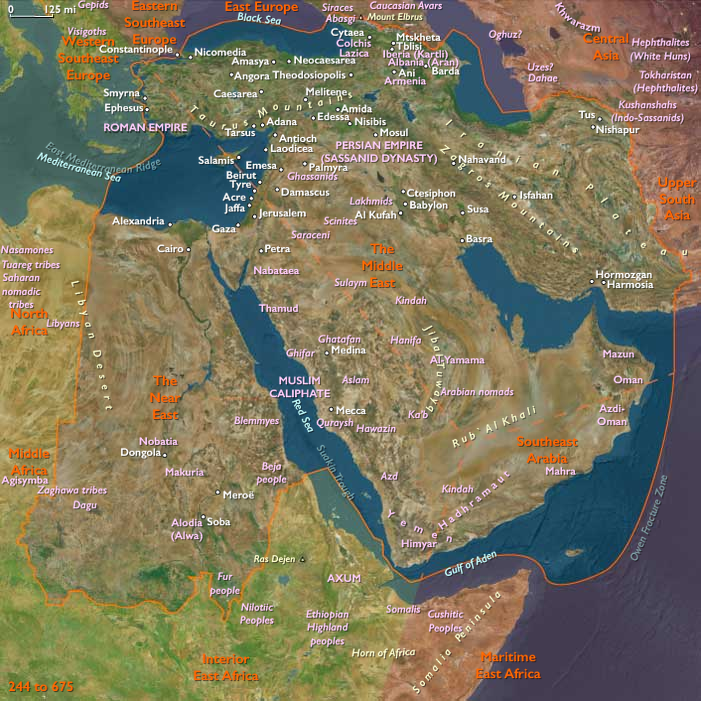
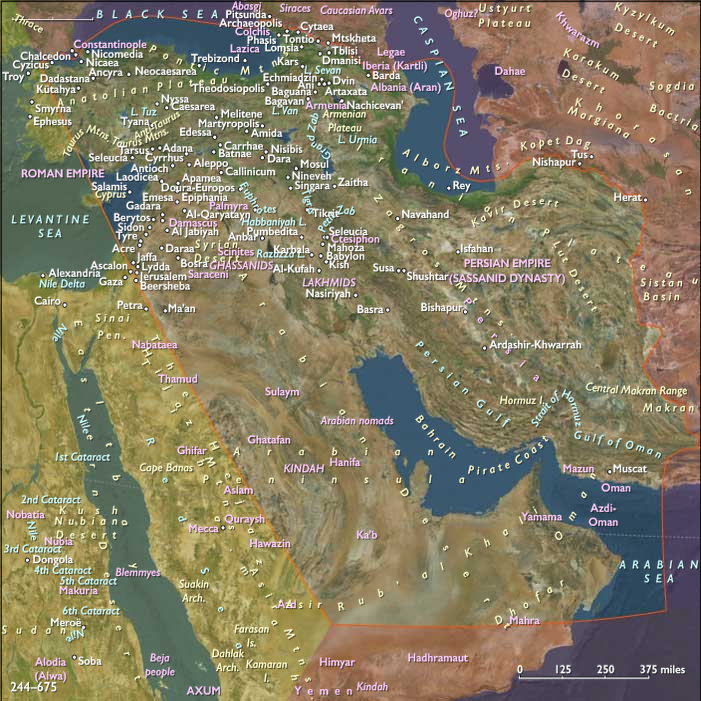
John Chrysostom, exiled to Pisunda, dies near the shore in 407.
Modern excavations in Pitsunda have unearthed remains of three fourth-century churches and a bath with superb mosaic floors.
The former "Great Pityus" harbor is now a mere lake within the town.
Locations
People
Groups
- Georgians
- Lazica (Egrisi), Kingdom of
- Persian Empire, Sassanid, or Sasanid
- Christianity, Nicene
- Roman Empire: Theodosian dynasty (Constantinople)
Topics
Subjects
Regions
Subregions
Related Events
Filter results
Showing 10 events out of 59203 total
Liu Bobo was born in 381, when his father Liu Weichen was an important Xiongnu chief and a vassal of Former Qin.
It is not known whether his mother Lady Fu was Liu Weichen's wife or concubine.
He was one of Liu Weichen's younger sons.
After Former Qin collapsed in light of various rebellions after its emperor Fu Jiān's defeat at the Battle of Fei River in 383, Liu Weichen took control of what is now part of Inner Mongolia south of the Yellow River and extreme northern Shaanxi, and while he nominally submitted to both Later Qin and Western Yan as a vassal, he was actually a powerful independent ruler.
However, in 391, he sent his son Liu Zhilidi to attack Northern Wei's prince Tuoba Gui, and Tuoba Gui not only defeated Liu Zhilidi, but crossed the Yellow River to attack Liu Weichen's capital Yueba (in modern Ordos, Inner Mongolia), capturing it and forcing Liu Weichen and Liu Zhilidi to flee.
The next day, Liu Weichen was killed by his subordinates, and Liu Zhilidi was captured.
Tuoba Gui seized Liu Weichen's territory and people and slaughtered his clan.
However, Liu Bobo escaped and fled to the Xuegan tribe, whose chief Tai Xifu refused to turn him over despite Northern Wei demands.
Instead, Tai delivered Liu Bobo to the Xianbei tribal chief Mo Yigan, the Duke of Gaoping, a Later Qin vassal, and Mo Yigan not only gave Liu Bobo refuge but also married one of his daughters to Liu Bobo.
Liu Bobo, from that point on, became highly dependent on his father-in-law.
(Meanwhile, in 393, Tuoba Gui, because of Tai Xifu's refusal to deliver Liu Bobo to him, attacked Tai and slaughtered his people, although Tai himself escaped and fled to Later Qin.)
Little is known about Liu Bobo's life during the following years.
In 402, Tuoba Gui's brother Tuoba Zun, the Prince of Changshan, attacked Mo's home base of Gaoping (in modern Guyuan, Ningxia), and Mo was forced to flee to Later Qin, abandoning his own people, who were scattered about, although later Later Qin recaptured Gaoping and gave that city back to Mo.
Sometime before 407, Liu Bobo, who has become known for being handsome, ability to speak well, alertness, and intelligence, had come to the attention of Later Qin's emperor Yao Xing.
Yao Xing had been so impressed by Liu Bobo's abilities when he met Liu Bobo that he wanted to make him a major general to defend against Northern Wei.
Yao Xing's brother Yao Yong, however, spoke against it, believing Liu Bobo to be untrustworthy.
Yao Xing initially, at Yao Yong's counsel, did not give Liu Bobo a commission, but eventually was so seduced by his talent that he made him a general and the Duke of Wuyuan, giving him the responsibility of defending Shuofang (in modern Ordos as well).
In 407, after suffering a number of losses against Northern Wei, Yao Xing decides to make peace with Northern Wei.
Upon hearing this, Liu Bobo becomes angry, because his father had been killed by Northern Wei, and he plans rebellion.
He therefore forcibly seizes the horses that Yujiulü Shelun), the khan of Rouran, had recently offered to Yao Xing as a tribute, and then makes a surprise attack on his father-in-law Mo Yigan, capturing Gaoping and killing Mo, seizing his troops.
He then declares himself a descendant of Yu the Great, the founder of Xia Dynasty, and names his state Xia.
He claims the title "Heavenly Prince" (Tian Wang).
Despite Liu Bobo's stated hatred for Northern Wei, he concentrates his efforts on undermining Later Qin, continually harassing Later Qin's northern territories and draining Later Qin's resources.
He therefore does not settle in a capital city; rather, he roved about with his mobile cavalry, constantly looking for Later Qin cities to pillage.
Also in 407, Liu Bobo seeks marriage with a daughter of the Southern Liang prince Tufa Rutan, but Tufa Rutan refuses.
In anger, Liu Bobo launches a punitive raid against Southern Liang, then retreats.
Tufa Rutan gives chase and, believing that he greatly outpowers Liu Bobo, is careless in his military actions.
Liu Bobo leads him into a canyon and locks the exit with ice and wagons, then ambushes him.
The defeat is such that it was said that sixty to seventy percent of Southern Liang's famed officials and generals died in the battle.
Tufa Rutan barely escapes capture.

Murong Chao sends his official Feng Kai to Later Qin in 407 to negotiate to have Yao Xing turn his mother and wife over to him.
Yao Xing demands that he submit as a vassal and further gives Later Qin either the court musicians of Former Qin (who had, after much travels, settled down in Southern Yan by this point) or one thousand captives from Jin.
Murong Chao readily agrees to be a vassal, but hesitates at both alternative demands.
Eventually, in fear of retaliation from Jin, he chooses to turn over one hundred and twenty musicians.
Yao Xing then delivers his mother Lady Duan and wife Lady Huyan to him.
Constantine III occupies Arles and established tenuous authority over Gaul, sharing control with marauding "barbarians".
This is generally seen as the beginning of Rome's withdrawal from Britain.
Constantine's two generals Iustinianus and the Frank Nebiogastes, leading the vanguard of his forces, are defeated in 407 by Sarus, Stilicho's lieutenant, with Nebiogastes being first trapped in, then killed outside, Valence.
However, Constantine sends another army headed by Edobichus and Gerontius, and Sarus is forced to retreat into Italy, needing to buy his passage through the Alpine passes from the brigand Bagaudae, who control them.
Constantine secures the Rhine frontier, and garrisons the passes that lead from Gaul into Italy.
The Senate deeply resents peace with Alaric, who has become the friend and ally of his late opponent, Stilicho; in 407, when Alaric marches into Noricum and demands a large payment for his expensive efforts in Stilicho's interests, the senate, prefers war.
One senator famously declaims Non est ista pax, sed pactio servitutis ("This is not peace, but a pact of servitude").
Nevertheless, under strong pressure from Stilicho, the Roman Senate consents to promise its payment of four thousand pounds of gold.
Stilicho sends Sarus, a Gothic general over the Alps to face the usurper Constantine III, but he loses and barely escapes, having to leave his baggage to the bandits who now infest the Alpine passes.
By 407, the estrangement between the eastern and western courts has become so bitter that it threatens civil war.
Stilicho has never abandoned his plans to annex Illyricum and puts them into operation in 407.
He closes the ports of Italy to all Eastern ships, instructs Alaric to hold Epirus for Honorius, and himself prepares to cross the Adriatic, but a false report reaches him that Alaric is dead, and he now hears of the revolt of Constantine in Britain.
Once more, he must abandon his plans.
Theodosius had in 384 arranged for the marriage of his grandniece Serena to Stilicho when he was a rising military officer, ensuing his loyalty to the House of Theodosius in the years ahead.
A resident at the court of her cousin, Honorius, she had selected a bride for the court poet, Claudian, and takes care of Honorius' half-sister, her cousin Galla Placidia.
She and Stilicho have a son, Eucherius, and two daughters, Maria and Thermantia.
Maria had married the emperor Honorius, her maternal first cousin, once removed, in 398.
Following her death in 407, her sister Aemilia Materna Thermantia marries Honorius.
Zosimus records how Serena, a Christian, took a necklace from a statue of Rhea Silvia and placed it on her own neck.
An old woman, the last of the Vestal Virgins, appeared, who rebuked Serena and called down punishment upon her for her act of impiety.
Serena was then subject to dreadful dreams predicting her own untimely death.
Marcus is soon assassinated and replaced in early 407 by Gratianus, acclaimed as emperor by the army in Britain.
His background, as recorded by Orosius, is that of a native Briton and one of the urban aristocracy.
He rules for four months at a time when a huge barbarian invasion is taking place in Gaul.
The Vandals, Suevi and Alans during 407 spread across northern Gaul towards Boulogne, and Zosimus writes that the troops in Britain feared an invasion across the English Channel.
The army wants to cross to Gaul and stop the barbarians but Gratian orders them to remain.
Unhappy with this, the troops kill him and choose Constantine III as their leader.
A common soldier but one of some ability, Constantine moves quickly.
He crosses the English Channel to the continent at Bononia and (historians have assumed) takes along with him all of the mobile troops left in Britain, thus denuding the province of any first line military protection and explaining their disappearance in the early fifth century.
This is generally seen as the beginning of Rome's withdrawal from Britain.
After three hundred and sixty years of occupation, the local regional British-Roman leaders raise their own levies for defense against Saxon sea rovers.
They cultivate oysters, having learned the technique from the Romans.
The Devastation of Gaul by the Vandals
Following the death of King Godigisel, his eldest surviving son, Gunderic, leads the Vandals on a brutal campaign through Gaul, leaving a trail of destruction and plunder in their wake. With Roman defenses in ruins and local authorities powerless to resist, the Vandals ravage the land, pillaging cities and settlements as they push westward and southward through Aquitaine.
Their advance further destabilizes Roman rule in Gaul, compounding the chaos caused by earlier Germanic incursions. The Vandal march is not simply one of conquest but also of desperation, as they seek new lands to settle amid the ongoing disintegration of the Western Roman Empire.
The devastation inflicted upon Aquitaine marks another irreversible blow to Roman control in the region, setting the stage for the eventual fragmentation of imperial authority and the rise of new barbarian kingdoms in former Roman territories.
Yao Xing sends his general Qi Nan to launch a major attack on Liu Bobo in 408.
Liu Bobo initially withdraws to let Qi believe that he fears Qi, and Liu Bobo makes a surprise counterattack and captures Qi.
Subsequently, much of Later Qin's northern territories fall into Xia hands.
Gwanggaeto has led several more campaigns against Xianbei as well as against Khitan tribes in Inner Mongolia, which he brings under his control.
In 408, the King sends a peace delegate to Gao Yun, the ruler of Later Yan/Northern Yan, to broker a settlement between the two dynasties, because Gao Yun descends from the Goguryeo royal house as well.
Goguryeo control over the Liaoning region is to remain strong until the Tang Dynasty seizes the area as a part of its war against Goguryeo in the late sixth century.
Murong Chao honors Lady Duan as empress dowager in 408, and creates Lady Huyan empress.
An army dispatched by Honorius lays siege to Constantine in Valentia (modern Valence, France) but soon withdraws.
Years: 407 - 407
Locations
People
Groups
- Georgians
- Lazica (Egrisi), Kingdom of
- Persian Empire, Sassanid, or Sasanid
- Christianity, Nicene
- Roman Empire: Theodosian dynasty (Constantinople)