Mir Wais dies of a natural cause …
Years: 1715 - 1715
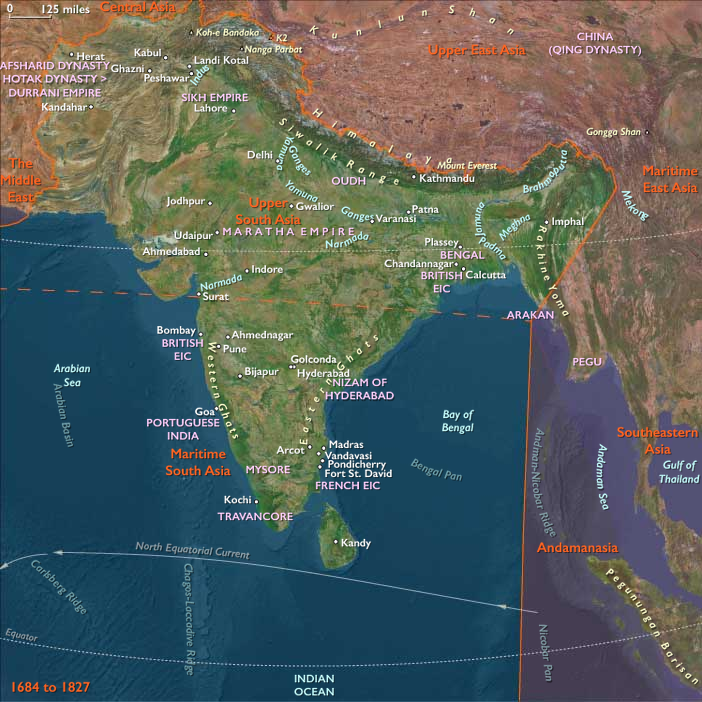
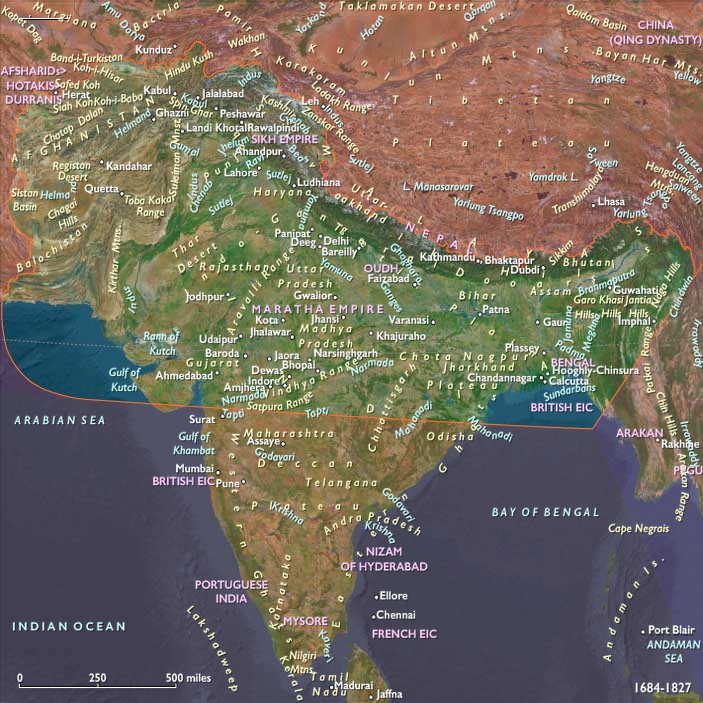
Mir Wais dies of a natural cause in November 1715 and is succeeded by his brother Abdul Aziz, who will soon be killed by Mir Wais' son Mahmud, allegedly for planning to return sovereignty over Qandahar to Persia.
Locations
People
Groups
- Muslims, Sunni
- Muslims, Shi'a
- Ghilzai (Pashtun tribal confederacy)
- Ottoman Empire
- Persia, Safavid Kingdom of
- Bukhara, (Astrakhanid) Khanate of
- Mughal Empire (Delhi)
Topics
Commodoties
Subjects
Regions
Subregions
Related Events
Filter results
Showing 10 events out of 28354 total
A total solar eclipse is seen across southern England, Sweden and Finland (it is the last total eclipse visible in London for almost nine hundred years).
Augustus II wants to strengthen royal power in the Commonwealth, and to this end has brought in troops from Saxony.
More than twenty-five thousand Saxon troops were inside Commonwealth's borders by the summer of 1714, a development that has produced dissent within the Commonwealth.
The increasingly powerful Russian Tsar Peter the Great meanwhile uses the growing conflict between Augustus II and the Polish nobility (szlachta).
At this time, Russia is not yet strong enough to conquer and absorb the Commonwealth outright, nor can it easily and openly assume control of it, despite the Commonwealth's dysfunctional politics; the "Polish anarchy" is not to be easily controlled.
Hence, Peter's goal is to weaken both sides, and to prevent Augustus from strengthening his position, which he fears will lead to a resurgent Commonwealth that could threaten Russia's recent gains and growing influence.
As an ally of the Commonwealth against Sweden in the great Northern War, he has succeeded in forcing through conditions (such as reduction of the Commonwealth army's size) that increases the Commonwealth's political dependence relative to Russia.
Peter has used Augustus' recent policies, aiming at the reduction of power of the hetmans (Polish military commanders-in-chief), as well as the occurrence of a bad harvest and some Polish-French negotiations, to stir up opposition to Augustus.
The nobles, spurred by Russian promises of support, form the Tarnogród Confederation on November 26, 1715.
The Confederation's marshal is Stanisław Ledóchowski.
The Tarnogród Confederation is only the most recent and most notable of several confederations formed against Augustus at this time.
The Confederates are supported by most of the Commonwealth's own army.
The Ottoman Empire, in retaliation for Venetian incitement of an uprising in Montenegro in 1714 (Venetians had invaded Bosnia and seized Turkish Mediterranean-based ships also), declares war on Venice and sends land and sea forces to capture Venetian islands and fortresses in the Aegean area.
The Turks besiege and conquer the entire Peloponnese after a year, and, ...
...with naval help from Egypt and the Barbary States, drive the Venetians from the Aegean and Crete, where they have held on to small strongholds after the Candian War.
The Venetians, receiving some help from Spain, Portugal, and several Italian states, repulse the Turkish assault on Corfu.
Spain's Catalan nobility had sided with the Habsburgs against the Bourbon Philip V, which leads to the abolition of Catalan autonomy with the last of the Nueva Planta decrees in 1715, and to an end of the national influence of the city of Barcelona.
Luigi Ferdinando Marsigli, born in Bologna to an old patrician family, had been educated in accordance with his rank, supplementing his training by studying mathematics, anatomy, and natural history with the best teachers and by personal observations.
After a course of scientific studies in his native city, he had traveled through the Ottoman Empire collecting data on its military organization, as well as on its natural history.
On his return, he had in 1682 entered the service of the Emperor Leopold and fought with distinction against the Turks, by whom he had been wounded and captured in an action on the river Rába, and sold to a pasha whom he had accompanied to the battle of Vienna.
After his release was purchased in 1684, he had returned to the imperial army and served as a talented military engineer.
Marsigli had contributed to the successful siege of Buda in 1696 and in the following years in the military operations of the liberation war against the Turks.
After the Treaty of Karlowitz, he had been commissioned to lead the Habsburg border demarcation commission.
Marsigli had mapped the eight hundred and fifty kilometer-long Habsburg-Ottoman border in the former Kingdom of Hungary (today Croatia, Serbia, Romania).
During the twenty years he spent in Hungary, he has collected scientific information, specimens, antiques, took measurements and observations for his work on the Danube.
He was assisted by Johann Christoph Müller of Nuremberg, who prepared the manuscript for printing and commissioned the engravers in Nuremberg.
The sample of the work, Prodromus, had been published in 1700 and the large work was expected by 1704.
He had been elected a Fellow of the Royal Society in November 1691.
During the War of the Spanish Succession, Marsigli had been second in command under Count d'Arco at the fortress of Breisach, which had surrendered in 1703.
Count d'Arco was beheaded because he was found guilty of capitulating before it was necessary, while Marsigli had been stripped of all honors and commissions, and his sword was broken over him.
His appeals to the emperor were in vain.
Public opinion, however, has acquitted him later of the charge of neglect or ignorance.
After he had to leave the Habsburg army, he had made journeys to Switzerland and then France, spending a considerable time at Marseilles to study the nature of the sea.
He has drawn plans, made astronomical observations, measured the speed and size of rivers, studied the products, the mines, the birds, fishes, and fossils of every land he visited, and also collected specimens of every kind, instruments, models, antiquities, etc.
He had shown in 1711 that coral is an animal rather than a plant as previously thought.
Finally he had returned to Bologna and presented his entire collection to the Senate of Bologna in 1712.
Here he founds his "Institute of Sciences and Arts", which is formally opened in 1715.
Six professors are put in charge of the different divisions of the institute.

The Whigs, within a year of George's accession, win an overwhelming victory in the general election of 1715.
The Prince of Wales (the future King George II) is in the same year elected as Governor of the South Sea Company at the election of directors.
Both the new King, George I, and his son, the Prince of Wales, have significant holdings in the company, as do some prominent Whig politicians, including James Cragg, the Earl of Halifax and Sir Joseph Jekyll.
James Cragg, as Postmaster General, is responsible for intercepting mail on behalf of the government to obtain political and financial information.
All Tory politicians are removed from the board and replaced with businessmen.
Whigs Horatio Townshend, brother in law of Robert Walpole, and the Duke of Argyll are elected directors.
The new government leads to a revival of the companies share value, which had fallen below its issue price.
The previous government had failed to make the interest payments to the company for the last two years, owing more than one million.
The new administration insists the debt be written off, but allows the company to issue new shares to stockholders to the value of the missed payments.
At around ten million pounds, this now represents half the share capital issued in the entire country.
The company in 1714 had two thousand to three thousand shareholders, more than either of its rivals.
Several members of the defeated Tory Party sympathize with the Jacobites, and some disgruntled Tories side with a Jacobite rebellion which becomes known as "The Fifteen".
The Jacobites seek to enthrone Anne's Catholic half-brother, James Stuart (called "James III" by his supporters and "the Pretender" by his opponents).
The Pretender's supporters, led by Lord Mar, an embittered Scottish nobleman who had previously supported the "Glorious Revolution", instigates rebellion in Scotland where support for Jacobitism is stronger than in England.
"The Fifteen", however, is a dismal failure; Lord Mar's battle plans are poor, and the Pretender arrives late with too little money and too few arms.
The rebellion by the end of the year has all but collapsed.
Rogers has collected information regarding pirates and their vessels near the island on Madagascar.
Finding that a large number of the pirates have gone native, he has persuaded many of them to sign a petition to Queen Anne asking her for clemency.
While Rogers' expedition is profitable, when it returns to London in 1715, the British East India Company vetoes the idea of a colonial expedition to Madagascar, believing a colony is a greater threat to its monopoly than a few pirates.
Accordingly, Rogers turns his sights from Madagascar to the West Indies.
His connections include several of the advisers to the new king, George I, who had succeeded Queen Anne in 1714, and Rogers is able to forge an agreement for a company to manage the Bahamas, which are infested with pirates, in exchange for a share of the colony's profits.
The Bahamas are at this time, according to the Governor of Bermuda, "without any face or form of Government" and the colony is a "sink or nest of infamous rascals". (Little, Brian (1960). Crusoe's Captain. Odhams Press.)
The islands have been nominally governed by absentee Lords Proprietor, who have done little except appoint a new, powerless governor when the position falls vacant.
The Lords Proprietor, under the agreement that underlies Rogers' commission, lease their rights for a token sum to Rogers' company for twenty-one years.
The Old Dock, originally known as Thomas Steer's dock, is the world's first commercial wet dock, built on the River Mersey in Liverpool, England, starting in 1709 and completed in 1715, by enlarging a previous natural tidal creek which was the "Pool" after which Liverpool was named.
Thomas Steers is the engineer responsible; additional advice had been obtained from engineer George Sorocold.
Opening on August 31, 1715, Old Dock, a tidal basin accessed directly from the river can accommodate up to one hundred ships.
The dock walls are constructed from brick laid directly on to sandstone bedrock.
The dock gates would have allowed as much as ten percent of the water out between high tides, resulting in a water level drop of several feet.
This may have been offset by water entering the dock from a stream.
Although Liverpool vessels had been involved in the slave trade before the dock opened, it will serve ships involved in the Africa-America trade, propelling Liverpool to world leader of this trade.
The dock leads to Liverpool's establishment as the leading European port and subsequent world trading port.
Years: 1715 - 1715
Locations
People
Groups
- Muslims, Sunni
- Muslims, Shi'a
- Ghilzai (Pashtun tribal confederacy)
- Ottoman Empire
- Persia, Safavid Kingdom of
- Bukhara, (Astrakhanid) Khanate of
- Mughal Empire (Delhi)