Minrekyawswa, renewing his invasion in 1416, is …
Years: 1415 - 1415
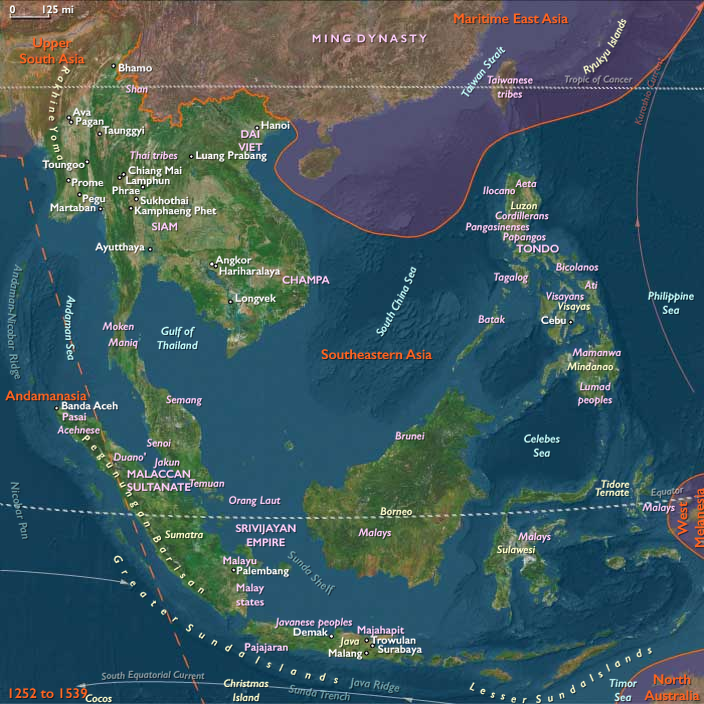
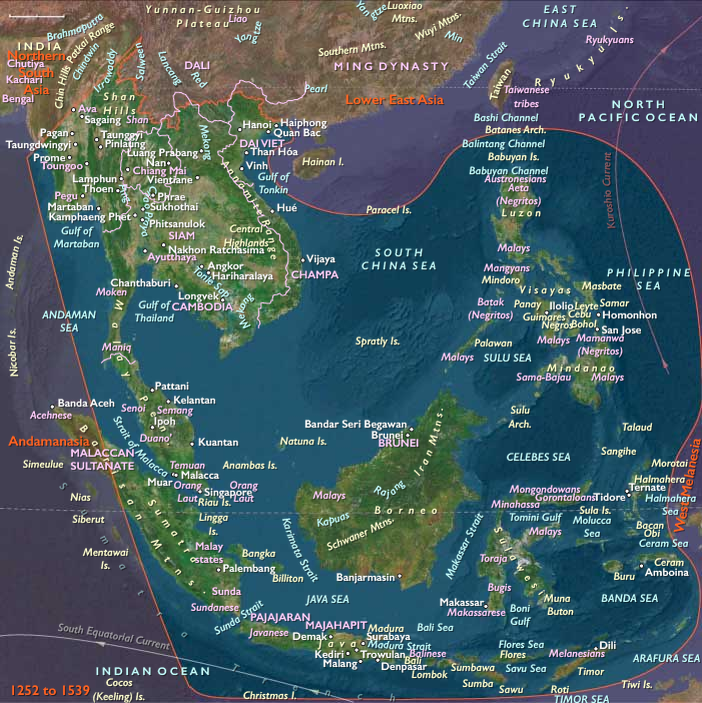
Minrekyawswa, renewing his invasion in 1416, is crippled accidentally by an elephant while in pursuit of Razadarit, is captured, and chooses execution over surrender.
This reduces the war’s intensity, but Ava’s forces aid the kingdom of Toungoo (on the Ava-Pegu border) to repulse a Mon attack in late 1416.
Locations
People
Groups
- Mon people
- Tai peoples, or Thais
- Rakhine State (Arakanese Kingdom)
- Bamar or Burmans
- Rakhine (Arakanese) people
- Hanthawaddy Pegu, (Mon) Kingdom of
- Shan States
- Ava, Kingdom of
Topics
Commodoties
Subjects
Regions
Subregions
Related Events
Filter results
Showing 10 events out of 42338 total
Arakanese aid enables Razadarit to repulse Minhkaung’s final attempt, in 1417, to conquer Pegu, after which Ava’s forces retreat to battle new incursions by the Shan.
Work had begun under the Yongle Emperor to reinstate the ancient Grand Canal of China, which had fallen into disuse and dilapidation during the previous Yuan Dynasty.
Between 1411 and 1415, a total of one hundred and sixty-five thousand laborers have dredged the canal bed in Shandong, built new channels, embankments, and canal locks.
Four large reservoirs in Shandong have also been dug in order to regulate water levels instead of resorting to pumping water from local tables.
A large dam is also constructed to divert water from the Wen River southwest into the Grand Canal.
This improvement to the grain shipment system of tribute traveling from south to north towards his new capital at Beijing solves the ongoing problem with the lack of food supply.
Sigismund, King of Germany from 1411, removes Brandenburg from the control of Bohemia-Moravia.
Lorenzo Monaco employs delicately patterned forms that are both decorative and naturalistic in the “Monte Oliveto Altarpiece,” executed in 1410, and The Coronation of the Virgin, characterized by a great number of saints and brilliant colors and painted in 1414.
(Contemporary documents record Lorenzo’s activity as a miniaturist during the early fifteenth century, but scholars can ascribe to him with certainty no paintings of this kind.)
The Emirate of Granada maintains its Iberian bastion while the Iberian Christians cross into Africa for the first time in 1415, in the person of the Portuguese King John and his sons, who live in an era where honor is as much earned as inherited; the medieval concept of chivalry still holds sway in European courts.
A "baptism of blood" is a tradition by which nobles prove their valor.
Given this worldview, it is not surprising that John I leads his sons and their assembled forces in an attack on the Moroccan stronghold of Ceuta.
Strategically located on the Strait of Gibraltar, Ceuta is one of the terminal ports of the trans-Saharan gold and slave trades.
In addition, the expedition feeds the crusading spirit of the warriors, as there is no greater glory for Iberian Christians of the Reconquista than that attained through the defeat of Moorish forces.
In an effort to curry favor with the pope and the Castilian king by a Christian crusade against the Muslims, John sails on July 25 from Lisbon with his sons and a naval fleet to seize the fortified port city, left undefended by the collapsing Marinids while their sultan is occupied with the suppression of a revolt in the Maghrib.
Anchoring at Tarifa, the Portuguese fleet moves on to attack Ceuta, but fails in its first assault.
The city’s residents place candles in their windows to appear as if their population is much higher then it actually is, and Moorish mountain-dwellers descend to aid the city’s defense, but the second assault ends in a Portuguese victory on August 24.
The Portuguese leave a small force at Ceuta that will withstand repeated assaults over the next three years, notably by the Moors of Granada.
The Portuguese victory over the forces of Islam rekindled dreams of a unified Christendom that could subdue Islam in a multi-pronged assault.
The prospect of a triumphant military and religious unification with distant Christian empires thus increases in its attraction to European leaders.
This military success marks one of the first steps in Portuguese expansion beyond the Iberian Peninsula, but it will prove costly to defend against the Muslim forces that soon besiege it.
The Portuguese will be unable to use it as a base for further expansion into the hinterland, and the trans-Saharan caravans will merely shift their routes to bypass Ceuta and/or use alternative Muslim ports.
John I of Portugal (r. 1385–1433) and the Beginnings of Portugal’s Maritime Expansion
Following his victory in the 1383–1385 Crisis, John I of Portugal ruled in peace and prosperity from 1390 onward, after the death of John I of Castile, whose marriage to Beatriz of Portugal had failed to produce an heir. Under his reign, Portugal strengthened its monarchy, economy, and overseas ambitions, setting the stage for the Age of Discovery.
Political and Economic Consolidation
- John I was ably advised by:
- João das Regras, his chancellor, who solidified the legal foundation of his rule.
- Nuno Álvares Pereira, his military commander, who ensured security at home.
- He weakened the power of the higher aristocracy, favoring the lesser nobility and merchants, strengthening royal authority.
- Portugal remained peaceful and stable, unlike other European states embroiled in the Hundred Years' War (1337–1453).
- With no external threats, John focused on maritime expansion, seeing it as Portugal’s path to wealth and influence.
The 1415 Conquest of Ceuta: The First Step in Expansion
Motivations for the Attack on North Africa
-
Continuing the Christian Crusade Against Islam
- Portugal’s military class sought to continue the Reconquista beyond Iberia.
- Capturing Muslim-controlled Ceuta, a strategic city in North Africa, was seen as a holy war against Islam.
-
Seeking Military Glory and Wealth
- The nobility and knights hoped for battlefield fame and riches.
- Ceuta was a major trade hub, believed to control West African gold, spices, and slaves.
-
Economic Expansion and Trade Control
- The capture of Ceuta would allow Portugal to control navigation along the African coast.
- Portugal wanted direct access to West African gold and the Asian spice trade, bypassing Muslim and Venetian intermediaries.
The Siege and Capture of Ceuta (1415)
- John I personally led the expedition, accompanied by his sons, including Prince Henry the Navigator.
- The Portuguese fleet transported thousands of troops, launching a successful siege and capturing Ceuta on August 21, 1415.
- Though a strategic victory, Ceuta did not yield the expected riches, as the overland trade routes shifted elsewhere.
Prince Henry the Navigator and the Birth of the Age of Discovery
Despite Ceuta’s disappointing economic returns, Prince Henry the Navigator became a strong advocate for continued exploration.
-
Henry’s Goals:
- To map the African coast beyond Cape Bojador, a mystical and feared limit of the known world.
- To find Prester John, the legendary Christian king of the East, rumored to be an ally against Islam.
- To reach Asia by sea, tapping into spice and gold trade routes.
-
The Establishment of a Portuguese Naval Tradition:
- Henry invested in shipbuilding and navigation, refining the caravel, a ship suited for deep-sea voyages.
- He sponsored expeditions down the West African coast, laying the foundation for Portuguese expansion.
Legacy: The Start of the Age of Exploration
- The conquest of Ceuta (1415) was the first step in Portugal’s maritime empire.
- Portuguese explorers, supported by Prince Henry, would:
- Sail beyond Cape Bojador (1434).
- Establish trading posts along the African coast.
- Eventually reach India (1498) and Brazil (1500).
John I’s policies of centralization, economic growth, and military expansion created the conditions for Portugal to become the first European global empire, shaping world history for centuries to come.
Pope Gregory XI's return to Rome in 1377, followed by his death and the controversial election of his successor, Pope Urban VI, had resulted in the defection of a number of cardinals and the election of a rival pope based at Avignon in 1378.
After thirty years of schism, the Council of Pisa had sought to resolve the situation by deposing the two claimant popes and elected a new pope, Alexander V. The council had claimed that, in such a situation, a council of bishops had greater authority than just one bishop, even if he were the bishop of Rome.
Though Alexander and his successor, John XXIII, have gained widespread support, especially at the cost of the Avignon pope, the schism remains, now involving not two but three claimants: Gregory XII at Rome, Benedict XIII at Avignon and John XXIII.
Therefore, many voices, including Sigismund, King of Germany and Hungary (and later Holy Roman Emperor) have pressed for another council to resolve the issue.
That council, called by John XXIII, is held from November 16, 1414 to April 22, 1418, in Constance, Germany.
According to Joseph McCabe, the council was attended by roughly 29 cardinals, 100 "learned doctors of law and divinity," 134 abbots, and 183 bishops and archbishops.
An innovation at the Council was that instead of voting as individuals, the bishops voted in national blocks, explicitly confirming the national pressures that had fueled the schism since 1378.
Pierre d'Ailly, cardinal of the University of Paris, dominates the early sessions of the council; his chancellor, Jean le Charlier de Gerson, also plays a leading role, advocating conciliarism as the only solution to the critical situation.
The famous decree Haec Sancta Synodus, which gives primacy to the authority of the Council and thus becomes a source for ecclesial conciliarism, is promulgated in the fifth session, April 6, 1415.
This decree, however, is not considered valid by the Magisterium of the Catholic Church, since it is never approved by Pope Gregory XII or his successors, and is passed by the Council in a session before his confirmation.
The Church declares the first sessions of the Council of Constance an invalid and illicit assembly of bishops, gathered under the authority of John XXIII.

The Council of Constance, with the support of King Sigismund, enthroned before the high altar of the cathedral of Constance, recommends that all three popes abdicate, and that another be chosen.
In part because of the constant presence of the King, other rulers demanded that they have a say in who would be pope.
Gregory XII then sends representatives to Constance, whom he grants full powers to summon, open and preside over an Ecumenical Council; he also empowers them to present his resignation to the Papacy.
This will pave the way for the end of the Western Schism.
The legates are received by King Sigismund and by the assembled Bishops, and the King yields the presidency of the proceedings to the papal legates, Cardinal Dominici of Ragusa and Prince Charles of Malatesta.
On July 4, 1415, the Bull of Gregory XII, which appoints Malatesta and Cardinal Dominici of Ragusa as his proxies at the council, is formally read before the assembled Bishops.
The cardinal then reads a decree of Gregory XII that convokes the council and authorizes its succeeding acts.
Thereupon, the Bishops vote to accept the summons.
Prince Malatesta immediately informs the Council that he is empowered by a commission from Pope Gregory XII to resign the Papal Throne on the Pontiff's behalf.
He asks the Council whether they would prefer to receive the abdication at that point or at a later date.
The Bishops vote to receive the Papal abdication immediately.
Thereupon the commission by Gregory XII authorizing his proxy to resign the Papacy on his behalf is read and Malatesta, acting in the name of Gregory XII, pronounces the resignation of the papacy by Gregory XII and hands a written copy of the resignation to the assembly.
Former Pope Gregory XII is then created titular Cardinal Bishop of Porto and Santa Ruffina by the Council, with rank immediately below the Pope (which makes him the highest-ranking person in the Church, since, due to his abdication, the See of Peter is vacant).
Gregory XII's cardinals are accepted as true cardinals by the Council, but the members of the council delay electing a new pope for fear that a new pope would restrict further discussion of pressing issues in the Church.
The council also deals harshly with the heresies of John Wycliffe and Jan Hus, posthumously condemning Wycliffe on May 4, 1415, and ordering his body exhumed and burned.
Hus, arrested within a month and summoned to Constance under a letter of indemnity, is condemned by council and burned at the stake notwithstanding on July 6, 1415.
Sigismund had refused to protect Hus despite his previous guarantees of safe conduct.
Richard of Conisburgh, a grandson of Edward III (through his fifth son Edmund, Duke of York and husband of Anne Mortimer, had in the Parliament of 1414 been created Earl of Cambridge, a title formerly held by his elder brother, Edward, 2nd Duke of York, who had earlier ceased to be Earl of Cambridge either by resignation of the title, or deprivation.
However Richard's creation as Earl of Cambridge had brought with it no accompanying grant of lands, and according to Harriss, Cambridge was 'the poorest of the earls' who were to set out on Henry V's invasion of France, and lacked the resources to properly equip himself for the expedition. (Harriss, G. L. (2004). Richard, earl of Cambridge (1385–1415). Oxford Dictionary of National Biography)
Perhaps partly for this reason, Cambridge conspires with Henry Scrope, 3rd Baron Scrope of Masham (whose uncle Richard le Scrope had been executed for his part in a 1405 revolt also supporting Mortimer's right), and Sir Thomas Grey (whose son, Thomas, had been betrothed in 1412 to Cambridge's only daughter, Isabel) to depose King Henry, and place his late wife Anne's brother, Edmund Mortimer, 5th Earl of March, on the throne.
The nominal principal, the Earl of March, had informed King Henry of the plot on July 31, stating that he had only just become aware of it.
Richard, Scrope, and Grey are promptly arrested.
The trial takes place in Southampton, on the site now occupied by the Red Lion Inn.
Mortimer is on the commission that condemns Cambridge to death.
Grey is beheaded on August 2 and the two peers on August 5, both in front of the Bargate, and buried in the chapel of God's House at Southampton.
Henry, satisfied, on August 11 sails for France.
Henry V’s Invasion and the English Triumph at Agincourt (1415)
By 1415, Henry V of England, a brilliant military strategist and capable ruler, had revived the long-running war against France, later known as the Hundred Years’ War (1337–1453). With France weakened by internal conflicts, including the Armagnac-Burgundian Civil War and the Cabochien Revolt, Henry saw an opportunity to renew hostilities and press his claim to the French throne.
I. The Political Situation in France and Henry’s Advantage
- France was divided:
- The Armagnacs controlled the French royal court and military, supporting the Dauphin Charles.
- The Burgundians, led by John the Fearless, remained neutral, refusing to support the Armagnacs against England.
- This fractured political landscape left France vulnerable, allowing Henry V to launch a major campaign without facing a united French resistance.
Years: 1415 - 1415
Locations
People
Groups
- Mon people
- Tai peoples, or Thais
- Rakhine State (Arakanese Kingdom)
- Bamar or Burmans
- Rakhine (Arakanese) people
- Hanthawaddy Pegu, (Mon) Kingdom of
- Shan States
- Ava, Kingdom of