Milan prospers as a center of trade …
Years: 1118 - 1118
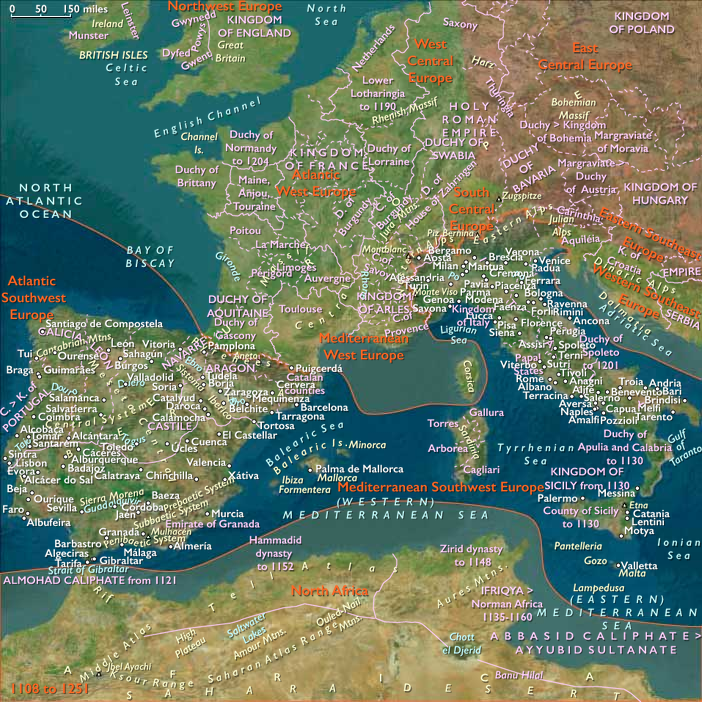
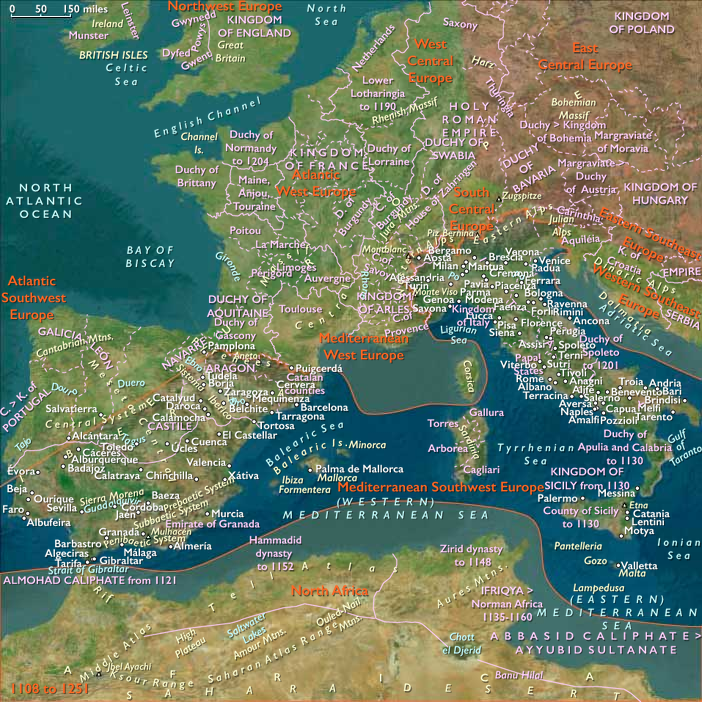
Milan prospers as a center of trade due to its command of the rich plain of the Po and routes from Italy across the Alps.
The economic competition between Milan and …
Locations
Groups
- Lombards (West Germanic tribe)
- German, or Ottonian (Roman) Empire
- Italy, Kingdom of (Holy Roman Empire)
Topics
Commodoties
Subjects
Regions
Subregions
Related Events
Filter results
Showing 10 events out of 49393 total
Sithu has spent the early part of his reign in repressing revolts, especially in Tenasserim and north Arakan.
A Pali inscription found at Mergui (Myeik) is evidence that Tenasserim then paid allegiance to the Pagan monarchy.
In north Arakan, a usurper (Kahton, lord of Thets) had driven out the rightful heir, who had fled to Pagan, where he subsequently died.
Pagan's initial attempt to restore the rightful heir Letya Min Nan—a combined land and seaborne invasion—had failed but the second attempt, mounted in 1118, succeeds. (The Arakanese chronicles report the date as 1103.)
Letya Min Nan, in gratitude, repairs the Buddhagaya shrine in the honor of his overlord Sithu.
Alexios has lost much of his popularity during the last twenty years of his life.
The years have been marked by persecution of the followers of the Paulician and Bogomil heresies—one of his last acts is to publicly burn at the stake Basil, a Bogomil leader, with whom he had engaged in a theological dispute.
Basil had first come to the attention of the emperor after imperial officers had tortured a member of the Bogomil sect to reveal the identity of their leader.
He admitted that Basil was their leader and that he had selected twelve teachers to act as his apostles.
This sect, noted for their Manichaean tendencies, iconoclastic principles and their detestation of the Orthodox hierarchy, has been rapidly gaining adherents throughout Alexius’ reign, and has begun to cause alarm among the Orthodox clergy.
Despite the success of the crusade, Alexios had also had to repel numerous attempts on his territory by the Seljuqs in 1110–1117.
Alexios was for many years under the strong influence of an eminence grise, his mother Anna Dalassene, a wise and immensely able politician whom, in a uniquely irregular fashion, he had crowned as Augusta instead of the rightful claimant to the title, his wife Irene Doukaina.
Dalassena had been the effective administrator of the Empire during Alexios' long absences in military campaigns: she was constantly at odds with her daughter-in-law and had assumed total responsibility for the upbringing and education of her granddaughter Anna Komnene.
Alexios' last years have also been troubled by anxieties over the succession.
Although he had crowned his son John II Komnenos co-emperor at the age of five in 1092, John's mother Irene Doukaina wishes to alter the succession in favor of her daughter Anna and Anna's husband, Nikephoros Bryennios the Younger.
Bryennios had been made kaisar (Caesar) and received the newly created title of panhypersebastos ("honored above all"), and has remained loyal to both Alexios and John.
Nevertheless, the intrigues of Irene and Anna disturb even Alexios' dying hours.
The emperor dies on August 15, 1118, and his son succeeds him as John II.
In conspiring to depose her brother, Anna is unable to obtain the support of her husband and the plot is discovered.
Nikephoros had refused to enter into the conspiracy set afoot by his mother-in-law and his wife Anna to depose John and raise himself to the throne.
His wife attributes his refusal to cowardice, but it seems from certain passages in his own work that he really regarded it as a crime to revolt against the rightful heir; the only reproach that can be brought against him is that he did not nip the conspiracy in the bud.
Anna forfeits her property, retiring to a convent, where she begins work on the Alexiad, a history of the life and reign of her father.

Muhammad I, along with his vizier Ahmad, later made a campaign in Iraq, where they had defeated and killed the Mazyadid ruler Sayf al-dawla Sadaqa ibn Mansur, who bore the title "king of the Arabs".
In 1109, Muhammad I had sent Ahmad and Chavli Saqavu to capture the Ismaili fortresses of Alamut and Ostavand, but they had failed achieve any decisive result and withdrew.
Ahmad had shortly been replaced by Khatir al-Mulk Abu Mansur Maybudi as vizier of the Sejluq Empire.
According to Ali ibn al-Athir, Ahmad then retired to a private life in Baghdad, but according to Anushirvan ibn Khalid, Muhammad I had Ahmad imprisoned for ten years.
Muhammad I dies in 1118 and is succeeded by Mahmud II in Iraq and Persia, although after Muhammad's death Sanjar, ruler of Khorasan and Transoxiana, is clearly the chief power in the Seljuq realms.
Joscelin fully endorses Baldwin II, despite their former hostility, over the candidacy of Baldwin I's brother Eustace III of Boulogne, as the successor to Baldwin I as king of Jerusalem; he is rewarded with the County of Edessa.
Arslan, constrained to seek refuge among the Afghans, is overtaken by the commander of Sanjar's army and is strangled on Bahram's orders, leaving Bahram ibn Mas'ud in undisturbed possession of the throne which Arslan ibn Mas'ud himself had occupied for only two years.
Baldwin had fallen ill in 1117.
Convinced that the sickness was due to his bigamous marriage to Adelaide, he had sent Adelaide back to Sicily, much to her disgust.
Baldwin had recovered, however, and in 1118 he marches into Egypt and plunders Pelusium.
Afterward, he catches and eats many fish, and falls ill once again.
Baldwin is carried back to Jerusalem on a litter but dies on the way on April 2 at the village of Al-Arish.
The crown is offered to the king's elder brother Eustace III, but Joscelin of Courtenay insists that the crown pass to Baldwin of Bourcq, despite Count Baldwin having exiled Joscelin from Edessa in 1113.
Baldwin of Edessa accepts and on Easter Sunday, April 14, 1118, is crowned king of Jerusalem as Baldwin II.
Almost immediately, the kingdom is simultaneously invaded by the Seljuqs from Syria and the Fatimids from Egypt, although by showing himself ready and willing to defend his territory, Baldwin forces the Muslim army to back down without a battle.
…Como drives the two cities to a war that will last for a decade.
The Cathedral of Sts. John and Paul occupies a part of the level top of Feretino’s ancient acropolis; it has been reconstructed on the site of an older church in 1099-1118; the interior will be modernized in 1693, but will be restored to its original form in 1902.
It contains a fine ciborium in the Cosmatesque style and a twelfth-century mosaic pavement.
Ramon Berenguer III had traveled to Rome in 1116 to petition Pope Paschal II for a crusade to liberate Tarragona.
By 1118, he has captured and rebuilt Tarragona, which becomes the metropolitan seat of the church in Catalonia (before that, Catalans had depended ecclesiastically on the archbishopric of Narbonne).
Years: 1118 - 1118
Locations
Groups
- Lombards (West Germanic tribe)
- German, or Ottonian (Roman) Empire
- Italy, Kingdom of (Holy Roman Empire)