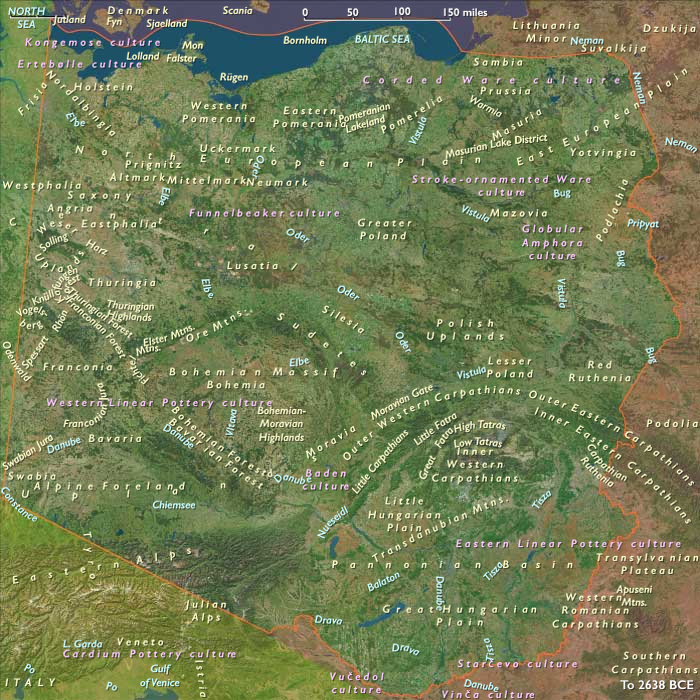
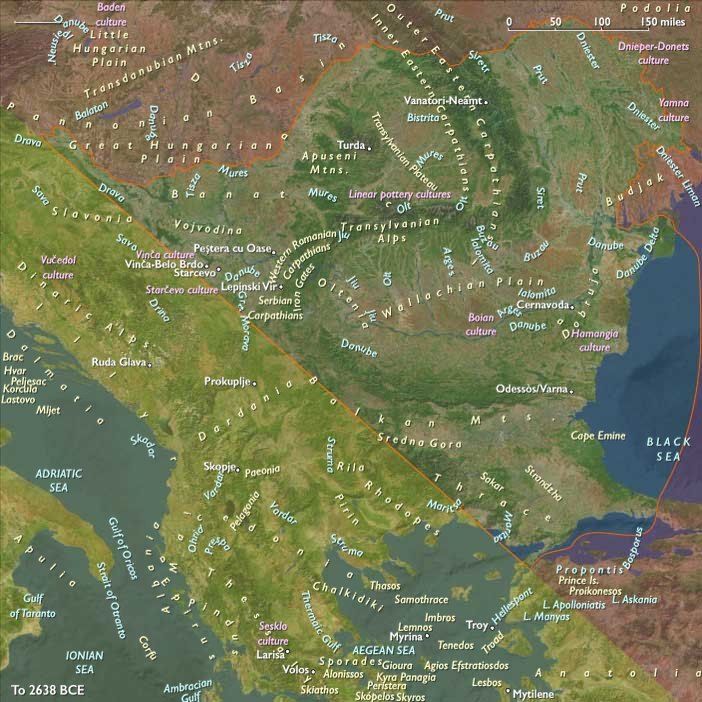
Migration from the Black Sea area into …
Years: 45837BCE - 44110BCE
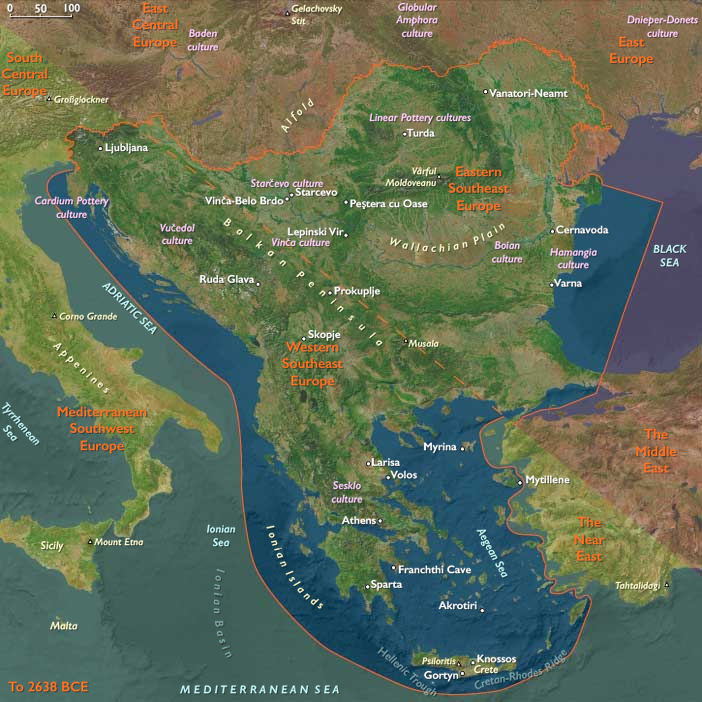
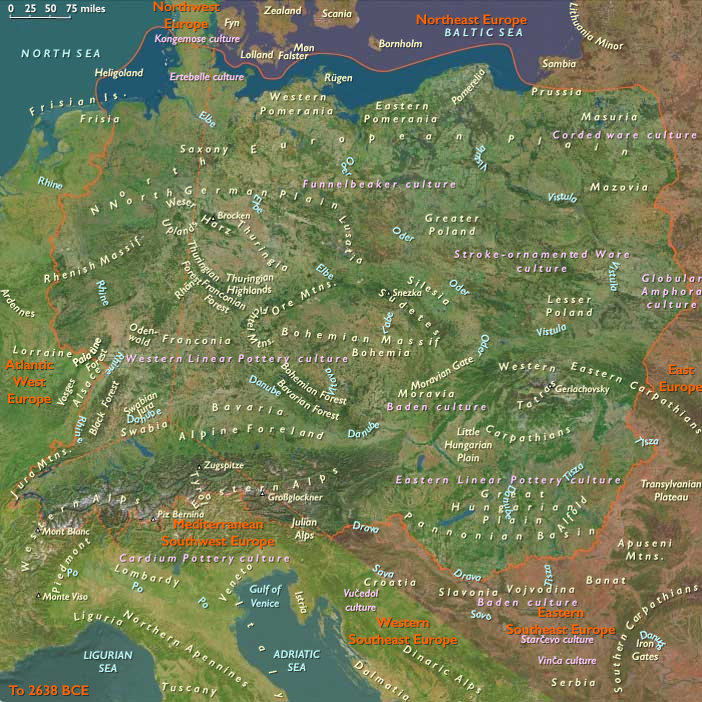
Migration from the Black Sea area into Europe started some around forty-five thousand years ago, probably along the Danubian corridor.
Topics
Subjects
Regions
Subregions
Related Events
Filter results
Showing 10 events out of 69607 total
The oldest non-archaic human remains from Europe are the finds from Peshtera cu Oase (the Cave with Bones) near the Iron Gates in Romania.
The site is situated in the Danubian corridor, which may have been the Early European Modern Human entry point into Central Europe.
The cave itself appears to be a hyena or cave bear den; the human remains may have been prey or carrion.
No tools are associated with the finds.
Oase 1 holotype is a robust mandible combining a variety of archaic, derived early modern, and possibly Neanderthal features.
The modern attributes place it close to European early modern humans among Late Pleistocene samples.
The fossil is one of the few finds in Europe that could be directly dated and is considered the oldest known early modern human fossil from Europe.
Two laboratories independently yielded collagen 14C age averaging to 34,950, +990, and –890, equivalent to about forty-five thousand calendar years.
The Oase 1 mandible was discovered on February 16, 2002.
A nearly complete skull of a young male (Oase 2) and fragments of another (Oase 3) were found in 2005, again with mosaic features, some of which are paralleled in the Oase 1 mandible.
Enkapune Ya Muto, also known as Twilight Cave, is a Late Stone Age site on the Mau Escarpment of Kenya.
Beads made of perforated ostrich egg shells found at the site have been dated to forty thousand years ago.
The beads found at the site represent some of the earliest known personal ornaments.
Bone flute fragments in Geissenklösterle Cave date back to around forty-two thousand years.
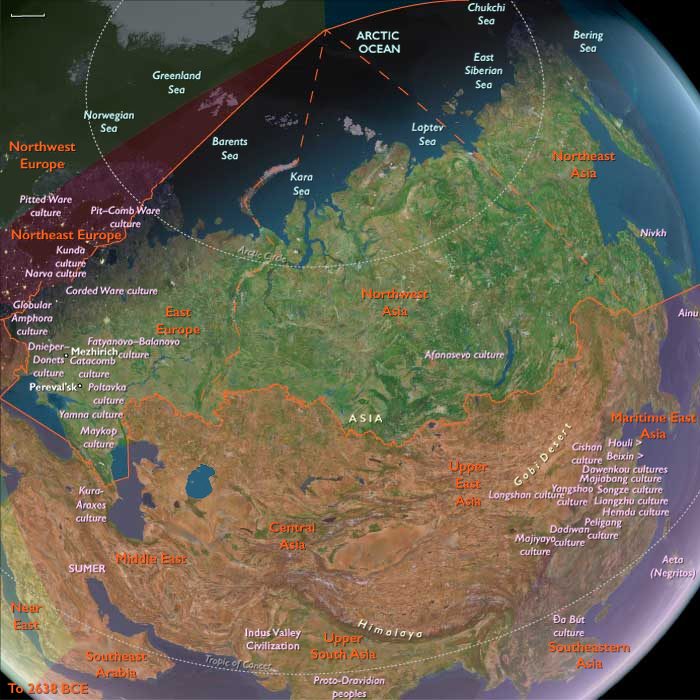
Siberia has paleontological significance, as it contains bodies of prehistoric animals from the Pleistocene Epoch, preserved in ice or in permafrost.
Specimens of Goldfuss cave lion cubs, Yuka the mammoth and another woolly mammoth from Oymyakon, a woolly rhinoceros from the Kolyma, and bison and horses from Yukagir have been found.
One of the largest-known volcanic events of the last 251 million years of Earth's geological history formed the Siberian Traps.
Volcanic activity continued here for a million years and some scientists consider it a possible cause of the "Great Dying" about 250 million years ago, estimated to have killed 90% of species existing at the time.
Cro-Magnons, the earliest modern humans in Europe, enter the continent (including France) around forty thousand years ago during a long interglacial period of particularly mild climate, when Europe was relatively warm, and food was plentiful.
When they arrive in Europe, they bring with them sculpture, engraving, painting, body ornamentation, music and the painstaking decoration of utilitarian objects.
The recently discovered Denisova hominin, based on bone fragments of a juvenile that lived about forty-one thousand years ago found in Denisova Cave (Altai Krai, Russia), a region also inhabited at about the same time by Neanderthals and modern humans, shares a common origin with the Neanderthals and interbred with the ancestors of modern Melanesians.
The mtDNA of the Denisova hominin is distinct from the mtDNAs of Neanderthals and modern humans.
Genetic studies link approximately four percent of non-African modern human DNA to Neanderthals.
In addition, tests comparing the Denisova hominin genome with those of six modern humans whose genome has been sequenced—a Kung from South Africa, a Nigerian, a French person, a Papua New Guinean, a Bougainville Islander and a Han Chinese—showed that between four percent and six percent of the genome of Melanesians (represented by the Papua New Guinean and Bougainville Islander) derives from a Denisovan population.
This was possibly introduced during the early migration of the ancestors of Melanesians into Southeast Asia.
This history of interaction suggests that Denisovans once ranged widely over eastern Asia.

Cultural features associated with modern humans, such as careful burial of the dead, the production of art in the form of elaborate cave decoration, and the decoration of objects of everyday use, date from this period.
Between 100,000 and 38,000 BCE, African cultures have adapted to desert, savanna, and forest environments, with distinctive toolkits for each.
Hunting, fishing, and gathering remain the basic way of life, but Africans employ a wider range of strategies in exploiting different environments.
The Venus of Hohle Fels (also known as the Venus of Schelklingen), an Upper Paleolithic “Venus” figurine found near Schelklingen, Germany, is dated to between forty thousand and thirty-five thousand years ago.
Belonging to the early Aurignacian, at the very beginning of the Upper Paleolithic, which is associated with the assumed earliest presence of Homo sapiens in Europe (Early European Modern Humans), it is the oldest undisputed example of Upper Paleolithic art and figurative prehistoric art in general.
The figurine is a representation of a woman, putting emphasis on the vulva and the breasts.
Consequently, it is presumed to be an amulet related to fertility.
It is made of a woolly mammoth tusk and had broken into fragments, of which six have been recovered, with the left arm and shoulder still missing.
In place of the head, the figurine has a perforation so that it could have been worn as a pendant.
Archaeologist John J. Shea suggests it would have taken "tens if not hundreds of hours" to carve the figurine.
Ancestors of Clovis people might have lived on the eastern coast of North America, as suggested by the archaeological sites at Topper in the state of South Carolina, U.S.A., dated fifty thousand years BP, and ...
...the Meadowcroft Rockshelter located near Avella in Washington County, in southwestern Pennsylvania, United States, dated to sixteen thousand years BP.
These discoveries have raised doubts about the "Clovis First" theory, and have led to alternative proposals for the routes of colonization and the diffusion of culture through the continent, in a heated dispute that has not been solved.