
Mieszko II has regained full power, but …
Years: 1034 - 1034
Mieszko II has regained full power, but he still has to fight against the nobility and his own subjects.
It should be noted that in Poland his renunciation of the royal crown isn't counted, and after 1032, in the chronicles he is still called King.
He dies suddenly between May 10 and 11, 1034, probably in Poznań.
The Polish chronicles clearly state that he died of natural causes; the information that he was murdered by the sword-bearer (Miecznik), given by the chronicles of Gottfried of Viterbo, refers to Bezprym.
However, the historians now think that he was killed in a plot hatched by the aristocracy.
He is buried in the Cathedral of St. Peter and St. Paul.
After Mieszko II's death, Poland's peasants revolt in a "pagan reaction."
The exact reasons and date are unknown.
Mieszko II's only son and heir, Casimir I, is either expelled by this insurrection, or the insurrection is caused by the aristocracy's expulsion of him.
Some modern historians argue that the insurrection was caused more by economic than by religious issues, such as new taxes for the Church and the militarization of the early Polish polity.
Priests, monks and knights are killed; cities, churches and monasteries are burned.
Locations
People
Groups
- Polytheism (“paganism”)
- Christianity, Chalcedonian
- Bohemia, Duchy of
- Kievan Rus', or Kiev, Great Principality of
- German, or Ottonian (Roman) Empire
- Poles (West Slavs)
- Poland of the first Piasts, Kingdom of
Topics
Commodoties
Subjects
Regions
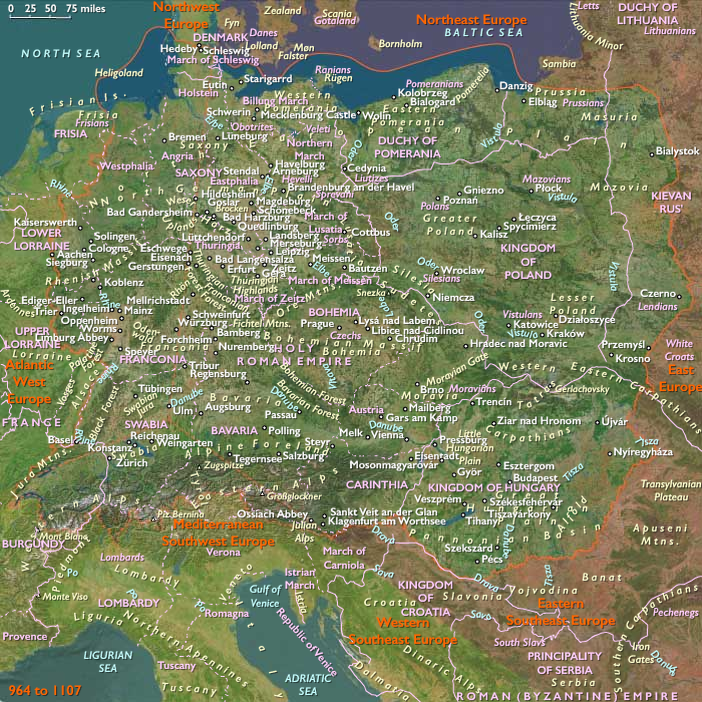
Subregions
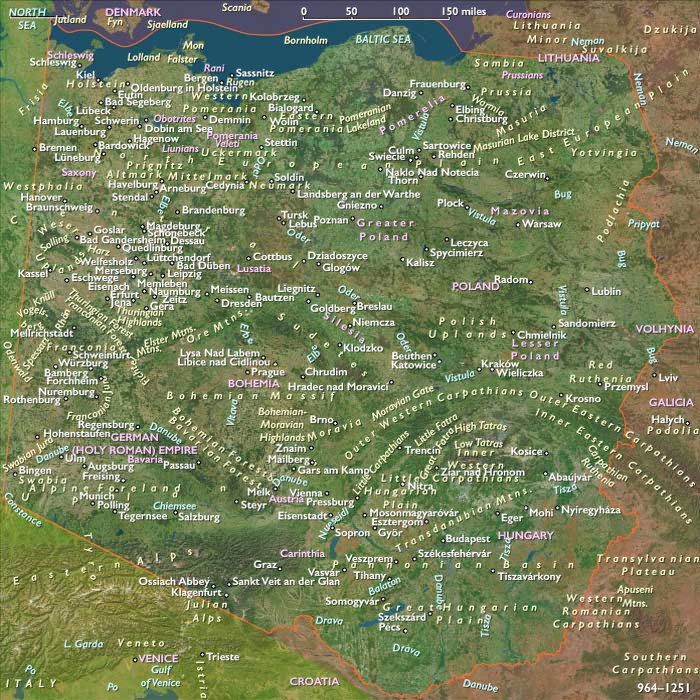
Years: 1034 - 1034
Locations
People
Groups
- Polytheism (“paganism”)
- Christianity, Chalcedonian
- Bohemia, Duchy of
- Kievan Rus', or Kiev, Great Principality of
- German, or Ottonian (Roman) Empire
- Poles (West Slavs)
- Poland of the first Piasts, Kingdom of
Topics
Commodoties
Subjects
Regions
Subregions