
The Near and Middle East (820 – …
Years: 820 - 963
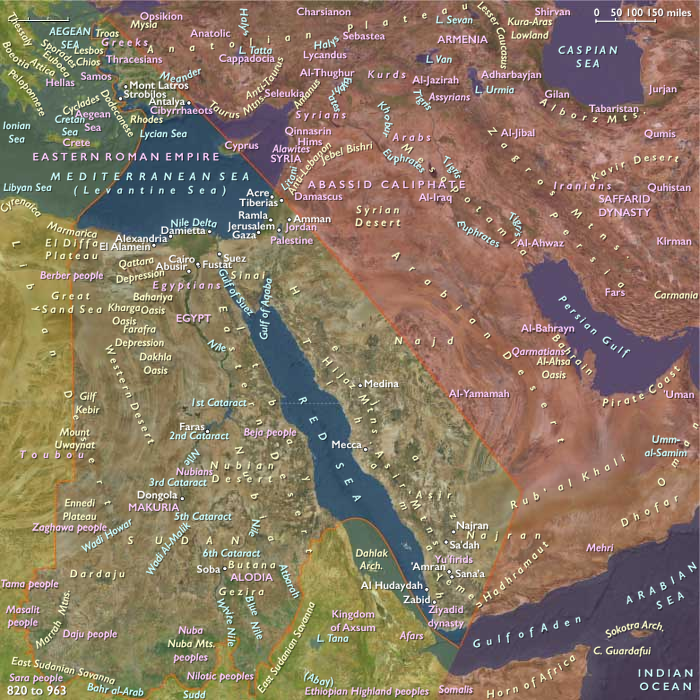
The Near and Middle East (820 – 963 CE): Abbasid Fragmentation, Local Dynasties, and the Maritime–Desert Frontier
Geographic and Environmental Context
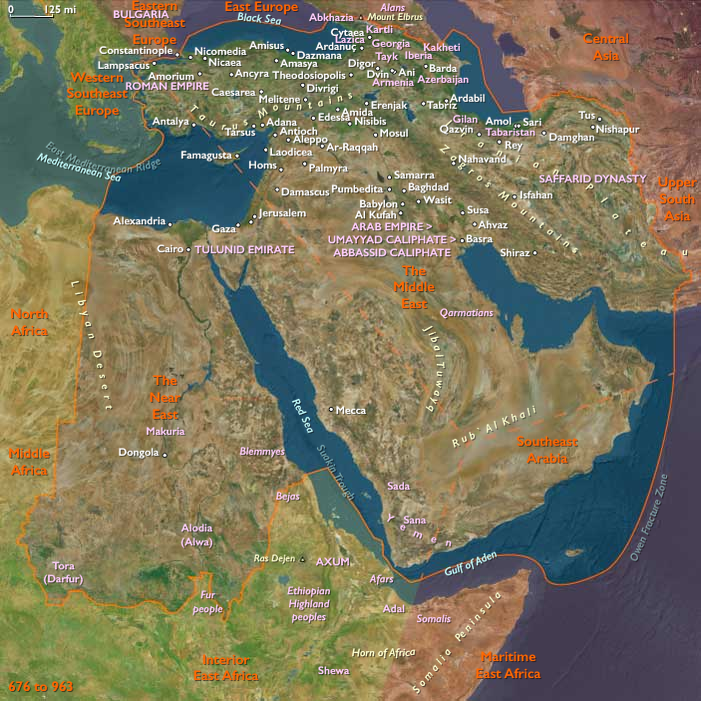
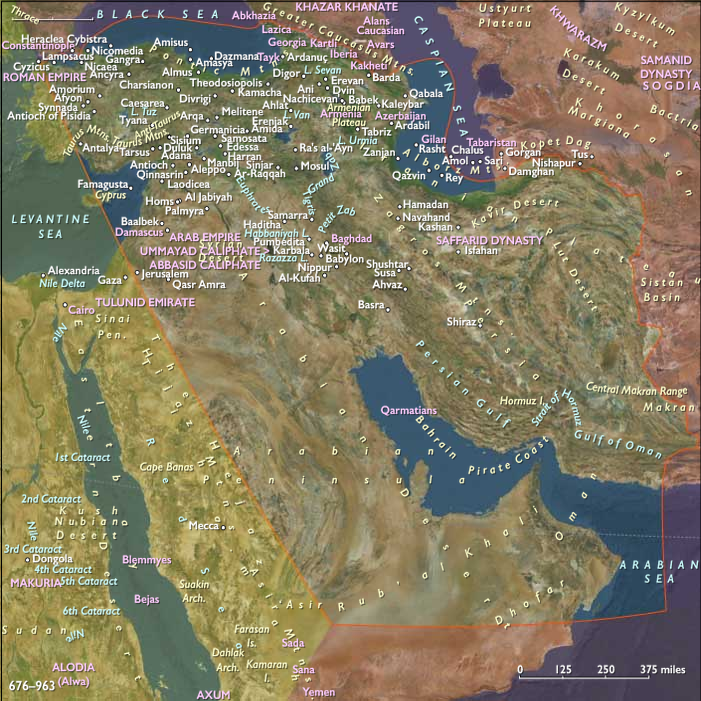
The Near and Middle East extended from Anatolia and the eastern Mediterranean through the Tigris–Euphrates basin and the Iranian uplands to the Arabian and Red Sea coasts and Gulf rim.
It included three linked zones:
-
The Middle East—Mesopotamia, Iran, Syria, the Caucasus, and the Persian Gulf littoral.
-
The Near East—Egypt, the Levant, western Arabia, Yemen, Sudan/Nubia, and western Anatolia.
-
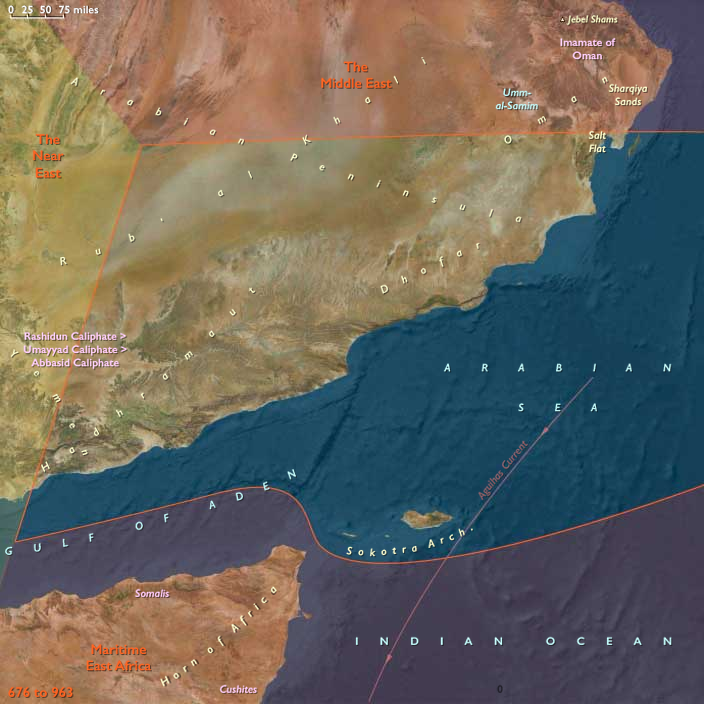
Southeast Arabia—the incense-producing highlands and coasts of Hadhramaut and Dhofar, the Empty Quarter, and Socotra, the island midway between Arabia and India.
Together these regions formed the central hinge of Afro–Eurasian civilization: canals, caravan routes, and monsoon ports tied together the Mediterranean, Indian Ocean, and Inner Asian worlds.
Climate and Environmental Shifts
The period fell within late-Holocene stability:
-
Mesopotamia and the Nile Valley maintained fertile irrigation systems;
-
Syrian and Anatolian uplands relied on rain-fed farming, sensitive to local drought;
-
Arabian deserts remained arid but supported caravan mobility;
-
Oases and wadis in Hadhramaut, Dhofar, and Oman sustained terrace farming and resin groves;
-
Gulf fisheries and pearl banks flourished under consistent sea temperatures.
This steady climate sustained both agrarian production and long-distance commerce.
Societies and Political Developments
Abbasid Caliphate and Regional Dynasties
-
Baghdad, still the symbolic heart of the Islamic world, saw its authority erode under competing dynasties and governors.
-
In Iran and Iraq, the Tahirids (Khurasan), Saffarids (Sistan), and Samanids (Transoxiana) rose to prominence.
-
In 945, the Buyids, a Shiʿi-leaning Persian house, seized Baghdad itself, reducing the caliphs to nominal figureheads.
-
Syria and Cilicia oscillated between Abbasid, Tulunid (868–905), and Ikhshidid (935–969) rule, with Byzantine–Muslim frontier warfare along the Cilician thughūr.
-
The Caucasus saw the revival of Christian kingdoms: Bagratid Armenia regained sovereignty in 885, while Georgia’s Bagrationi princes consolidated their realms.
Egypt and the Levant
-
Ahmad ibn Tulun (868–884) founded the Tulunid dynasty, asserting Egypt’s autonomy.
-
His capital near Fustat built monumental mosques and efficient fiscal systems.
-
-
After Tulunid decline, the Ikhshidids maintained quasi-independent rule until the Fatimids seized Egypt in 969.
-
Levantine ports—notably Tyre and Tripoli—prospered as glass, textile, and sugar centers.
-
In western Anatolia, Byzantine control persisted along the Aegean, despite raids from Cilicia and Syria.
Arabia and the Gulf
-
Eastern Arabia and Oman: The Qarmatians, a radical Shiʿi movement centered in al-Ahsa–Qatif, rose after 899, seizing Bahrain and attacking pilgrim caravans.
-
Ibāḍī Oman endured as a theocratic state, its ports at Suhar and Qalhat linking the Gulf to India.
-
In Yemen, Zaydi imams established authority in the northern highlands, while the southern Hadhramaut and Dhofar valleys thrived on frankincense cultivation.
-
Socotra stood as a maritime crossroads where Arab, Persian, and Indian traders mingled with local Austronesian-descended seafarers.
-
The Empty Quarter (Rubʿ al-Khali) remained the preserve of Bedouin tribes guiding caravans across vast, ungoverned sands.
Sudan, Nubia, and Christian Frontiers
-
Makuria and Alodia, Christian kingdoms of the Nile south of Aswan, maintained independence through the Baqt treaty, trading slaves and gold for Egyptian grain and textiles.
-
Armenia and Georgia to the north and Nubia to the south framed the Islamic heartlands with strong Christian enclaves, balancing the Abbasid world through diplomacy and trade.
Economy and Trade
-
Agrarian cores:
-
Iraq and Khuzestan: grain, dates, flax, and cotton under canal irrigation.
-
Egypt: Nile surpluses of wheat, barley, and linen textiles.
-
Yemen and Oman: aromatics, coffee precursors, horses, and pearls.
-
Syria and Anatolia: olives, vines, and cereals.
-
-
Maritime commerce:
-
The Persian Gulf hosted fleets linking Basra and Siraf to India, Socotra, and East Africa.
-
The Red Sea tied Aden, Aydhab, and Jeddah to Egypt and Levantine ports.
-
-
Caravan and overland routes:
-
From Tabriz–Rayy–Nishapur across Iran;
-
Mosul–Aleppo–Cilicia toward the Byzantine frontier;
-
Caucasus passes (Darial/Derbent);
-
Hadhramaut–Najran–Mecca incense road through the desert interior.
-
-
Coinage and credit: Abbasid gold dīnārs and silver dirhams circulated widely; regional mints under Buyids and Samanids proliferated; merchants’ letters of credit (suftaja) streamlined long-distance exchange.
Subsistence and Technology
-
Canals and qanāt systems sustained Mesopotamia and Iran.
-
Syrian norias and Yemeni terraces optimized water management.
-
Shipbuilding: sewn-plank and nailed hulls; lateen sails enabled monsoon navigation.
-
Craft industries: Egyptian linen, Levantine glass, Persian silks, Yemeni aromatics, and Anatolian wines defined the region’s artisan wealth.
-
Military innovation: cavalry archery, heavy cataphracts, and fortified passes; the Cilician frontier became a laboratory of cross-cultural warfare.
Movement and Interaction Corridors
-
Tigris–Euphrates canal system: arteries of Mesopotamian life.
-
Nile River: the logistical spine of Egypt.
-
Red Sea and Arabian Sea routes: joined the Mediterranean to the Indian Ocean via Aden and Socotra.
-
Caucasus and Anatolian corridors: funneled trade between steppe and Mediterranean.
-
Pilgrimage routes: Mecca and Medina connected the Islamic world through faith and exchange.
From the incense valleys of Dhofar to the ports of Tyre and Tripoli, these networks bound deserts, rivers, and seas into one integrated economy.
Belief and Symbolism
-
Islam: Abbasid orthodoxy persisted at Baghdad, but regional heterodoxies thrived—Qarmatian egalitarianism, Zaydi imamate in Yemen, and Ibāḍī autonomy in Oman.
-
Christianity: Byzantium retained coastal Anatolia and Cyprus; Armenia, Georgia, Nubia, and Makuria remained vibrant Christian realms on Islam’s periphery.
-
Judaism: thriving mercantile communities in Cairo, Fustat, and the Levant linked Mediterranean and Indian Ocean trade.
-
Pilgrimage and ritual: The Hajj unified Muslims across regions; incense rituals in Dhofar and Hadhramaut blended ancient practice with Islamic trade wealth.
-
Socotra’s syncretism: Islam and Christianity coexisted with pre-Islamic traditions, embodying the cultural crossroads of the Arabian Sea.
Adaptation and Resilience
-
Decentralization allowed flexibility: Tulunid Egypt, Buyid Iraq, and Zaydi Yemen adapted governance to local needs.
-
Hydraulic and maritime redundancy—multiple water and trade routes—buffered ecological shocks.
-
Pluralism fostered resilience: Islamic, Christian, and Jewish communities often cooperated economically.
-
Caravan–port symbiosis balanced overland and sea commerce, ensuring continuity even amid political fragmentation.
Long-Term Significance
By 963 CE, the Near and Middle East had evolved into a polycentric system:
-
Baghdad remained the spiritual capital but shared power with Buyid amirs, Tulunid–Ikhshidid Egypt, Zaydi Yemen, and Qarmatian Bahrain.
-
Christian Armenia, Georgia, Nubia, and Byzantine Anatolia endured as autonomous partners and rivals.
-
Southeast Arabia and Socotra connected caravan deserts with Indian Ocean circuits, ensuring the region’s role as the commercial and religious nexus of the Old World.
This balance of fragmentation and connectivity defined the transitional centuries between the early Abbasid empire and the later Islamic golden age—an era of hydraulic empires, desert confederations, and maritime corridors linking Africa, Asia, and Europe in a single interdependent world.
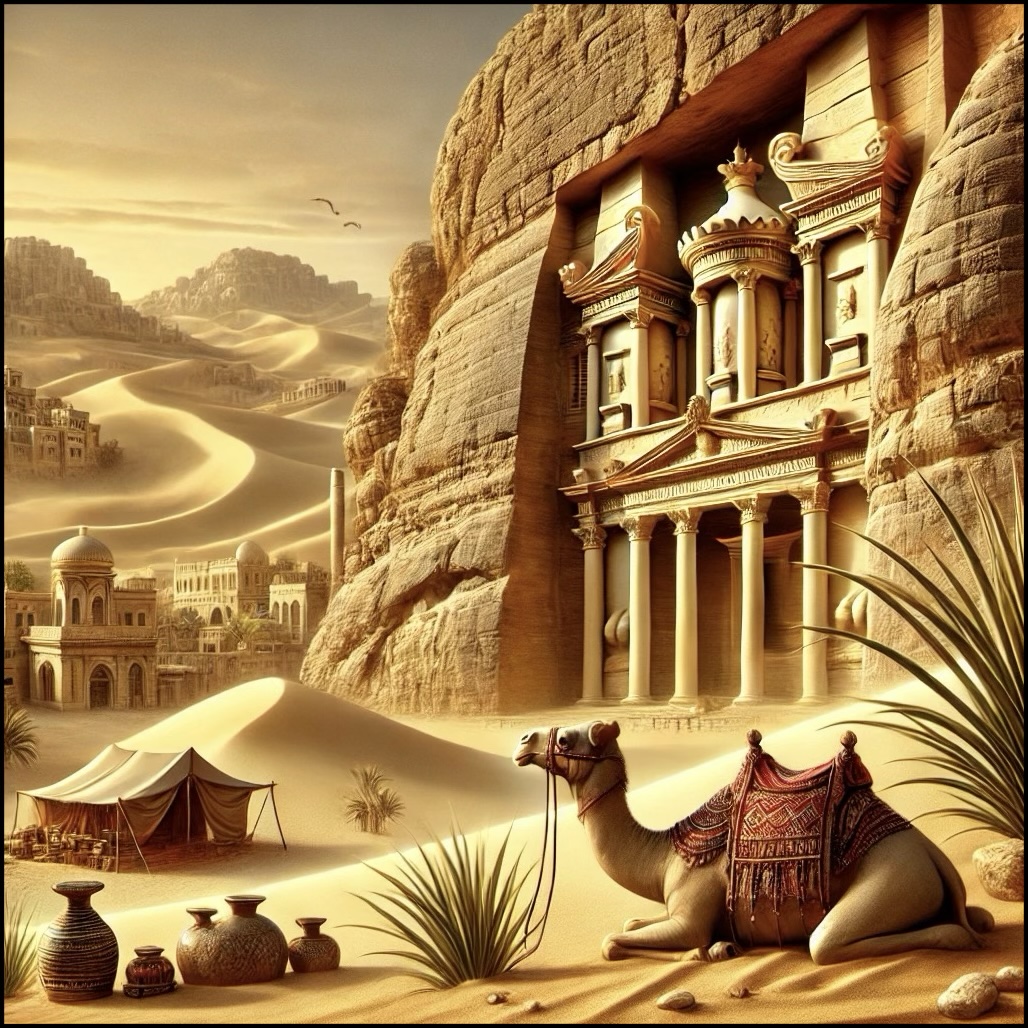
Middle East (with civilization) ©2024-25 Electric Prism, Inc. All rights reserved.
People
Groups
- Iranian peoples
- Arab people
- Zoroastrians
- Jews
- Kurdish people
- Abkhaz people
- Christians, Armenian Apostolic Orthodox
- Christian community of Najran
- Christians, Eastern (Diophysite, or “Nestorian”) (Church of the East)
- Christians, Maronite
- Christians, Miaphysite (Oriental Orthodox)
- Christianity, Chalcedonian
- Iberia, Principate of
- Muslims, Sunni
- Armenia, Ostikanate of
- Muslims, Kharijite
- Muslims, Shi'a
- Muslims, Ibadi
- Zaidiyyah
- Cyprus, Roman-Abbasid condominium of
- Oman, First Imamate of
- Ismailism
- Abbasid Caliphate (Baghdad)
- Abkhazia (Abasgia), Kingdom of
- Tao-Klarjeti (Georgian [Kartvelian] kingdoms and principalities)
- Samanid dynasty
- Tahirid dynasty
- Saffarid dynasty
- Tulunids
- Qarmatians
- Armenia, Bagratid
- Hamdanid Dynasty
- Armenia, Bagratid
- Buyid dynasty
- Ikhshidid dynasty
- Armenia, Bagratid
- Armenia, Zakarid
Topics
- Arab-Byzantine Wars
- Byzantine-Muslim War of 830-41
- Byzantine-Muslim War of 851-63
- Kharijite Rebellion
- Zanj Rebellion
- Byzantine-Muslim War of 871-85
- Medieval Warm Period (MWP) or Medieval Climate Optimum
- Byzantine-Muslim War of 960-76
Commodoties
- Gem materials
- Glass
- Domestic animals
- Grains and produce
- Textiles
- Fibers
- Ceramics
- Slaves
- Money
- Aroma compounds
- Spices
Subjects
- Language
- Writing
- Conflict
- Mayhem
- Faith
- Government
- Custom and Law
- Technology
- Medicine
- Mathematics
- Astronomy
Regions
Subregions
Years: 820 - 963
Middle East (with civilization) ©2024-25 Electric Prism, Inc. All rights reserved.
People
Groups
- Iranian peoples
- Arab people
- Zoroastrians
- Jews
- Kurdish people
- Abkhaz people
- Christians, Armenian Apostolic Orthodox
- Christian community of Najran
- Christians, Eastern (Diophysite, or “Nestorian”) (Church of the East)
- Christians, Maronite
- Christians, Miaphysite (Oriental Orthodox)
- Christianity, Chalcedonian
- Iberia, Principate of
- Muslims, Sunni
- Armenia, Ostikanate of
- Muslims, Kharijite
- Muslims, Shi'a
- Muslims, Ibadi
- Zaidiyyah
- Cyprus, Roman-Abbasid condominium of
- Oman, First Imamate of
- Ismailism
- Abbasid Caliphate (Baghdad)
- Abkhazia (Abasgia), Kingdom of
- Tao-Klarjeti (Georgian [Kartvelian] kingdoms and principalities)
- Samanid dynasty
- Tahirid dynasty
- Saffarid dynasty
- Tulunids
- Qarmatians
- Armenia, Bagratid
- Hamdanid Dynasty
- Armenia, Bagratid
- Buyid dynasty
- Ikhshidid dynasty
- Armenia, Bagratid
- Armenia, Zakarid
Topics
- Arab-Byzantine Wars
- Byzantine-Muslim War of 830-41
- Byzantine-Muslim War of 851-63
- Kharijite Rebellion
- Zanj Rebellion
- Byzantine-Muslim War of 871-85
- Medieval Warm Period (MWP) or Medieval Climate Optimum
- Byzantine-Muslim War of 960-76
Commodoties
- Gem materials
- Glass
- Domestic animals
- Grains and produce
- Textiles
- Fibers
- Ceramics
- Slaves
- Money
- Aroma compounds
- Spices
Subjects
- Language
- Writing
- Conflict
- Mayhem
- Faith
- Government
- Custom and Law
- Technology
- Medicine
- Mathematics
- Astronomy
Regions
Subregions