
The Near and Middle East (820 – …
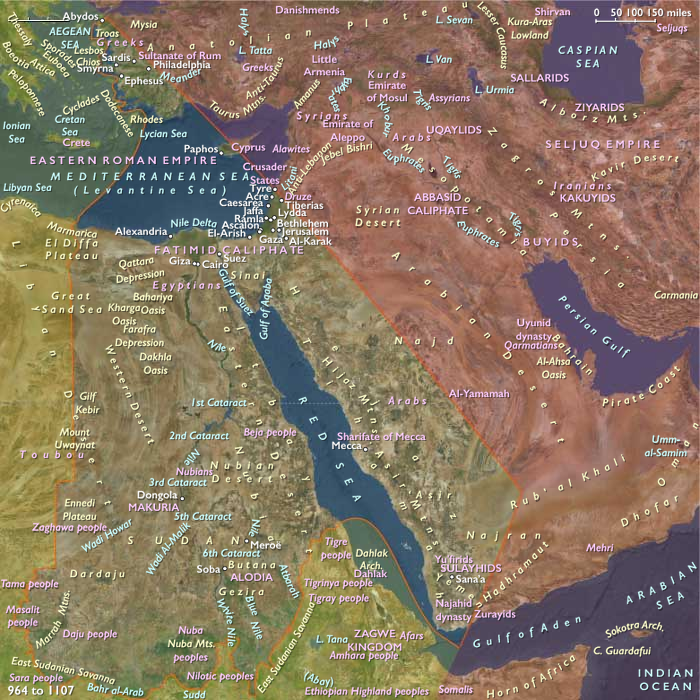
Years: 964 - 1107
The Near and Middle East (820 – 1107 CE): Abbasid Fragmentation, Fatimid Cairo, and the Gulf of Frankincense
Geographic and Environmental Context
Between the Tigris–Euphrates heartlands and the Nile Valley, across the Caucasus, Levant, Arabian deserts, and Red Sea–Indian Ocean corridors, the Near and Middle East formed one of the most interconnected and volatile regions of the early second millennium.
Its landscapes ranged from Mesopotamian canal plains and Persian qanāt belts to Syrian steppe margins, Caucasian uplands, Arabian incense valleys, and Egypt’s deltaic floodplains.
Cities such as Baghdad, Rayy, Tabriz, Cairo, Tyre, and Aden anchored a web of trade routes linking Byzantine Anatolia, Central Asia, India, and East Africa.
Climate and Environmental Shifts
Throughout this period, stable late-Holocene conditions supported agricultural and maritime prosperity.
The Tigris–Euphrates canals, qanāt systems of Iran, and Syrian norias sustained irrigated cores.
The Medieval Warm Period (after c. 950) modestly improved growing seasons in Egypt and western Anatolia, though the 1060s Nile failure precipitated crisis and reform under the Fatimids.
In the Gulf and southern Arabia, arid stability continued; monsoon-fed groves in Dhofar sustained incense cultivation, while Red Sea and Indian Ocean winds structured predictable sailing cycles.
Societies and Political Developments
Fragmentation and Transformation in the Abbasid Realm (820–963 CE)
During the later Abbasid centuries, imperial unity gave way to regional dynasties and shifting religious allegiances.
-
In Iraq and Iran, local powers—the Tahirids of Khurasan, Saffarids of Sistan, and Samanids of Transoxiana—asserted autonomy.
-
In 945, the Buyids seized Baghdad, establishing a Shi‘i-leaning amirate over the caliphate.
-
Syria and Cilicia oscillated between Abbasid, Tulunid, and later Ikhshidid governors; frontier thughūr (Cilicia) endured Byzantine–Muslim warfare.
-
In the Caucasus, the Bagratid kings of Armenia (885) and Bagrationi princes of Georgia consolidated Christian monarchies.
-
In eastern Arabia, the Qarmatians (from 899)—a radical Isma‘ili movement—dominated the al-Ahsa–Qatif oasis, raiding pilgrim routes and challenging Abbasid legitimacy.
-
Oman preserved Ibāḍī autonomy through coastal and oasis sheikhdoms.
-
The northeastern coast of Cyprus and northern Lebanon (Tripoli) remained contested or semi-autonomous trade nodes.
The Fatimid and Byzantine Ascendancy (964–1107 CE)
From the late tenth century, the regional axis shifted westward and southward.
-
Egypt, seized by the Fatimids in 969, became the intellectual and commercial core of the Isma‘ili world. Cairo and al-Azhar (970) emerged as twin centers of government and scholarship.
-
After the Nile crisis of the 1060s, Vizier Badr al-Jamālī restructured army and finance, restoring stability.
-
The Nubian kingdoms of Makuria and Alodia maintained Christian sovereignty under the Baqt treaty, linking Upper Egypt and the Sudanese gold and ivory trade.
-
In the southern Levant, Tyre remained a Fatimid-aligned port and cultural hub even after the First Crusade (1099), functioning as Egypt’s last Levantine lifeline.
-
Across western Arabia, Mecca and Medina remained under shifting control but continued as pilgrimage and trade nexuses of the Red Sea.
-
In western Yemen, a succession of Ziyadid, Yufirid, Najahid, and Sulayhid dynasties ruled; under Queen Arwa al-Sulayḥī (from 1067), Yemen entered a period of prosperity and Fatimid-aligned reform.
-
In western Anatolia, the Byzantine themes of Ionia and Caria faced Seljuk incursions after Manzikert (1071), yet by 1107, coastal cities and southwestern Cyprus still operated within Byzantine maritime networks.
Southeast Arabia: Frankincense and Maritime Crossroads (964–1107 CE)
To the southeast, Hadhramaut and Dhofar remained the incense heartlands.
-
Tribal principalities controlled frankincense wadis and exported resins via Aden into the Fatimid trade sphere.
-
Socotra, midway between Aden and India, alternated among Abbasid, Omani, and local rule, hosting Muslim, Christian, and mixed-faith communities.
-
The Empty Quarter and Najran corridors stayed under Bedouin control, guarding wells and caravan routes.
Economy and Trade
Agrarian surpluses and maritime commerce sustained this vast region.
-
Mesopotamia and Iran: irrigation-fed cereals, dates, flax, cotton, and silk formed the economic core.
-
Caucasus: exported metals, wine, and timber through Tabriz–Rayy–Khurasan and Derbent corridors.
-
The Gulf: pearls from Bahrain/Qatif, Arabian horses, and dates moved to India; Hormuz’s precursors and Omani ports connected Gulf and Indian markets.
-
Egypt and the Red Sea: Fatimid fleets carried grain, sugar, and flax northward and imported spices, textiles, and aromatics from India and Yemen.
-
Tyre exported glass, dyed textiles, and silverware; its port linked Fatimid Egypt to Byzantium and post-Crusade markets.
-
Western Anatolia and Cyprus shipped timber, wine, and oil; Byzantine coins and Fatimid dinars circulated concurrently.
-
Southeast Arabia exported frankincense, myrrh, dragon’s blood, and pearls; Socotra became a vital provisioning and exchange stop for sailors en route to India.
Regional and transoceanic trade tied Baghdad, Cairo, Aden, Basra, Hormuz, Tyre, and Byzantium into a unified commercial matrix.
Subsistence and Technology
-
Irrigation and hydraulics: Abbasid–Buyid qanāts, Fatimid canal dredging, and Yemeni terrace farming exemplified environmental control.
-
Architecture: Abbasid domes, Fatimid mosques and palaces, and mountain fortresses of Armenia and Yemen reflected plural artistic traditions.
-
Industry: Syrian and Lebanese glass, Persian textiles, Egyptian sugar, and Omani shipbuilding drove production.
-
Maritime technology: lateen-rigged merchantmen, stitched Omani hulls, and Red Sea galleys expanded regional range.
-
Education and law: Cairo’s al-Azhar and Baghdad’s madrasas became twin pillars of Islamic scholarship, influencing law from North Africa to Iran.
Movement and Interaction Corridors
-
Overland routes:
-
Tabriz–Rayy–Nishapur linked the Caspian and Khurasan.
-
Mosul–Aleppo–Cilicia formed the Byzantine–Muslim frontier artery.
-
Baghdad–Basra–Gulf joined caravan and maritime exchange.
-
Caucasus passes (Darial, Derbent) tied Eurasia’s steppe to Iran and Armenia.
-
-
Maritime routes:
-
Red Sea–Aden–Socotra–India formed the incense and spice conveyor of the western Indian Ocean.
-
Aegean–Cyprus–Levantine lanes connected Byzantine and Fatimid economies.
-
-
Pilgrimage and religious routes:
-
The Hajj linked Cairo, Damascus, and Mecca; Nubian and Coptic pilgrims used the Nile corridor.
-
Qarmatian disruptions (late ninth–tenth century) reshaped caravan security until their decline.
-
Belief and Symbolism
Religion shaped politics and art across the region’s diverse civilizations.
-
Abbasid Baghdad upheld Sunni orthodoxy, while Buyid Shi‘i patronage introduced dual authority in the caliphal capital.
-
Fatimid Cairo represented Isma‘ili Shi‘ism, expressed through ceremonial procession and missionary (daʿwa) networks.
-
Seljuk and Sunni revivalism later strengthened orthodox learning through Nizāmiyya madrasas.
-
Armenia and Georgia thrived as Christian kingdoms; Nubia maintained strong Coptic ties.
-
Oman and Hadhramaut preserved Ibāḍī and emerging Sufi traditions.
-
Socotra remained a unique enclave of overlapping Christian, Muslim, and local rituals.
-
Byzantine Orthodoxy and Islamic scholarship met in Aegean borderlands, each influencing Mediterranean art and philosophy.
Adaptation and Resilience
Regional resilience stemmed from environmental management and trade flexibility:
-
Canal repair and Nile engineering in Fatimid Egypt restored food security after crisis.
-
Maritime redundancy—using Tyre and Red Sea routes—sustained commerce during wars.
-
Nomadic–sedentary alliances in Arabia stabilized caravan systems.
-
Hydraulic innovation and mountain terrace farming in Yemen and Iran prevented ecological decline.
-
Religious institutions—mosques, monasteries, and madrasas—served as networks of welfare, education, and credit that buffered communities during political upheaval.
Long-Term Significance
By 1107 CE, the Near and Middle East had evolved into a polycentric, commercially integrated, and religiously diverse region:
-
Fatimid Cairo dominated Nile–Red Sea exchange and became the intellectual capital of the Islamic world.
-
Baghdad remained a symbolic caliphal seat, overshadowed by Buyid and later Seljuk power.
-
Armenia and Georgia flourished as Christian highland monarchies.
-
Byzantine Anatolia held its Aegean shores against Seljuk incursions.
-
The Gulf and Southeast Arabia prospered through frankincense, pearls, and seaborne trade, linking Arabia with India and East Africa.
-
Yemen and the Hejaz, under Sulayhid and Fatimid influence, mediated the pilgrimage and spice routes.
-
Nubia and Tyre preserved Christianity and commerce amid rising Crusader–Muslim rivalry.
The eleventh century thus marked a moment when no single empire commanded the region, yet its networks of irrigation, scholarship, and seafaring produced an enduring unity—one sustained by faith, trade, and the disciplined adaptation of societies to land and sea alike.
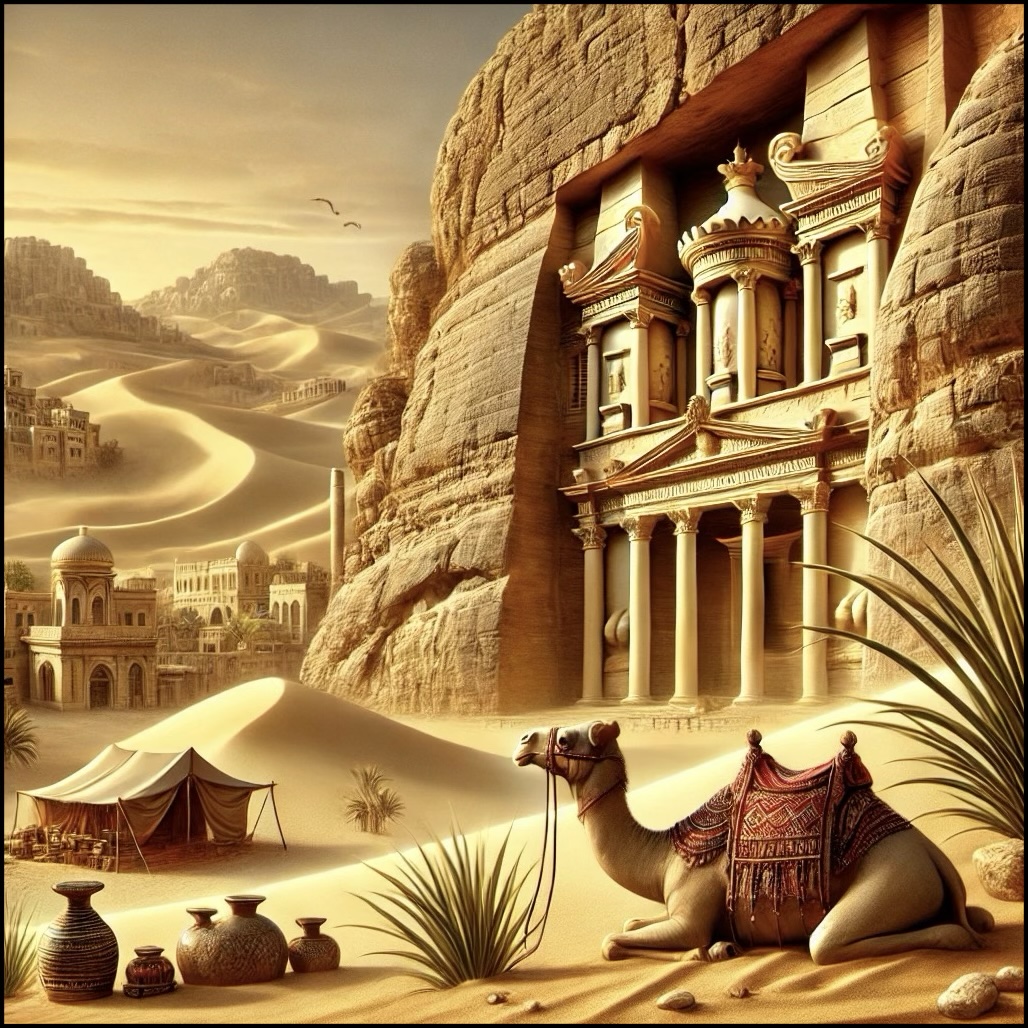
Middle East (with civilization) ©2024-25 Electric Prism, Inc. All rights reserved.
People
Groups
- Iranian peoples
- Arab people
- Kurdish people
- Oghuz Turks
- Iberia, Principate of
- Islam
- Bahrain, Province of
- Muslims, Sunni
- Armenia, Ostikanate of
- Muslims, Kharijite
- Muslims, Shi'a
- Muslims, Ibadi
- Cyprus, Roman-Abbasid condominium of
- Oman, First Imamate of
- Ismailism
- Abbasid Caliphate (Baghdad)
- Tao-Klarjeti (Georgian [Kartvelian] kingdoms and principalities)
- Samanid dynasty
- Tahirid dynasty
- Saffarid dynasty
- Qarmatians
- Iberians, Kingdom of the
- Hamdanid Dynasty
- Buyid dynasty
- Armenia, Zakarid
- Armenia, Bagratid
- Fatimid Caliphate
- Bahrain, 'Abbasid
- Georgia, (Bagratid) Kingdom of
- Mirdasid dynasty
- Uqaylid Dynasty of Tikrit
- Seljuq Empire (Neyshabur)
- Seljuq Empire (Rayy)
- Seljuq Empire (Isfahan)
- Christians, Roman Catholic
- Christians, Eastern Orthodox
- Rum, Sultanate of
- Armenia, Baronry of Little, or Lesser
- Assassins
Topics
Commodoties
- Hides and feathers
- Domestic animals
- Grains and produce
- Fibers
- Textiles
- Ceramics
- Slaves
- Money
- Manufactured goods
- Aroma compounds
- Spices
Subjects
- Commerce
- Architecture
- Watercraft
- Engineering
- Conflict
- Mayhem
- Faith
- Government
- Custom and Law
- Medicine
- Mathematics
- Astronomy
- Human Migration
Regions
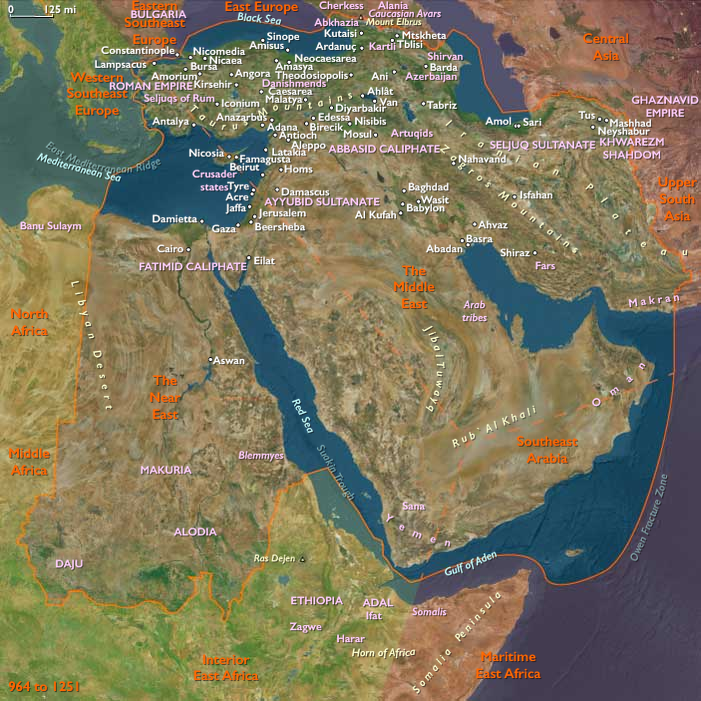
Subregions
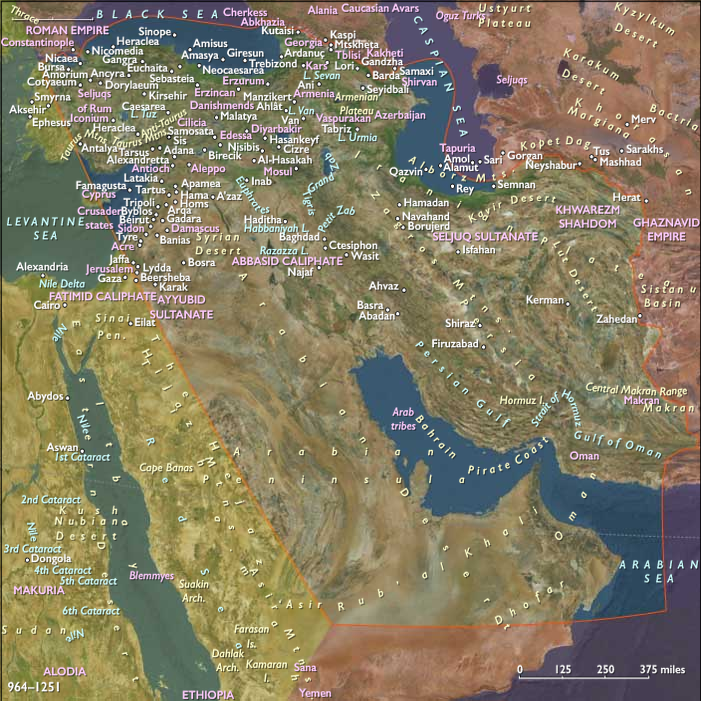
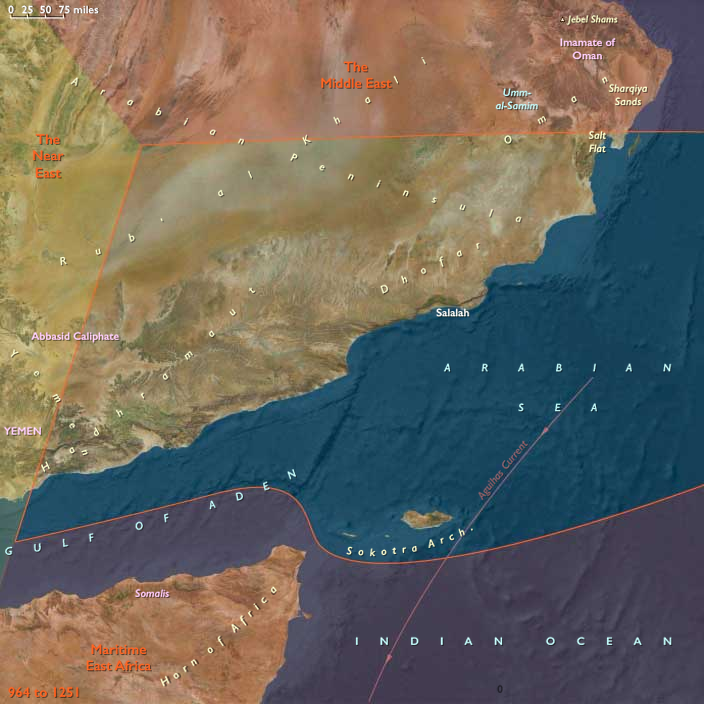
Related Events
Showing 10 events out of 52798 total
Years: 964 - 1107
Middle East (with civilization) ©2024-25 Electric Prism, Inc. All rights reserved.
People
Groups
- Iranian peoples
- Arab people
- Kurdish people
- Oghuz Turks
- Iberia, Principate of
- Islam
- Bahrain, Province of
- Muslims, Sunni
- Armenia, Ostikanate of
- Muslims, Kharijite
- Muslims, Shi'a
- Muslims, Ibadi
- Cyprus, Roman-Abbasid condominium of
- Oman, First Imamate of
- Ismailism
- Abbasid Caliphate (Baghdad)
- Tao-Klarjeti (Georgian [Kartvelian] kingdoms and principalities)
- Samanid dynasty
- Tahirid dynasty
- Saffarid dynasty
- Qarmatians
- Iberians, Kingdom of the
- Hamdanid Dynasty
- Buyid dynasty
- Armenia, Zakarid
- Armenia, Bagratid
- Fatimid Caliphate
- Bahrain, 'Abbasid
- Georgia, (Bagratid) Kingdom of
- Mirdasid dynasty
- Uqaylid Dynasty of Tikrit
- Seljuq Empire (Neyshabur)
- Seljuq Empire (Rayy)
- Seljuq Empire (Isfahan)
- Christians, Roman Catholic
- Christians, Eastern Orthodox
- Rum, Sultanate of
- Armenia, Baronry of Little, or Lesser
- Assassins
Topics
Commodoties
- Hides and feathers
- Domestic animals
- Grains and produce
- Fibers
- Textiles
- Ceramics
- Slaves
- Money
- Manufactured goods
- Aroma compounds
- Spices
Subjects
- Commerce
- Architecture
- Watercraft
- Engineering
- Conflict
- Mayhem
- Faith
- Government
- Custom and Law
- Medicine
- Mathematics
- Astronomy
- Human Migration
Regions
Subregions