
The Near and Middle East (1108 – …
Years: 1108 - 1251
The Near and Middle East (1108 – 1251 CE): Ayyubid Ascendancy and the Maritime–Steppe Crossroads
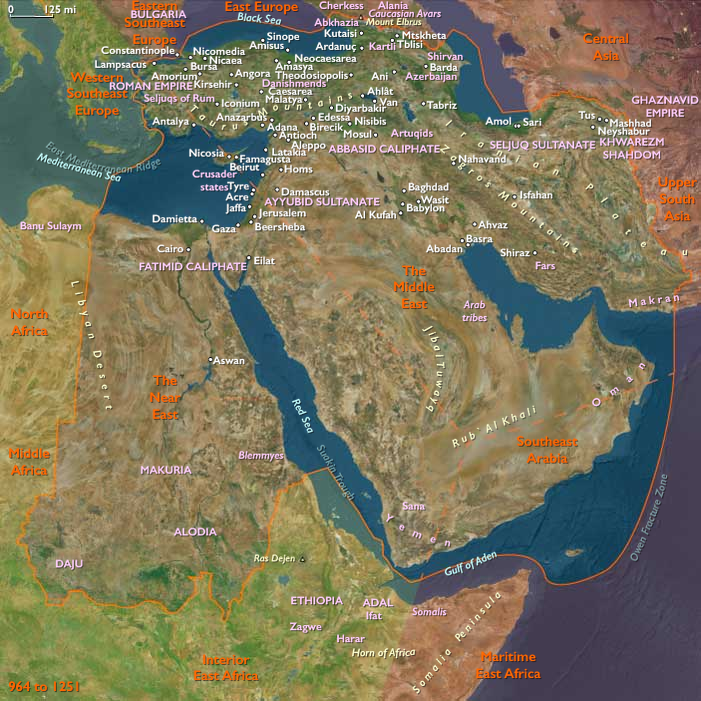
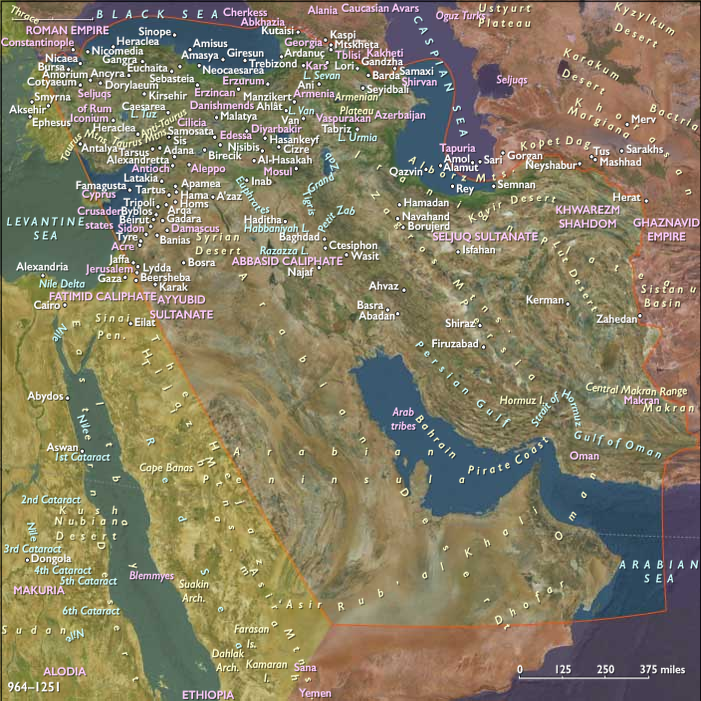
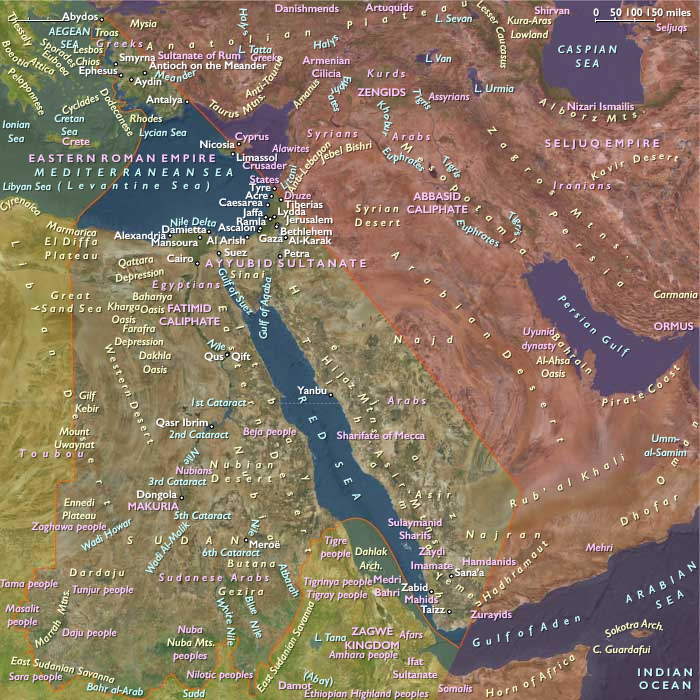
Between 1108 and 1251 CE, the Near and Middle East thrived as the crossroads of empires, faiths, and trade. From the Nile Valley and Ayyubid Syria to the Persian plateau and the Gulf, this was an age of hydraulic renewal, urban magnificence, and maritime expansion.
The Seljuk world fragmented, giving rise to local dynasties; the Ayyubids reunited Egypt and Syria under Sunni orthodoxy; the Crusader states persisted along the Mediterranean edge; and in the east, Persianate emirates and Omani ports turned trade winds into wealth.
As the Mongol storm gathered beyond the Oxus, the region balanced between consolidation and vulnerability—its cities luminous, its frontiers restless, and its sea-lanes alive with global exchange.
Geographic and Environmental Context
This broad region stretched from the Nile to the Zagros Mountains, encompassing:
-
The Tigris–Euphrates basin and Iranian plateau, where Seljuk and later Khwarazmian rule gave way to Mongol pressure.
-
The Syrian plains and Cilician uplands, where Ayyubid, Crusader, and Armenian forces vied for mastery.
-
The Caucasus, peaking under Queen Tamar’s Georgian realm, before Mongol intrusion.
-
The Hejaz and Yemen, hubs of pilgrimage and Red Sea commerce.
-
The Persian Gulf, whose ports—from Hormuz to Bahrain—channeled Indian Ocean trade.
-
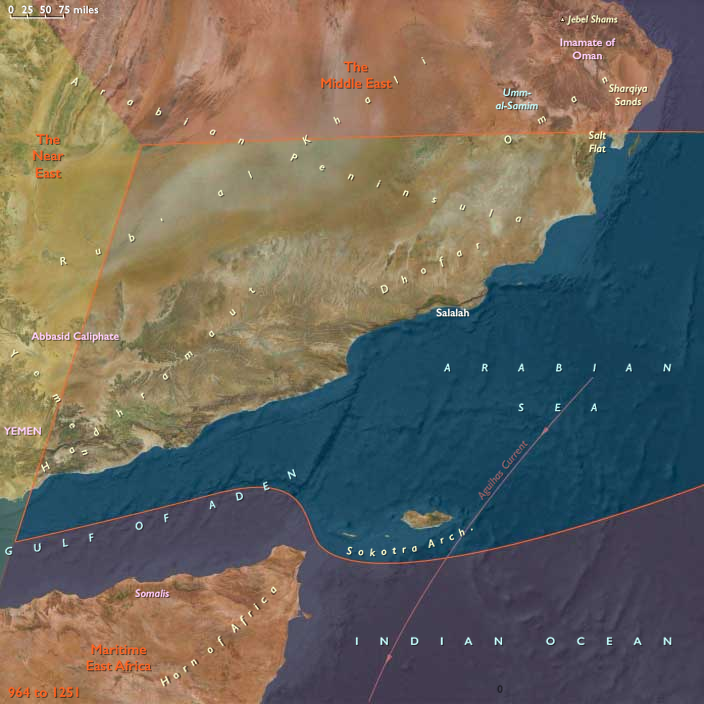
The Arabian Sea and Dhofar coast, where frankincense, pearls, and horses connected Arabia to India and Africa.
Together these lands formed an immense corridor linking the Mediterranean, Central Asia, and the Indian Ocean.
Climate and Environmental Shifts
The Medieval Warm Period provided relative climatic stability.
Rain-fed agriculture in Syria and Mesopotamia supported recovery after earlier droughts, while the Nile’s floods, though erratic, stabilized under Ayyubid hydraulic reform.
On the Iranian plateau, moderate rains supported cotton and sugar cultivation; steppe droughts occasionally pushed Turkmen tribes into Anatolia and Azerbaijan.
Along the Gulf and Arabian coasts, monsoon rhythms governed both frankincense production and maritime navigation.
This climatic equilibrium underpinned the agrarian base of empires and the steady flow of Indian Ocean trade.
Political and Cultural Developments
Ayyubid Egypt and Syria (1171–1250):
Founded by Ṣalāḥ al-Dīn (Saladin) after the fall of the Fatimids, the Ayyubid dynasty reestablished Sunni rule across Egypt, Syria, and the Hejaz.
Cairo flourished as the empire’s capital and a beacon of Islamic learning, centered on al-Azhar and new madrasas.
Damascus and Aleppo prospered under Ayyubid princes, their citadels and markets rebuilt after Crusader wars.
Saladin’s victories, culminating in Ḥaṭṭīn (1187), reshaped the Crusader world, yet truces and trade persisted through Tyre and Cyprus.
Crusader and Byzantine Frontiers:
After the Third Crusade, Tyre became the chief Latin port in the Levant, exporting glass, textiles, and Syrian grain.
In the Aegean, Byzantium’s Komnenian revival ended with the sack of Constantinople (1204), dividing the region among the Empire of Nicaea, the Latin principalities, and the Seljuks of Rum in Anatolia.
By 1251, Nicaea controlled the Ionian and Carian coasts, while Cilician Armenia, a Crusader ally, anchored the northeastern Mediterranean.
Iran and Mesopotamia:
The Great Seljuk Empire fragmented, leaving a patchwork of dynasties—Khwarazmians, Atabegs, and Zengids—across Iran and Iraq.
These states fostered trade and culture but succumbed in the 1220s–1230s to the Mongol advance.
Urban life in Tabriz, Rayy, and Baghdad reached high sophistication, supported by caravan trade and Persianate arts.
Sufi brotherhoods spread spiritual authority, softening the sectarian divides left by earlier conflicts.
Caucasus and the Iranian North:
The Christian kingdoms of Armenia and Georgia enjoyed a cultural zenith under Queen Tamar (r. 1184–1213), their art and architecture blending Byzantine and Persian influences.
The Mongols’ westward thrust would soon eclipse these mountain states, but in this age they bridged Christian, Islamic, and steppe worlds.
Southeast Arabia and the Gulf:
In Oman and eastern Yemen, the Sulayhid and later Ayyubid influence fostered prosperity through trade.
Dhofar’s frankincense groves supplied global demand, while ports such as Qalhat, Suḥar, and Hormuz linked the Gulf with India and Africa.
Socotra, at the Arabian Sea’s nexus, hosted mixed Christian, Muslim, and local communities, serving as a vital provisioning and resupply point for monsoon shipping.
Economy and Trade
The Near and Middle East in this period was the keystone of Eurasian commerce:
-
Agriculture: The Tigris–Euphrates and Nile valleys produced grain, flax, sugar, and dates; Iranian cotton and silk enriched export markets.
-
Crafts and industries: Damascus steel, Mosul textiles, and Tabriz ceramics were prized globally.
-
Caravan routes: Tabriz ⇄ Rayy ⇄ Baghdad ⇄ Aleppo carried silks, spices, and books.
-
Maritime trade: Indian pepper, Chinese porcelain, and East African ivory reached Hormuz and Aden, thence to Cairo via the Red Sea or overland through Basra.
-
Pearls and horses were exported from the Gulf; frankincense, ambergris, and dates from Arabia; glassware, paper, and sugar from Syria and Egypt.
-
Cyprus and Tyre mediated between Muslim and Latin worlds, exporting Mediterranean wine and timber in return for eastern luxuries.
This dense network of caravan and sea routes integrated the region into both the Indian Ocean and Silk Road economies.
Subsistence, Technology, and Urban Life
-
Hydraulic systems: Ayyubid engineers dredged Nile canals, built new barrages, and extended Yemen’s terraced irrigation.
-
Architecture: Cairo’s citadel and madrasas, Aleppo’s fortifications, and Hormuz’s early port defenses reflect Ayyubid and Persian ingenuity.
-
Shipbuilding: Omani and Yemeni shipwrights refined sewn-plank dhows; Syrian and Nicaean fleets used lateen-rigged galleys for trade and war.
-
Crafts: Metalwork, bookbinding, and textile arts reached new sophistication; paper mills multiplied across Syria and Iran.
-
Science and learning: Scholars like al-Qifti and Ibn al-Nafis contributed to medicine and philosophy; Sufi orders expanded literacy beyond courts.
Belief and Symbolism
Religion was both unifying and plural:
-
Sunni Islam reasserted dominance under the Ayyubids, who patronized scholars and Sufis.
-
Shi‘i communities endured in the Gulf, Bahrain, and southern Iran.
-
Ibāḍī Oman preserved a distinctive Islamic school emphasizing communal autonomy.
-
Christianity persisted in Coptic Egypt, Nubia, Armenia, and Georgia, while Latin and Greek rites coexisted uneasily in Crusader Cyprus and Tyre.
-
Judaism remained vibrant in Cairo and Baghdad, tied to long-distance finance.
Across faiths, pilgrimage and devotion sustained exchange: Hajj caravans across the Hejaz, monastic journeys in Armenia and Georgia, and Sufi circuits from Khurasan to Damascus.
Adaptation and Resilience
-
Hydraulic reconstruction in Egypt restored agrarian surplus.
-
Maritime redundancy—through Tyre, Cyprus, Aden, and Hormuz—ensured trade continued despite Crusades and shifting powers.
-
Cultural pluralism and flexible governance stabilized multiethnic societies.
-
Desert and mountain autonomy (Bedouin and Kurdish) provided safety valves against imperial overreach.
-
Monsoon rhythms tied the Gulf and Red Sea to the Indian Ocean’s stable seasonal exchange, buffering inland volatility.
These systems gave the Near and Middle East unusual resilience, allowing prosperity even amid political fragmentation.
Long-Term Significance
By 1251 CE, the Near and Middle East was an interconnected lattice of cities, faiths, and markets:
-
Cairo was the intellectual and commercial heart of the Islamic world.
-
Damascus and Aleppo linked Egypt and Mesopotamia through Ayyubid unity.
-
Hormuz, Qalhat, and Dhofar commanded Indian Ocean trade.
-
Tyre and Cyprus balanced Crusader and Ayyubid economies.
-
Armenia, Georgia, and Nicaea stood as cultural highlands between Islam and Christendom.
The region’s syncretic architecture, shared scholarship, and overlapping networks of caravan and sea laid the foundations for the Mongol–Mamluk–Ilkhanid realignments that would redefine Eurasia in the later 13th century.
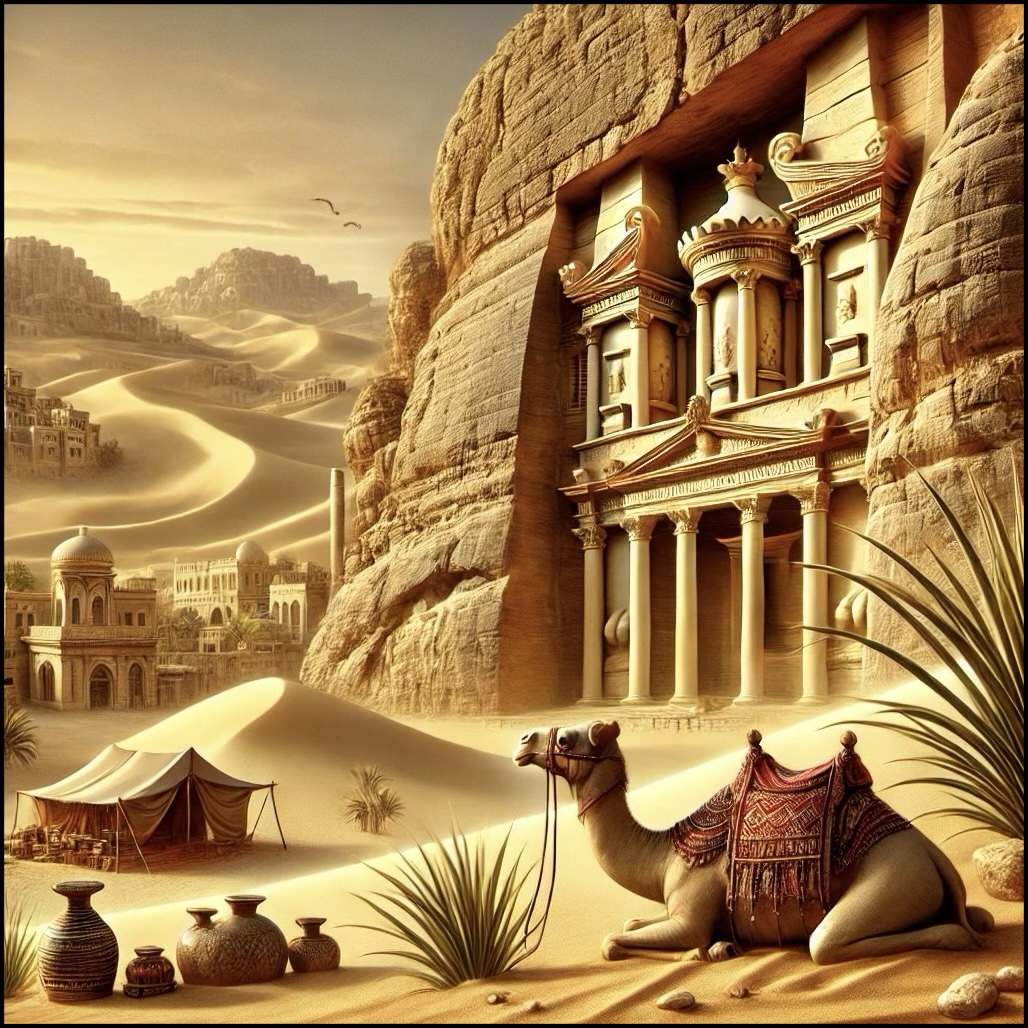
Middle East (with civilization) ©2024-25 Electric Prism, Inc. All rights reserved.
People
Groups
- Iranian peoples
- Arab people
- Persian people
- Armenian people
- Khwarezm
- Islam
- Muslims, Sunni
- Muslims, Kharijite
- Muslims, Shi'a
- Sufism
- Muslims, Ibadi
- Abbasid Caliphate (Baghdad)
- Bahrain, 'Abbasid
- Georgia, (Bagratid) Kingdom of
- Seljuq Empire (Isfahan)
- Christians, Eastern Orthodox
- Christians, Roman Catholic
- Danishmends
- Melitene, Danishmendid Emirate of
- Uyunid dynasty
- Khwarezm dynasty
- Rum, Sultanate of
- Armenia, Baronry of Little, or Lesser
- Roman Empire, Eastern: Komnenos dynasty, restored
- Artuquids
- Edessa, County of
- Antioch, Principality of
- Jerusalem, Latin Kingdom of
- Artuqid dynasty of Hasankeyf
- Artuqid dynasty of Mardin
- Seljuq Empire, Western capital
- Seljuq Empire, Eastern capital
- Georgia, (Bagratid) Kingdom of
- Mongols
- Zengid dynasty
- Zengid dynasty of al-Jazirah
- Zengid dynasty of Syria
- Zengid dynasty of Sinjar
- Egypt, Ayyubid Sultanate of
- Roman Empire, Eastern: Angelid dynasty
- Armenia, Baronry of Little, or Lesser
- Armenian Kingdom of Cilicia, or Little Armenia
- Mongol Empire
- Khwarezm dynasty
- Khwarezm dynasty
- Khwarezmians
- Khwarezm dynasty
Topics
- Medieval Warm Period (MWP) or Medieval Climate Optimum
- Georgian Golden Age
- Crusades, The
- Crusade, Second
- Myriokephalon, Battle of
- Crusade, Third
- Genghis Khan, Conquests of
- Mongol invasion of Khwarezmia and Eastern Iran
- Mongol Invasions of Georgia and Armenia
Commodoties
- Gem materials
- Domestic animals
- Grains and produce
- Fibers
- Textiles
- Ceramics
- Strategic metals
- Manufactured goods
Subjects
Regions
Subregions
Years: 1108 - 1251
Middle East (with civilization) ©2024-25 Electric Prism, Inc. All rights reserved.
People
Groups
- Iranian peoples
- Arab people
- Persian people
- Armenian people
- Khwarezm
- Islam
- Muslims, Sunni
- Muslims, Kharijite
- Muslims, Shi'a
- Sufism
- Muslims, Ibadi
- Abbasid Caliphate (Baghdad)
- Bahrain, 'Abbasid
- Georgia, (Bagratid) Kingdom of
- Seljuq Empire (Isfahan)
- Christians, Eastern Orthodox
- Christians, Roman Catholic
- Danishmends
- Melitene, Danishmendid Emirate of
- Uyunid dynasty
- Khwarezm dynasty
- Rum, Sultanate of
- Armenia, Baronry of Little, or Lesser
- Roman Empire, Eastern: Komnenos dynasty, restored
- Artuquids
- Edessa, County of
- Antioch, Principality of
- Jerusalem, Latin Kingdom of
- Artuqid dynasty of Hasankeyf
- Artuqid dynasty of Mardin
- Seljuq Empire, Western capital
- Seljuq Empire, Eastern capital
- Georgia, (Bagratid) Kingdom of
- Mongols
- Zengid dynasty
- Zengid dynasty of al-Jazirah
- Zengid dynasty of Syria
- Zengid dynasty of Sinjar
- Egypt, Ayyubid Sultanate of
- Roman Empire, Eastern: Angelid dynasty
- Armenia, Baronry of Little, or Lesser
- Armenian Kingdom of Cilicia, or Little Armenia
- Mongol Empire
- Khwarezm dynasty
- Khwarezm dynasty
- Khwarezmians
- Khwarezm dynasty
Topics
- Medieval Warm Period (MWP) or Medieval Climate Optimum
- Georgian Golden Age
- Crusades, The
- Crusade, Second
- Myriokephalon, Battle of
- Crusade, Third
- Genghis Khan, Conquests of
- Mongol invasion of Khwarezmia and Eastern Iran
- Mongol Invasions of Georgia and Armenia
Commodoties
- Gem materials
- Domestic animals
- Grains and produce
- Fibers
- Textiles
- Ceramics
- Strategic metals
- Manufactured goods
Subjects
Regions
Subregions