
Middle Africa (1828–1971 CE): Abolition, Partition, Extraction, …
Years: 1828 - 1971
Middle Africa (1828–1971 CE): Abolition, Partition, Extraction, and Independence
Geographic & Environmental Context
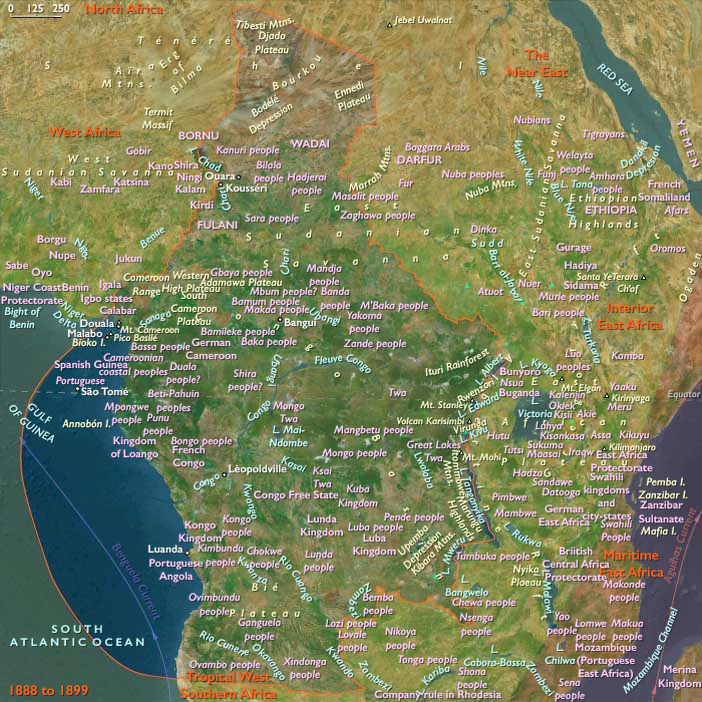
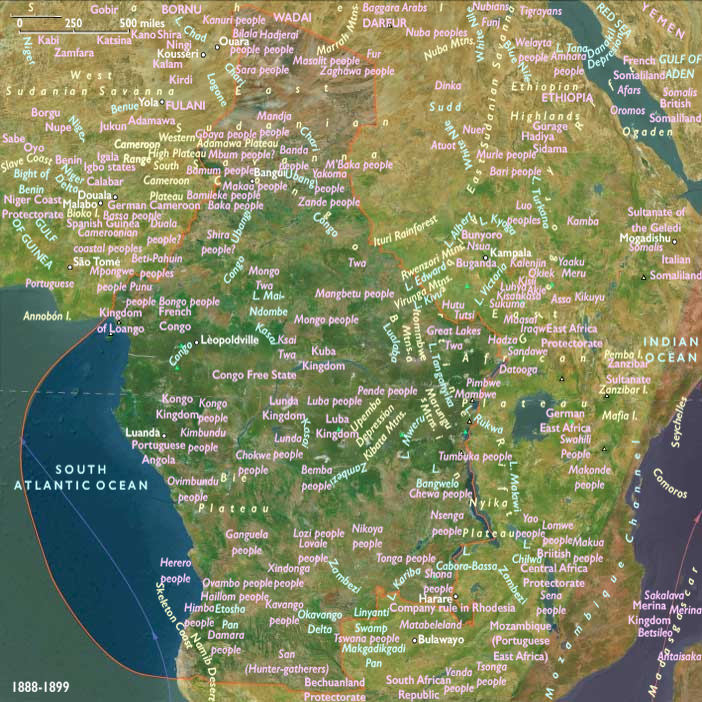
The subregion of Middle Africa includes Chad, the Central African Republic, Cameroon, Equatorial Guinea, São Tomé and Príncipe, Gabon, the Republic of the Congo, the Democratic Republic of the Congo, and Angola.Anchors included the Congo–Kasai–Ubangi river system and ports (Matadi, Léopoldville/Kinshasa, Brazzaville), the Atlantic harbors of Luanda, Lobito, Pointe-Noire, Libreville, Douala, the Cameroon Highlands and forest massifs, the northern savanna and Lake Chad basin, and the Gulf of Guinea islands (São Tomé, Príncipe, Bioko). From equatorial rainforest to Sahelian margin, the region’s corridors were re-engineered by abolition’s aftermath, the Scramble for Africa, and 20th-century state formation.
Climate & Environmental Shifts
With the retreat of the Little Ice Age, rainfall belts oscillated. Congo basin forests stayed humid, but dry-season length varied by decade; high river years expanded floodplain farming yet raised erosion risk. The Lake Chad basin swung between flood and shrinkage pulses (notably late 1960s drought). Along the Atlantic, heavy rains alternated with stormy seasons that reshaped estuaries and mangroves. Logging, plantation clearance, and later oil extraction intensified local micro-climate and watershed stress.
Subsistence & Settlement
Abolition redirected labor from slave corridors to plantations, mines, and ports.
-
Forest and riverine belts: Cassava (by now a staple famine reserve), plantain/banana, yam, taro, maize, oil palm, groundnuts, and beans anchored household nutrition; fishing and smoked/dried fish stores remained vital. Cocoa and coffee spread in Cameroon, Gabon, and on São Tomé and Príncipe, where plantation monoculture dominated.
-
Savanna and Lake Chad: Millet, sorghum, rice, and cattle herding persisted, with recession farming along floodplains.
-
Urbanization: Port and rail towns (Douala, Pointe-Noire, Libreville, Léopoldville/Kinshasa, Brazzaville, Luanda) expanded around docks, depots, and workshops; mining towns rose in Katanga (copper, cobalt), Kasai (diamonds), and the Angolan interior (iron, diamonds).
Technology & Material Culture
Colonial regimes laid railways that reoriented trade: the Congo–Ocean Railway (1921–1934) to Pointe-Noire; the Benguela Railway linking Katanga to Lobito; Douala–Nkongsamba and other lines in Cameroon. River steamers, dredged channels, and ports (Matadi, Boma) integrated the Congo corridor with the Atlantic. Concession companies built mills for palm oil, timber yards, and mining plants; mission presses, schools, and clinics proliferated. Forced-labor systems supplied roads, rails, and estates—prestations in French Equatorial Africa, contract labor and chibalo in Portuguese Angola, with coerced migration to São Tomé and Príncipe cocoa roças (sparking early 1900s boycotts). Household craft and market production—blacksmithing, weaving, pottery, canoe carpentry—adapted to cash economies; urban workshops forged a new artisanal landscape.
Movement & Interaction Corridors
-
River and rail grids funneled palm products, timber, copper/cobalt, diamonds, and cocoa to Atlantic ports.
-
Atlantic lanes connected Luanda, Lobito, Pointe-Noire, Douala, Libreville, and São Tomé with Lisbon, Antwerp, Marseille, and later New York.
-
Labor migrations moved workers from savannas to mines, plantations, and docks; seasonal and contract flows tied the Lake Chad fringe to forest and port towns.
-
Mission and medical circuits (sleeping-sickness campaigns) penetrated deep inland. Late in the period, roads and airstrips extended state reach; large projects (e.g., Inga on the lower Congo, planned in the 1960s) heralded hydro-modernity at decade’s end.
Cultural & Symbolic Expressions
Mission Christianity spread schooling, print, and new associational life; prophetic and African-initiated churches transformed religious landscapes—Kimbanguism (founded 1921) in the lower Congo became a mass church by mid-century; later Angolan movements (e.g., Tokoist strands) blended biblical and local idioms. Urban music and dance forged modern publics: Congolese rumba/soukous, Cameroonian makossa, Angolan semba, all carried ngoma drum lineages into amplified nightlife. Writers (e.g., Ferdinand Oyono, Mongo Beti) and painters chronicled colonial contradiction. Court and village arts endured—masks, nkisi figures, raffia and cotton textiles—now circulating through markets and museums alike.
Environmental Adaptation & Resilience
Households hedged risk with multicropping (cassava as standing reserve), compound gardens, and fish smoking/drying. Forest communities rotated fields and protected sacred groves; savanna herders shifted grazing with the rains; floodplain cultivators followed river pulses. During epidemics and forced labor drives, kin networks rehomed dependents; mutual-aid societies, mission parishes, and later unions buffered shocks. Conservation began as colonial game reserves and national parks (e.g., Odzala 1930s) and post-colonial protected areas; fisheries and forest regulations emerged unevenly under pressure from urban markets.
Technology & Power Shifts (Conflict & Polity Dynamics)
The Atlantic slave trade collapsed, but concessionary regimes (rubber, ivory) in the Congo Free State (1885–1908)produced catastrophic violence—amputation terror and demographic collapse—before annexation as the Belgian Congo. France consolidated French Equatorial Africa; Germany took Kamerun (later partitioned to France/Britain after World War I); Spain held Equatorial Guinea; Portugal deepened rule in Angola and on São Tomé and Príncipe. After 1945, anticolonial nationalism surged: strikes, student leagues, churches, and cultural clubs nurtured parties and fronts.
Key turning points:
-
Congo–Léopoldville independence (1960): crisis—Patrice Lumumba, Katanga secession (1960–1963), UN intervention, and the 1965 coup by Joseph-Désiré Mobutu; the country was renamed Zaire in 1971.
-
Congo–Brazzaville, Gabon, Chad, Central African Republic, Cameroon: 1960 independence, followed by one-party consolidations and, in places, insurgencies (UPC in Cameroon; conflict in Chad from 1965).
-
Equatorial Guinea: independence (1968), authoritarian turn under Francisco Macías Nguema.
-
Angola: anticolonial war from 1961 (MPLA, FNLA, UNITA), still under Portuguese rule within our span.
-
São Tomé and Príncipe: plantations persisted under Portugal; independence would follow after 1971.
Transition
By 1971 CE, Middle Africa had traversed coerced extraction, partition, and a turbulent decolonization. New states—Cameroon (federation of 1961), Congo-Brazzaville, Gabon, Chad, the Central African Republic, Equatorial Guinea, and Zaire—stood astride river and rail grids built for export, now reimagined for nation-building. Angola fought a widening independence war; São Tomé and Príncipe remained under plantation rule; Gabon entered an oil economy; Kinshasa’s rumba and Brazzaville’s dance bands broadcast urban modernities from riverbanks to continents. Beneath the rush of copper and oil, timber and cocoa, household multicropping, river fisheries, and kin solidarities still sustained everyday life—resilient repertoires forged across forests and floodplains, now tasked with the work of sovereignty.
People
- Agostinho Neto
- Ahmadou Ahidjo
- Alphonse Massamba-Débat
- Barthélemy Boganda
- David Dacko
- Ernest Ouandié
- Francisco Macías Nguema
- François Tombalbaye
- Fulbert Youlou
- Félix-Roland Moumié
- Gabriel Lisette
- Henry Morton Stanley
- Holden Roberto
- Jean-Bédel Bokassa
- Jean-Hilaire Aubame
- Jonas Savimbi
- Joseph Kasa-Vubu
- Leopold II of Belgium
- Léon M'ba
- Marien Ngouabi
- Mobutu Sese Seko
- Moise Tshombe
- Mário Pinto de Andrade
- Omar Bongo
- Patrice Lumumba
- Pierre Ryckmans
- Pierre Savorgnan de Brazza
- Rabih az-Zubayr
- Ruben Um Nyobè
Groups
- Luba people
- Kongo people
- Ovimbundu
- Kongo, Kingdom of
- Lunda people
- Chokwe people
- Portuguese Empire
- São Tomé and Príncipe, Portuguese
- Spanish Empire
- Bagirmi, Sultanate of
- Luba, Kingdom of
- Wadai Empire
- Lunda, Kingdom of
- Spanish Guinea
- Spain, Bourbon Kingdom (first restoration) of
- Bornu, Kingdom of
- France, constitutional monarchy of
- German Confederation
- Belgium, Kingdom of
- Bornu, Sultanate of
- France, Second Republic of
- France, Second Empire of
- Spain, Regency of
- German Empire (“Second Reich”)
- France (French republic); the Third Republic
- Spain, Bourbon Kingdom (second restoration) of
- Congo, French
- Congo Free State (King Leopold's Congo)
- Portuguese West Africa (Angola)
- Chad, French
- French West Africa
- Congo, Middle
- Belgian Congo
- French Equatorial Africa
- Gabon, French territory of
- Ubangi-Shari, French territory of
- Middle Congo, French territory of
- Kamerun
- Cameroons, British
- Germany, Weimar Republic of
- French Cameroun
- Portugal, (Second) Republic of
- Britain (United Kingdom of Great Britain and Northern Ireland)
- Spain (Spanish Republic, Second)
- Germany, Third Reich
- Spain, Franconian Regency of (Spanish State)
- France, Free
- France (French republic); the Fourth Republic
- FNLA (National Liberation Front of Angola)
- MPLA (People's Movement for the Liberation of Angola)
- France (French republic); the Fifth Republic
- Cameroon, Republic of
- Congo, Republic of the (Lèopoldville)
- Gabon (Gabonese Republic)
- Congo, (restored) Republic of the
- Chad, Republic of
- Central African Republic
- Congo, Democratic Republic of the
- UNITA (National Union for the Total Independence of Angola)
- Equatorial Guinea, Republic of
- Zaire, Republic of
Topics
- Colonization of Africa, German
- Kousséri, Battle of
- Cold War
- Angolan War of Independence
- Katanga Revolt: Congo
Commodoties
Subjects
Regions
Subregions
Years: 1828 - 1971
People
- Agostinho Neto
- Ahmadou Ahidjo
- Alphonse Massamba-Débat
- Barthélemy Boganda
- David Dacko
- Ernest Ouandié
- Francisco Macías Nguema
- François Tombalbaye
- Fulbert Youlou
- Félix-Roland Moumié
- Gabriel Lisette
- Henry Morton Stanley
- Holden Roberto
- Jean-Bédel Bokassa
- Jean-Hilaire Aubame
- Jonas Savimbi
- Joseph Kasa-Vubu
- Leopold II of Belgium
- Léon M'ba
- Marien Ngouabi
- Mobutu Sese Seko
- Moise Tshombe
- Mário Pinto de Andrade
- Omar Bongo
- Patrice Lumumba
- Pierre Ryckmans
- Pierre Savorgnan de Brazza
- Rabih az-Zubayr
- Ruben Um Nyobè
Groups
- Luba people
- Kongo people
- Ovimbundu
- Kongo, Kingdom of
- Lunda people
- Chokwe people
- Portuguese Empire
- São Tomé and Príncipe, Portuguese
- Spanish Empire
- Bagirmi, Sultanate of
- Luba, Kingdom of
- Wadai Empire
- Lunda, Kingdom of
- Spanish Guinea
- Spain, Bourbon Kingdom (first restoration) of
- Bornu, Kingdom of
- France, constitutional monarchy of
- German Confederation
- Belgium, Kingdom of
- Bornu, Sultanate of
- France, Second Republic of
- France, Second Empire of
- Spain, Regency of
- German Empire (“Second Reich”)
- France (French republic); the Third Republic
- Spain, Bourbon Kingdom (second restoration) of
- Congo, French
- Congo Free State (King Leopold's Congo)
- Portuguese West Africa (Angola)
- Chad, French
- French West Africa
- Congo, Middle
- Belgian Congo
- French Equatorial Africa
- Gabon, French territory of
- Ubangi-Shari, French territory of
- Middle Congo, French territory of
- Kamerun
- Cameroons, British
- Germany, Weimar Republic of
- French Cameroun
- Portugal, (Second) Republic of
- Britain (United Kingdom of Great Britain and Northern Ireland)
- Spain (Spanish Republic, Second)
- Germany, Third Reich
- Spain, Franconian Regency of (Spanish State)
- France, Free
- France (French republic); the Fourth Republic
- FNLA (National Liberation Front of Angola)
- MPLA (People's Movement for the Liberation of Angola)
- France (French republic); the Fifth Republic
- Cameroon, Republic of
- Congo, Republic of the (Lèopoldville)
- Gabon (Gabonese Republic)
- Congo, (restored) Republic of the
- Chad, Republic of
- Central African Republic
- Congo, Democratic Republic of the
- UNITA (National Union for the Total Independence of Angola)
- Equatorial Guinea, Republic of
- Zaire, Republic of
Topics
- Colonization of Africa, German
- Kousséri, Battle of
- Cold War
- Angolan War of Independence
- Katanga Revolt: Congo
Commodoties
Subjects
Regions
Subregions