
Middle Africa (1876–1887 CE): Portuguese Claims, European …
Years: 1876 - 1887
Middle Africa (1876–1887 CE): Portuguese Claims, European Partition, and Intensified Slave Trade
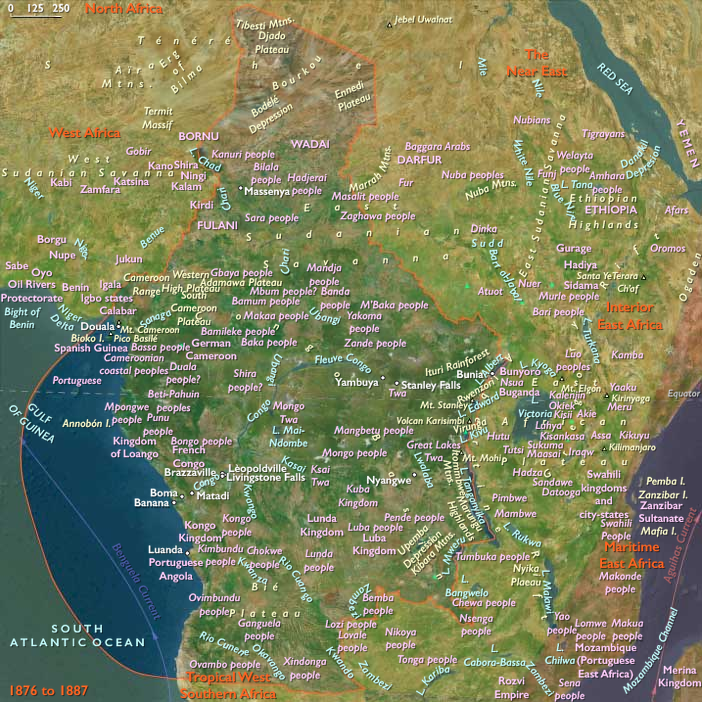
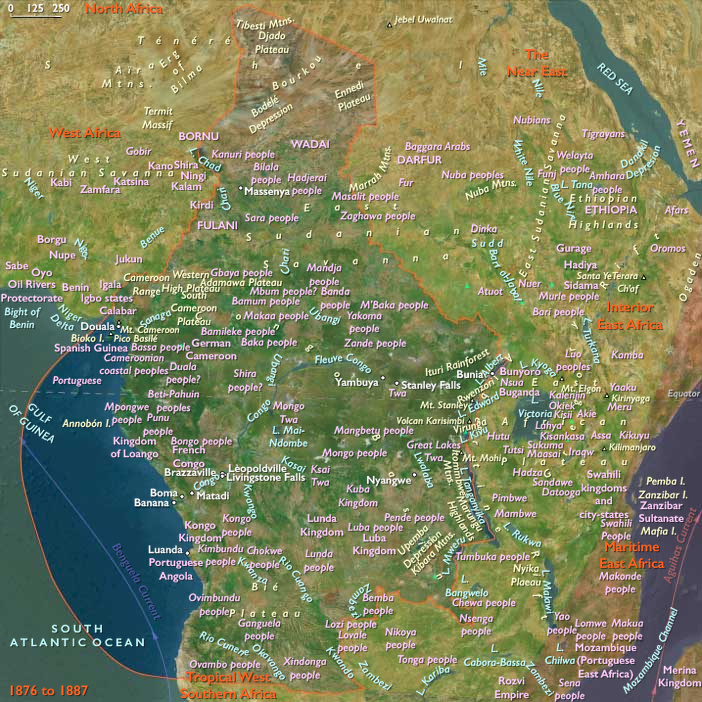
Between 1876 and 1887 CE, Middle Africa—covering modern Chad, Cameroon, Central African Republic, Equatorial Guinea, São Tomé and Príncipe, Gabon, Republic of the Congo, Democratic Republic of the Congo (DRC), and Angola (including its Cabinda enclave)—experiences intensified European colonial ambitions, extensive disruptions from slave-trading activities, and the early stages of partitioning by European powers.
Portuguese Claims and the Berlin Conference
In 1883, aware of competing French and Belgian activities along the lower Congo River, Portugal occupies Cabinda and Massabi, asserting longstanding territorial claims north of the Congo River and annexing areas of the former Kongo Kingdom. Portugal seeks international recognition by negotiating a treaty with Britain in 1884, but this agreement is rejected by other European powers, especially France and Belgium.
Portugal's appeals for an international conference initially find little support. However, German Chancellor Otto von Bismarck seizes upon this idea, aiming to diminish French and British colonial dominance. Consequently, the pivotal Berlin Conference (1884–1885) convenes, profoundly impacting Central African geopolitics. At the conference, Belgium’s King Leopold II gains recognition for his privately controlled International Association of the Congo, subsequently establishing the Congo Free State. This territory, officially neutral and open to free trade, is in reality subjected to Leopold’s brutal exploitation in the following decades.
German Establishment in Kamerun
Germany formalizes its presence in Central Africa during this era. In 1884, Chancellor Otto von Bismarck, influenced by merchant Adolph Woermann, dispatches the gunboat SMS Möwe to protect German trading interests at Douala, laying foundations for the colony of Kamerun. Prominent German firms—including Woermann and Jantzen & Thormählen—establish expansive trading networks and plantations, notably cultivating bananas and other export crops. The administration supports commercial interests by suppressing local uprisings, as Germany aspires to link Kamerun to its East African territories through the Congo region.
French Expansion in Gabon and the Congo
French explorers, notably Pierre Savorgnan de Brazza, significantly expand French influence during this period. Brazza, guided by Gabonese bearers, explores the upper reaches of the Congo River, securing treaties and establishing strategic posts. In 1880, Brazza negotiates a treaty with King Makoko of the Bateke, formally establishing the French Congo colony in 1882, with Franceville founded as an important regional center. By 1885, France officially occupies Gabon, though full administrative control will be delayed until the early twentieth century.
Devastating Slave Trade in the Central African Interior
The late nineteenth century witnesses intensified slave-raiding activities in the present-day Central African Republic and surrounding regions. Slave traders from the Sahara, the Nile Basin, and Arab-led expeditions disrupt local societies severely. The Bobangi people, controlling slave trade along the upper Congo and Ubangi rivers, dominate commerce, selling captives primarily to the Americas. The widespread use of the Bangi language emerges to facilitate interethnic commerce throughout the Congo Basin.
Slave raiders from the Sudanese states of Wadai and Darfur, along with Khartoum-based armies under leaders like Rabih al-Zubayr, decimate populations such as the Banda people. Raids, warfare, and forced migrations profoundly disrupt indigenous societies, with extensive population losses caused directly by slavery and related conflicts.
Azande Expansion and Fragmentation
The Azande people, emerging from the merging of the Bandia and Vungara peoples, continue their territorial expansion across the southeastern savannas of present-day Central African Republic and neighboring regions. Succession struggles among Azande rulers drive defeated contenders to establish new kingdoms, facilitating their spread northward and eastward. By the late nineteenth century, Azande territories become fragmented by slave raids from the north, and soon thereafter, colonial boundaries established by Belgium, France, and the Anglo-Egyptian Sudan permanently divide Azande society.
Luba Instability and Chokwe Expansion
By the late nineteenth century, the Luba Kingdom experiences severe internal instability due to continual dynastic conflicts. The absence of stable succession mechanisms weakens the Luba monarchy significantly, facilitating invasions by the aggressive and militarily superior Chokwe people. Armed with firearms and driven by the lucrative trade in slaves, ivory, wax, and later rubber, Chokwe warriors conquer and occupy extensive Luba territories, spreading turmoil across the central savannas.
The Chokwe quickly absorb conquered populations, integrating them into their existing social structure, thereby rapidly expanding their influence. However, by the end of the century, the Chokwe will be pushed back by resilient Lunda forces.
Multicultural Development in Fernando Pó
On Spanish-controlled Fernando Pó (now Bioko), significant administrative and social changes take place. Following recommendations to move settlements to higher elevations to reduce tropical disease exposure, by 1884 major plantations and administrative functions have relocated to Basile, several hundred meters above sea level. This move greatly improves survival rates for Europeans and other settlers. The island continues to host a vibrant, multicultural community of Creoles, Africans, and exiled Europeans, enhancing its distinctive cultural landscape.
Lasting Consequences of the Era
Between 1876 and 1887, the foundations of European colonial empires in Central Africa are decisively laid, accompanied by severe disruptions from intensified slave raiding and interethnic warfare. European competition and the outcomes of the Berlin Conference reshape the geopolitical landscape profoundly, setting the stage for the colonial era that will dominate the region well into the twentieth century.
People
Groups
- Teke people
- Luba people
- Chokwe people
- Portuguese Empire
- Spanish Empire
- Angola (Portuguese colony)
- Luba, Kingdom of
- Portugal, Bragança Kingdom of
- Bobangi people
- Azande peple
- Sierra Leone, British Colony of
- Hamburg, Free and Hanseatic City of
- Spain, Bourbon Kingdom (first restoration) of
- Sudan, Turco-Egyptian
- Belgium, Kingdom of
- Liberia, Republic of
- France (French republic); the Third Republic
- German Empire (“Second Reich”)
- International Association of the Congo
- Congo, French
- Kamerun
- Congo Free State (King Leopold's Congo)
Topics
Commodoties
Subjects
Regions
Subregions
Related Events
Showing 10 events out of 12322 total
Years: 1876 - 1887
People
Groups
- Teke people
- Luba people
- Chokwe people
- Portuguese Empire
- Spanish Empire
- Angola (Portuguese colony)
- Luba, Kingdom of
- Portugal, Bragança Kingdom of
- Bobangi people
- Azande peple
- Sierra Leone, British Colony of
- Hamburg, Free and Hanseatic City of
- Spain, Bourbon Kingdom (first restoration) of
- Sudan, Turco-Egyptian
- Belgium, Kingdom of
- Liberia, Republic of
- France (French republic); the Third Republic
- German Empire (“Second Reich”)
- International Association of the Congo
- Congo, French
- Kamerun
- Congo Free State (King Leopold's Congo)
Topics
Commodoties
Subjects
Regions
Subregions