Michael’s son Theophilos, crowned as co-emperor in …
Years: 829 - 829
Michael’s son Theophilos, crowned as co-emperor in 820, had shortly thereafter married a beauty, Theodora, chosen from a group of candidates.
Liberally educated by the scholar and ardent Iconoclast John Philoponus, Theophilos is also much influenced by the learned court of the famous Caliph Harun ar-Rashid of Baghdad, whose long rein had ended twenty years earlier.
On becoming sole emperor at sixteen upon the death of his father in October 829, he emulates Harun ar-Rashid by wandering about the capital informally, listening to his subjects' complaints.
Locations
People
Groups
- Greeks, Medieval (Byzantines)
- Abbasid Caliphate (Baghdad)
- Roman Empire, Eastern: Phrygian or Armorian dynasty
Topics
Subjects
Regions
Subregions
Related Events
Filter results
Showing 10 events out of 54375 total
The Khazar Khaganate at its height is an immense and powerful state.
The Khazaria heartland is the lower Volga and the Caspian coast as far south as Derbent.
Khazar dominion over most of the Crimea and the northeast littoral of the Black Sea dates from the late seventh century.
By 800, Khazar holdings included most of the Pontic steppe as far west as the Dnieper River and as far east as the Aral Sea (some Turkic history atlases show the Khazar sphere of influence extending well east of the Aral).
During the Arab–Khazar war of the early eighth century, some Khazars had evacuated to the foothills of the Ural Mountains, and some settlements may have remained.
For a century and a half, the Khazars have ruled the southern half of Eastern Europe and present a bulwark blocking the Ural-Caspian gateway from Asia into Europe, while serving as a major artery of commerce between northern Europe and southwestern Asia along the Silk Road.
Their territory comprises much of modern-day southern European Russia, western Kazakhstan, eastern Ukraine, Azerbaijan, large portions of the northern Caucasus (Circassia, Dagestan), parts of Georgia, the Crimea, and northeastern Turkey.
Various place names invoking Khazar persist today.
The Caspian Sea, traditionally known as the Hyrcanian Sea and Mazandaran Sea in Persian, is still known to Muslims as the 'Khazar Sea' (Bahr ul-Khazar).
Many other cultures still use the name "Khazar Sea".
In Hungary, there are villages (and people with family names) called Kozár and Kazár.
At the peak of their empire, the Khazar permanent standing army may have numbered as many as one hundred thousand, controlling or exacting tribute from thirty different nations and tribes inhabiting the vast territories between the Caucasus, the Aral Sea, the Ural Mountains, and the Ukrainian steppes.
Khazar armies were led by the Khagan Bek and commanded by subordinate officers known as tarkhans.
When the bek sent out a body of troops, they would not retreat under any circumstances.
If they were defeated, every one who returned was killed.
Bulan was a Khazar king who led the conversion of the Khazars to Judaism.
The date of his reign is unknown, as the date of the conversion is hotly disputed, though it is certain that Bulan reigned some time between the mid-700s and the mid-800s.
Nor is it settled whether Bulan was the Bek or the Khagan of the Khazars.
D. M. Dunlop was certain that Bulan was a Khagan; however, more recent works, such as The Jews of Khazaria by Kevin Brook, assume that he was the Bek due to references to him leading military campaigns.
Khazar tradition held that before his own conversion, Bulan was religiously unaffiliated.
In his quest to discover which of the three Abrahamic religions would shape his own religious beliefs, he invited representatives from each to explain their fundamental tenets.
In the end, he chose Judaism.

Ansgar, born near Amiens to a noble family, is a product of the phase of Christianization of Saxony (present day Northern Germany) begun by Charlemagne and continued by his son and successor, Louis the Pious.
When Saxony becomes no longer the focus of Christianization, what is now Denmark falls under the sweeping missionary gaze, with a group of monks including Ansgar sent back to Jutland with the baptized Jutish king Harald Klak.
Ansgar returns two years later after educating young boys who had been purchased because Harald had possibly been driven out of his kingdom.
Ansgar had been one of a number of missionaries sent in 822 to found the abbey of Corvey (New Corbie) in Westphalia, and there became a teacher and preacher.
Louis, in response to a request from the Swedish king Björn at Hauge for a mission to the Swedes in 829, appoints Ansgar missionary.
With an assistant, the friar Witmar, he preaches and makes converts for six months at Birka, on Lake Mälaren, organizing a small congregation here with the king's steward, Hergeir, as its most prominent member.
Michael II's successor Theophilos sends an embassy to Abd ar-Rahman II of Córdoba proposing a joint action against the Andalusian exiles, but beyond Abd ar-Rahman giving his assent to any imperial action against Crete, this comes to nothing.
The Battle of Thasos is fought on October 829 between the fleets of the Empire and the newly founded Emirate of Crete.
The Cretan Arabs score a major victory: Theophanes Continuatus records that almost the entire imperial fleet was lost.
This success opens up the Aegean to the Saracens' raids.
The Cyclades and other islands are pillaged, and Mount Athos is so devastated that it will be deserted for long time.
The Muslim invaders have encountered resistance at Syracuse but gain a foothold in Mazara del Vallo.
The Emperor sends his son Lothair to Pavia in August 829 to wear the Iron Crown.
Louis summons Bernard to replace his son at court, granting him the title of camerarius or Chamberlain and the custody of the young Charles, at this time just Duke of Alsace, Alemannia, and Rhaetia, but later destined to be King of West Francia.
Bernard delegates the government of his counties to his brother Gaucelm, who thereupon takes the title marchio or margrave.
After only a few months at court, Bernard has made many enemies.
Indeed, he is the prime catalyst for the revolt of Lothair the following year.
The proto-Magyars around the Don River are subordinates of the Khazar Khaganate.
Their neighbors are the archaeological Saltov Culture, i.e.
Bulgars (Proto-Bulgarians, descendants of the Onogurs) and the Alans, from whom they learned gardening, elements of cattle breeding and of agriculture.
The Bulgars and Magyars have shared a long-lasting relationship in Khazaria, either by alliance or rivalry.
The system of two rulers (later known as kende and gyula) is also thought to be a major inheritance from the Khazars.
Tradition holds that the Magyars are organized at this time in a confederacy of tribes called the Hét Magyar, whose tribes are Jenő, Kér, Keszi, Kürt-Gyarmat, Megyer (Magyar), Nyék, and Tarján.
The confederacy had been formed as a border defending allies of Khazaria, mainly during the reign of Khagan Bulan, the Khazar king who led the conversion of the Khazars to Judaism, and Ovadyah, with the Magyar tribe as ascendant.
A civil war breaks out in the Khazar khaganate around 830.
As a result, three dissident tribes of the Khazars, called Kabars, join the seven Magyar tribes and they move to ...
...what the Magyars call the Etelköz, i.e., the territory between the Carpathians and the Dnieper River (today's Ukraine).
The exact location of Etelköz is disputed.
"Etel", which means Volga in Old Turkic, could stand for the river Volga, or Etil.
According to Hungarian tradition, Etelköz was located between the river Volga and the lower Danube.
Modern historians, however, usually name slightly different locations, such as around the Dnieper, etc.
In any case, the Magyars appear around 830 on the west banks of the Don River.
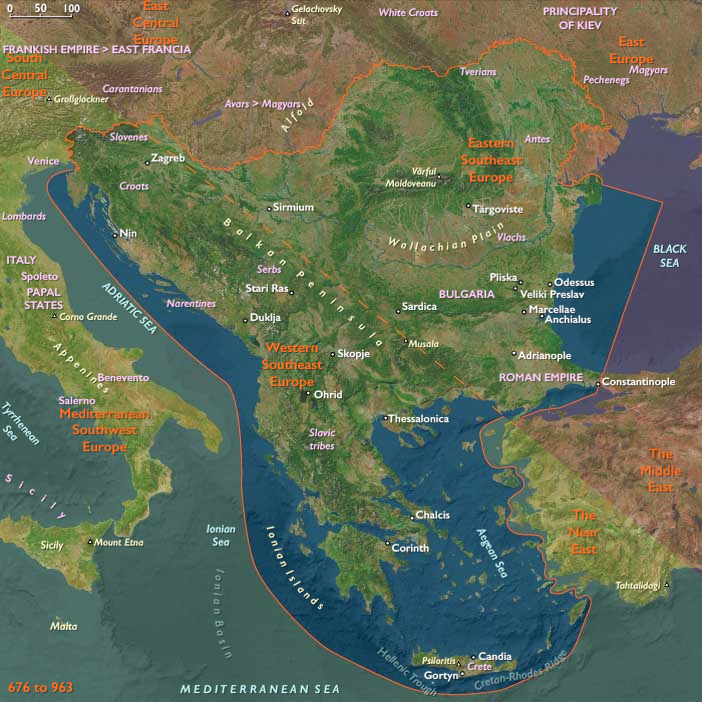
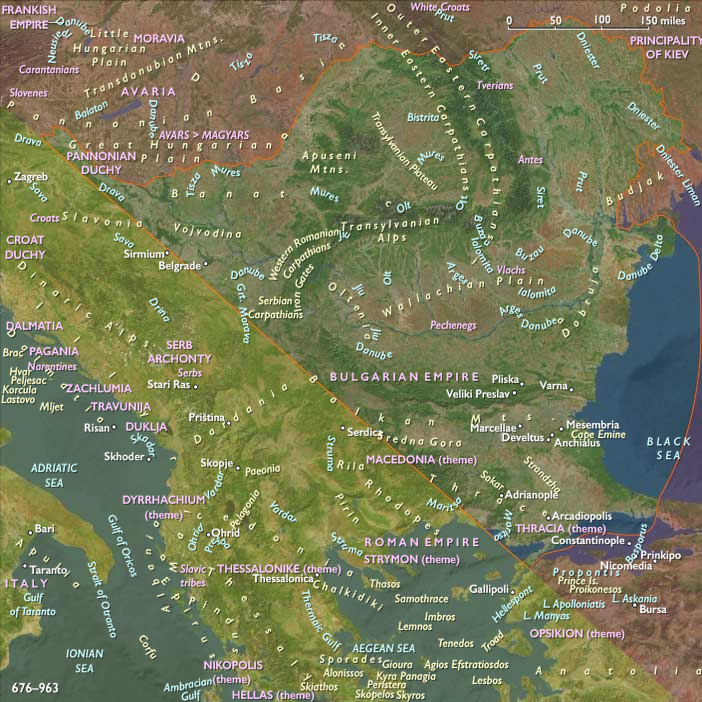
Theophilos, an intelligent financier and administrator, dispatches architects and engineers to construct fortresses that will anchor the empire’s northern defenses against the Vikings and the Magyars.
Despite his interest in Islamic culture, he also bolsters his defenses, east and west, against the Muslims, with whom he will be compelled to war throughout his reign.
Baghdad, as the 'Abbasid capital, had became the center of scientific studies and trade after the Islamic conquest of Persia, and many merchants and scientists from as far as China and India travel to this city, as had Muslim mathematician Al-Khwārizmī.
Caliph al-Ma'mun, who encourages the translation of Greek philosophical and scientific work, founds an academy in Baghdad in 829 called the Bayt al-Hikmah, or House of Wisdom, to which the translators, most often Christians, are attached.
He also imports manuscripts of particularly important works that do not exist in the Islamic countries from Constantinople.
The contributions of Al-Khwārizmī', who works in the House of Wisdom, to mathematics, geography, astronomy, and cartography establish the basis for innovation in algebra and trigonometry.
His systematic approach to solving linear and quadratic equations leads to algebra, a word derived from the title of his 830 book on the subject, "The Compendious Book on Calculation by Completion and Balancing".
On the Calculation with Hindu Numerals, written about 825, is principally responsible for spreading the Indian system of numeration throughout the Middle East and Europe.
It will be translated into Latin as Algoritmi de numero Indorum.
Al-Khwārizmī, rendered as (Latin) Algoritmi, will lead to the term "algorithm".
Some of his work is based on Persian and Babylonian astronomy, Indian numbers, and Greek mathematics.
Al-Ma'mun, developing an interest in the sciences as well, establishes observatories at the Bayt al-Hikmah, and at …
…Tudmur (Palmyra) in the plains, at which Muslim scholars can verify the astronomic knowledge handed down from antiquity.
These institutions foster the development of an Islamic school of astronomic sciences.
Years: 829 - 829
Locations
People
Groups
- Greeks, Medieval (Byzantines)
- Abbasid Caliphate (Baghdad)
- Roman Empire, Eastern: Phrygian or Armorian dynasty