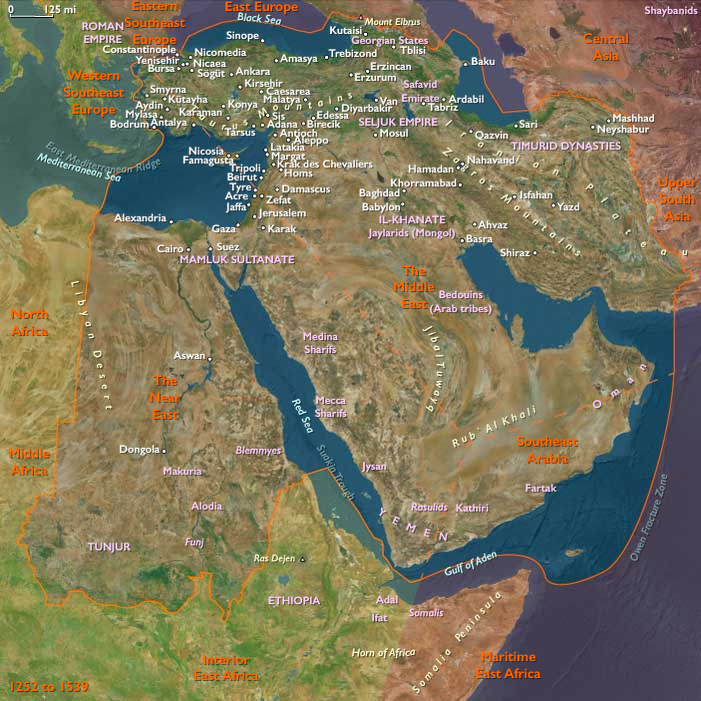
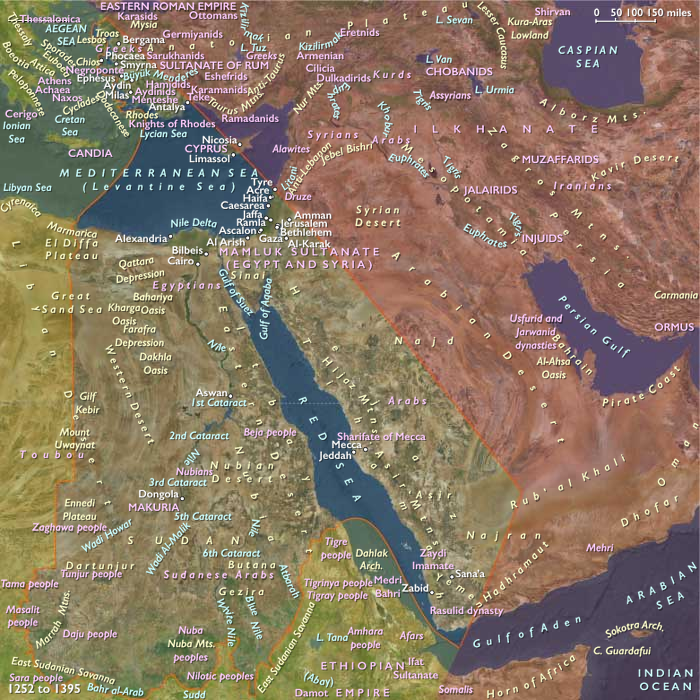
Mézières goes later in 1347 to Cyprus, …
Years: 1347 - 1347
Mézières goes later in 1347 to Cyprus, where he finds a kindred spirit in the son of the king of Cyprus, Peter of Lusignan, count of Tripol.
He returns to France, again as a soldier of fortune.
Locations
People
Groups
Topics
Commodoties
Subjects
Regions
Subregions
Related Events
Filter results
Showing 10 events out of 44348 total
Charles IV, Holy Roman Emperor-elect and king of Bohemia, gives city privileges in 1347 to the place located on the Tepla River that subsequently is named after him: Carlsbad (Karlovy Vary), according to legend, after he had acclaimed the healing power of the hot springs.
However, earlier settlements can be found in the outskirts of today's city.
William of Ockham, whose nominalist views in law and ethics lead him to voluntarism and emphasis on the divine command, concludes that the ultimate source of value and obligation lies not in any "natures" of things but in the free will of God.
He views the rightness or wrongness of human acts as a function of their being commanded or forbidden by divine authority.
Ockham probably dies in Munich in 1347, a victim of the Black Death.
The German electors had finally accepted the papal deposition of Louis in 1346, and had elected to replace him with Charles of Luxembourg, recent inheritor of the Bohemian throne following the death of his father John at the Battle of Crécy.
Louis is preparing to fight, but his sudden death on October 11, 1347, from a stroke suffered during a bear-hunt in Puch near Fürstenfeldbruck, avoids a longer civil war.
He is buried in the Frauenkirche in Munich.
Charles becomes Holy Roman Emperor Karl (Charles) IV later this year.
Aegeae had grown to become an important harbor city of the Armenian Kingdom of Cilicia in the Middle Ages, and particularly in the thirteenth century.
The Venetians call Aegeae Aiazzo or (incorporating the initial of the definite article) Laiazzo, and it becsme known locally as Ayas.
The fall of Acre and the silting up of the harbor of Tarsus made it became the center of trade between West and East, benefiting from its good roads eastward.
Marco Polo had disembarked here to begin his trip to China in 1271.
The Battle of Laiazzo in 1294, in which the navy of the Republic of Genoa overcame that of the Republic of Venice, is thought by some to be that in which Marco Polo later became a prisoner of the Genoese.
Within the city a quarter and trading post belonging to another of the Italian maritime republics, Pisa, was also established.
The city, increasingly oppressed by the Mamluks, falls definitively into their hands in 1347, and when European trade routes with the East moves away from the Mediterranean, the city and its harbor will lose importance.
Tensions between the Muslims forced by Delhi to emigrate to the overwhelmingly Hindu province of Daulatabad had become open revolt in 1346.
After the Sultan, Muhammad Tughlaq, left Daulatabad, Maharashtra, the city had been conquered by Zafar Khan.
Independence from Delhi was immediately declared and Khan had established a sultanate of his own.
A Turkish or Afghan officer of unknown descent, Zafar Khan, whose name is Hasan Gangu, had earlier participated in a mutiny of troops in Gujarat.
When he establishes the Bahmani dynasty as Alaud-Din Bahman Shah, he probably does not feel too safe in Daulatabad, so he shifts his capital a ear later to Gulbarga (Karnataka), located in a fertile basin.
His dynasty that will rule he Deccan for nearly two centuries.
Delhi dispatches an army the following year, but troubles closer to home forces the sultanate to recall it before it is able to depose Alaud-Din, who will have to fight various remnants of Muhammad Tughlaq’s troops, as well as the Hindu rulers of Orissa and Warangal, who had also expanded their spheres of influence as soon as Muhammad had left the Deccan.
When the incapable Humbert's army disbands, Mézières makes his way to Jerusalem, arriving in 1347.
Realizing the advantage which the discipline of the Saracens gives them over the disorderly armies of the West, he conceives the idea of a new order of knighthood, Ordre de la Passion (“Order of the Passion”), whose members will be spiritually distant from worldly preoccupations and devoted to conquering the holy places. (He will later draw up a prospectus for this order, but it will never become a reality.)
The final occupation of the region of present Albania in 1347 by the Serbs, led by Dushan, ends a thousand years of Greek rule over Albania and causes massive migrations of Albanians abroad, especially to Greece and the Aegean islands.
Taddeo Gaddi was considered Giotto's most talented pupil, according to Giorgio Vasari: in 1347 he is placed at the top in a list of Florence's most renowned painters.
According to some scholars, Taddeo collaborated in the Stefaneschi Polyptych in Rome.
His other works include a Madonna in Bern, an Adoration of the Magi in Dijon, the Stories of Job (Pisa, Camposanto Monumentale), the Madonna Enthroned with Child, Angels and Saints (Florence, Uffizi Gallery), the Madonna del Parto (Florence), and the Polyptych in Santa Felicita's sacristy, Florence.
He is the father of Agnolo Gaddi.
Petrarch’s “Triumphs,” written in Italian triple rhyme in 1344, takes the form of a vision a series of triumphs, one superseding the other, so that Love in the end is overcome by Time and Eternity.
He had in 1346 begun a Latin treatise, “The Life of Solitude,” in which he compares the leisure of a country life to the fatigue of a city life.
His love of classical antiquity makes him sympathetic to Cola di Rienzo's 1347 revolution in Rome.
Andrea Pisano first learned the trade of a goldsmith, then became a pupil of Mino di Giovanni, about 1300, and worked with him on the sculpture for S. Maria della Spina at Pisa and elsewhere.
He made his chief works in Florence, and the formation of his mature style was due rather to Giotto di Bondone than to his earlier master.
Of the three world-famed bronze doors of the Baptistery in Florence, the earliest one, that on the south side, was Pisano's work; he started it in 1330, finishing in 1336.
It consists of a number of small quatrefoil panels, the lower eight containing single figures of the Virtues, and the rest scenes from the life of John the Baptist.
While living in Florence, Andrea also produced many important works of marble sculpture, all of which show strongly the influence of Giotto, who he had succeeded in 1340 as Master of the Works of Florence Cathedral.
There he had produced a series of reliefs, possibly designed by his former teacher as, for instance, the double band of panel-reliefs which Pisano executed for the great campanile.
The subjects of these are the Four Great Prophets, the Seven Virtues, the Seven Sacraments, the Seven Works of Mercy and the Seven Planets.
The duomo contains Pisano's other principal Florentine works in marble.
He is in 1347 placed in charge of the construction and decoration of Orvieto Cathedral, which had already been designed and begun by Lorenzo Maitani.
It is a post he will retain until his until his death the following year.
These and the aforementioned doors are Pisano's only known works.