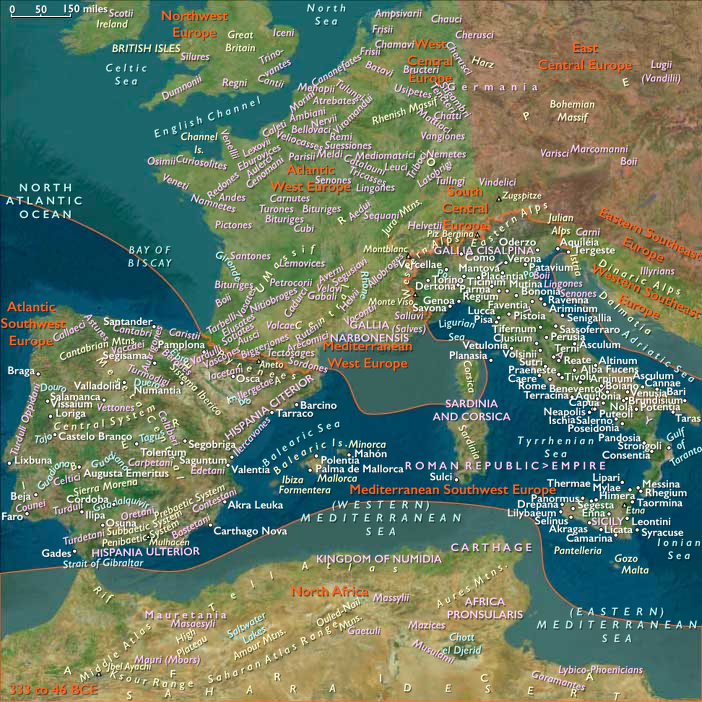
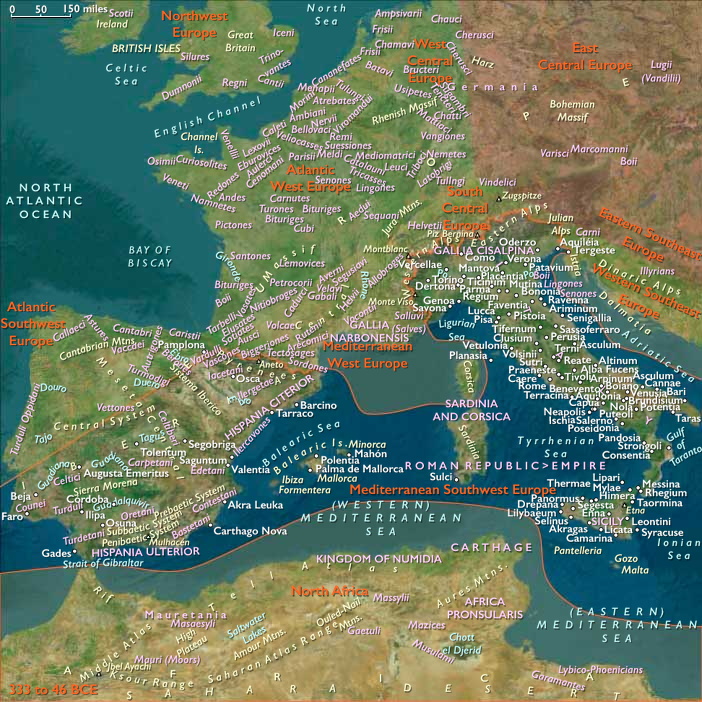
Metellus had been elected consul in 143. …
Years: 142BCE - 142BCE
Metellus had been elected consul in 143.
As the new governor in Hispania, he attacks the territory of the Vettones, but is not able to take the city of Numancia.
Locations
People
Groups
Topics
Commodoties
Subjects
Regions
Subregions
Related Events
Filter results
Showing 10 events out of 63088 total
Diodotus, intending to cow the Jews, is about to enter Judea when he is confronted by Jonathan’s brother, Simon, ready for battle.
Simon, who has quietly and loyally served under his other brothers, all now dead, is a man of character and prudence as well as a born leader.
Diodotus, avoiding an engagement, demands one hundred talents and Jonathan's two sons as hostages, in return for which he promises to liberate Jonathan.
Although Simon does not trust Diodotus Tryphon, he complies with the request in order that he might not be accused of the death of his brother.
However, Diodotus, angry that Simon has everywhere blocked his way and that he can accomplish nothing, executes Jonathan; nothing is known of his two captive sons.
The Hasmonean revolt, waged by the orthodox Jews of southern Syria against Seleucid rule over Judah, has been largely successful.
Simon secures from Diodotus, in the name of the general’s ward, Antiochus VI, exemption from taxation for the Jews and the right to issue his own coins.
The Jews pass a decree in Simon's honor, granting the right of permanent incumbency to Simon and to his successors, until "an accredited prophet" should arise.
It is thus during Simon's reign that the rule of the priest-prince will be transformed into a secular hereditary rule.
Polybius, a witness to the the final reduction of Carthage, had returned to Greece shortly after the destruction of Corinth in the same year and made use of his Roman connections to lighten the conditions here; entrusted with the difficult task of organizing the new form of government in the Greek cities, in this office he has gained for himself the highest recognition.
As the geographer Pausanias states, Achaean gratitude found expression in the erection of statues in his honor at Tegea, Pallantium, Mantineia, Lycosura—where the inscription declared that “Greece would never have come to grief, had she obeyed Polybius in all things, and having come to grief, she found succor through him alone”—and Megalopolis, where it was recorded that “he had roamed over all the earth and sea, had been the ally of the Romans, and had quenched their wrath against Greece.”
He seems to have spent the succeeding years in Rome, engaged on the completion of his historical work, and occasionally undertaking long journeys through the Mediterranean countries in the interest of his history, more particularly with a view to obtaining firsthand knowledge of historical sites.
It also appears that he sought out and interviewed war veterans in order to clarify details of the events he was writing about, and was given access to archival material for the same purpose.
In his major historical work, containing forty books (of which the first five are extant, in addition to large fragments of the remaining volumes) Polybius presents the facts and causes of Rome's rapid rise to world dominion from 221 to 168, with an introduction describing Roman history from 264 to 220 and a conclusion, related in Books XXX–XXXIX, summarizing the recent events from 168 to 146.
Polybius probably conceived his revision after 146, having by this date completed his narrative down to the end of the Second Punic War.
At least Books I–VI seem to have been published by about 150; there is no information as to when the rest of the work, including the revised plan in Book III, appeared.
A rationalist who rejects religious superstitions, he emphasizes the causes, circumstances, and consequences of events, and the inevitability of change.
The didactic historian expresses his conviction that the Romans prevailed over their opponents because of a superior constitution and military organization.

Roman engineers construct the first stone bridge over the Tiber River, completed in 142 BCE.
The Huainanzi, a second century BCE Chinese philosophical classic from the Han dynasty that blends Taoist, Confucianist, and Legalist concepts, including theories such as Yin-Yang and the Five Phases, is written under the patronage of Liu An, Prince of Huainan.
Advisor to his nephew, Emperor Wu of Han, Liu An is a legendarily prodigious author.
The text, also known as the Huainan honglie ("The Great Brilliance of Huainan"), is a collection of essays presented as resulting from literary and philosophical debates between Liu and guests at his court, in particular the scholars known as the Eight Immortals of Huainan.
The Huainanzi is the first Chinese classic text to use the Pythagorean comma, and to precisely analyze twelve-tone tuning in Chinese music (McClain and Ming 1979:213, 206), although the latter had been preceded by bronze inscriptions on the (433 BCE) bells of the Marquis Yi of Zeng (Temple 1986:199).
The date of composition for the Huainanzi is more certain than for most early Chinese texts.
Both the Book of Han and Records of the Grand Historian record that when Liu An paid a state visit to his nephew the Emperor Wu of Han in 139 BCE, he presented a copy of his "recently completed" book in twenty-one chapters.
An eclectic compilation of chapters or essays that range across topics of mythology, history, astronomy, geography, philosophy, science, metaphysics, nature, and politics, the Huainanzi discusses many pre-Han schools of thought (especially Huang-Lao Daoism), and contains more than eight hundred quotations from Chinese classics.
Chinese puppeteers develop the shadow play, a form of puppetry in which flat cutout figures are silhouetted against a translucent screen and manipulated with rods while the puppeteer intones the story to musical accompaniment.
Shadow puppetry originates during the Han Dynasty when one of the concubines of Emperor Wu of Han died from an illness.
The emperor was devastated, and he summoned his court officers to bring his beloved back to life.
The officers made a shape of the concubine using donkey leather.
Her joints were animated using eleven separate pieces of the leather, and adorned with painted clothes.
Using an oil lamp, they made her shadow move, bringing her back to life.
The Middle East: 141–130 BCE
Parthian Expansion and the Final Decline of Seleucid Power
The era from 141 to 130 BCE marks a decisive shift in power dynamics within the Middle East as the Seleucid Empire faces irrecoverable territorial losses to the rapidly expanding Parthian Empire.
In 141 BCE, the Parthian king Mithridates I captures the strategically vital city of Seleucia, the eastern capital of the Seleucid Empire. This conquest effectively transfers control of Mesopotamia and Babylonia to the Parthians, extending their dominion from the Euphrates River to the Indus River and firmly establishing Parthia as a major regional power.
Seleucid authority east of the Euphrates is effectively extinguished with the loss of Seleucia, prompting desperate countermeasures. In 139 BCE, Seleucid king Demetrius II launches a major military campaign aimed at reclaiming these lost eastern territories. However, the Parthian forces decisively defeat this counterattack, capturing Demetrius II and effectively ending Seleucid claims east of the Euphrates.
Despite further attempts to reverse these losses, such as the ambitious but ultimately unsuccessful campaign of Antiochus VII in 130 BCE, the Seleucid Empire's disintegration is rapid and irreversible. The Seleucids can no longer project effective military or political authority over their eastern provinces, leading to the emergence of fully autonomous Parthian rule in these regions.
Thus, the period from 141 to 130 BCE is defined by the dramatic ascendancy of Parthian power, the severe territorial contraction of the Seleucid Empire, and a fundamental realignment of regional power structures in the Middle East. This era solidifies Parthian dominance and marks a significant step toward the ultimate disintegration of Seleucid influence throughout the region.
A list enumerating the Seven Wonders of the World first appears in about 130 in a poem written by Antipater of Sidon in the Greek “Anthology”.
His top seven are the pyramids of Egypt, the Walls and the Hanging Gardens of Babylon, the Temple of Artemis at Ephesos, the Statue of Zeus at Olympia, the Mausoleum at Halikarnassos, and the Colossus of Rhodes.
All Seleucid lands east of the Euphrates are gone by 141 BCE, and attempts by Seleucid kings Demetrius II in 141 BCE and Antiochus VII in 130 BCE cannot halt the rapid disintegration of the kingdom.
The Parthians capture the major Seleucid city of Seleucia (which is the eastern capital of the Seleucid empire) in 141 BCE, giving their king Mithridates control over Mesopotamia and Babylonia.
Parthia now controls over all the land between the Euphrates and Indus Rivers.
The Parthians defeat a major Seleucid counterattack in 139 BCE breaking the Seleucid army and capturing Demetrius II, effectively ending Seleucid claims to any land east of the Euphrates River.
The term Tocharian or Tokharian is based on the ethnonym Tokharoi used by Greek historians (e.g.
Ptolemy VI, 11, 6).
The first Greek mention of the Tocharians appeared in the first century BCE, when Strabo presented them as a Scythian tribe, and explained that the Tocharian—together with the Assianis, Passianis and Sakaraulis—had taken part in the destruction of the Greco-Bactrian kingdom (present day Afghanistan-Pakistan) in the second half of the second century BCE.
These Tocharians have frequently been identified with the Yuezhi and the later (and probably related) Kushan peoples.
Many scholars believe the Yuezhi originally spoke a Tocharian language.
However, the debate about the origins and original language(s) of the Yuezhi and the Kushan continues, and there is no general consensus.
The geographical term Tokharistan usually refers to first millennium Bactria.
Today, the term is associated with those Indo-European languages known as "Tocharian".
Tocharian A is also known as East Tocharian, or Turfanian (of the city of Turpan), and Tocharian B is also known as West Tocharian, or Kuchean.
Based on a Turkic reference to Tocharian A as twqry, these languages were associated with the Kushan ruling class, but the exact relation of the speakers of these languages and the Kushan Tokharoi is uncertain, and some consider "Tocharian languages" a misnomer.
The term is so widely used, however, that this question is somewhat academic.
Tocharians in the modern sense are, then, defined as the speakers of the Tocharian languages.
The last Greco-Bactrian king, Heliocles I, retreats and moves his capital to the Kabul Valley.
The eastern part of Bactria is eventually occupied by Pashtun people.
Near East (141–130 BCE): Artistic Excellence and Hasmonean Ascendancy
The era from 141 to 130 BCE in the Near East is characterized by notable cultural achievements and significant political developments, particularly involving Judaea and the declining Seleucid influence.
In the artistic realm, this period witnesses the creation of one of the most renowned masterpieces of ancient Greek sculpture, the Venus de Milo. Carved from marble by Alexandros of Antioch-on-the-Maeander between 130 and 100 BCE, the statue portrays the Greek goddess Aphrodite (Venus to the Romans), embodying beauty and love. Originally slightly larger than life-size at approximately two hundred and three centimeters (six feet eight inches), the statue is distinguished by its exquisite craftsmanship despite having lost part of an arm and its original plinth. Today, this celebrated sculpture resides in the Louvre Museum in Paris.
Politically, the era is defined by significant developments in Judaea, where the Seleucid pretender Diodotus recognizes Hasmonean sovereignty in exchange for a nominal tribute. This pivotal recognition establishes a theocratic government in Judaea—an institution unprecedented in biblical texts—and marks a critical juncture in Jewish history. Under native Hasmonean leadership, Judaea progressively asserts its autonomy, driving out the remaining Greco-Syrian Seleucid forces. The Hasmonean kingdom expands to a scale reminiscent of the semi-legendary united monarchy under King David. However, this growth is accompanied by persistent internal political and religious conflicts, reflecting the complex nature of governance and cultural identity in this transitional period.
Legacy of the Era
The era from 141 to 130 BCE solidifies cultural and political transformations that leave lasting imprints on the Near East. The creation of iconic art such as the Venus de Milo symbolizes the enduring Hellenistic influence, while the rise of the Hasmonean kingdom reshapes Judaea’s political and religious landscape, setting the stage for future historical dynamics in the region.