…Merseburg (in June), and …
Years: 1046 - 1046
…Merseburg (in June), and …
Locations
People
- Eckard II
- Godfrey III, Duke of Lower Lorraine
- Henry I of France
- Henry III, Holy Roman Emperor
- Henry VII of Bavaria
- Peter, King of Hungary
Groups
- Germans
- Hungarian people
- Flanders, County of
- Swabia, Duchy of
- Bavaria, Ottonian Duchy of
- German, or Ottonian (Roman) Empire
- Meissen, March of
- Lorraine, (second) Duchy of
- Lorraine (Lothier), Lower, (second) Duchy of
Commodoties
Subjects
Regions
Subregions
Related Events
Filter results
Showing 10 events out of 51293 total
The celebrated Norse warrior Harald Hardrada, the half brother of Norway’s King Olaf II, for whom he had fought at the Battle of Stiklestad, had initially served as a mercenary under Yaroslav, grand duke of Kiev, whose daughter Elisiv he has married.
It is possible that the marriage with Elisiv had been agreed to already during Harald's first time in Rus', or that they at least had been acquainted.
During his service in the elite Varangian Guard of Emperor Michael IV in Constantinople, Harald had composed a love poem which included the verse "Yet the goddess in Russia/ will not accept my gold rings" (whom Snorri Sturluson identifies with Elisiv), although Morkinskinna claims that Harald had to remind Yaroslav of the promised marriage when he returned to Kiev.
According to the same source, Harald had spoken with Yaroslav during his first time in Rus', requesting to marry Elisiv, only to be rejected because he was not yet wealthy enough.
It is in any case significant that Harald had been allowed to marry the daughter of Yaroslav, since his other children are married to figures such as Henry I of France, Andrew I of Hungary and the daughter of Constantine IX.
Seeking to regain for himself the kingdom lost by his half-brother Olaf Haraldsson, Harald had begun his journey westwards in early 1045, departing from Novgorod (Holmgard) to Staraya Ladoga (Aldeigjuborg) where he obtained a ship.
His journey had gone through Lake Ladoga, down the Neva River, and then into the Gulf of Finland and the Baltic Sea.
He arrives in Sigtuna in Sweden, probably at the end of 1045 or in early 1046.
When he arrives in Sweden, according to the skald Tjodolv Arnorsson, his ship is unbalanced by its heavy load of gold.
In Harald's absence, the throne of Norway had been restored to Magnus the Good, an illegitimate son of Olaf.
Harald may actually have known this, and it could have been the reason why Harald wanted to return to Norway in the first place.
Since Cnut the Great's sons had chosen to abandon Norway and instead fight over England, and his sons and successors Harold Harefoot and Harthacnut had died young, Magnus's position as king had been secured.
No domestic threats or insurrections are recorded to have occurred during his eleven-year reign.
After the death of Harthacnut, which had left the Danish throne vacant, Magnus had in addition been selected to be the king of Denmark, and had managed to defeat the Danish royal pretender Sweyn Estridsson.

Harald, having heard of Sweyn's defeat by Magnus, meets up with his fellow exile in Sweden (who is also his nephew), as well as with the Swedish king Anund Jacob, and the three join forces against Magnus.
Their first military exploit consists of raiding the Danish coast, in an effort to impress the natives by demonstrating that Magnus offers them no protection, and thus leading them to submit to Harald and Sweyn.
Magnus, learning of their actions, knows that Norway will be their next target.
Harald may have planned to be taken as king of his father's petty kingdom, and thereafter claim the rest of the country.
The people are in any case unwilling to turn against Magnus, and upon hearing news of Harald's schemes, Magnus (abroad at the time) goes home to Norway with his entire army.
Magnus's advisors recommend that instead of going to war the young king not fight his uncle, and a compromise is reached in 1046 in which Harald will rule Norway (not Denmark) jointly with Magnus (although Magnus will have precedence).
Notably, Harald also has to agree to share half of his wealth with Magnus, who is effectively bankrupt and badly in need of funds.
Sweyn increases the pressure on Magnus from his base in Scania, but Magnus has by late 1046 driven Sweyn out of Denmark.
The two members of Hungary’s exiled Árpád dynasty, András and Levente, only set out after the agents they had sent to Hungary confirmed that the Hungarians were ripe for an uprising against the king.
Fearing ambush and accompanied by Russian troops from Kiev, they enter the still-pagan portion of Hungary.
In Újvár (today Abaújvár, after the Aba family), they immediately gain the support of the pagan and other factions opposed to Peter’s rule, despite the fact that András is Christian (Levente had remained pagan).
On their return, a rebellion begins that András and Levente initially support.
During this rebellion, a pagan noble named Vata (or Vatha) gains power over a group of rebels who wish to abolish Christian rule and revert to paganism.
According to legend.
Vata shaved his head in the pagan fashion, leaving three braids remaining, and declared war on the Christians.
King Peter plans to flee again to the Holy Roman Empire, but András invites him to a meeting at Székesfehérvár.
Soon realizing that András's envoys actually want to arrest him, the deposed king flees to a fortified manor at Zámoly, but his opponent's supporters seize it and capture him three days later.
All fourteenth-century Hungarian chronicles attest that Peter was blinded, which caused his death.
However, the near-contemporary Cosmas of Prague relates that Judith of Schweinfurt, widow of Duke Bretislaus I of Bohemia who was expelled by her son, fled to Hungary and married Peter about 1055 "as an insult to" her son "and all the Czechs".
If the latter report is reliable, Peter survived his mutilation and died during the late 1050s.
He is in any case buried in the cathedral of Pécs.
András, as the oldest brother, pronounces himself king.
The bishops Gellért (Italian: Gerard), Besztrik, Buldi, and Beneta gather to greet them András and Levente's men as they move towards Pest.
The bishops are attacked in Pest on on September 24 by Vata's mob, who begin stoning the bishops; Buldi is stoned to death.
Gellért repeatedly makes the sign of the cross as the pagans throw rocks at him, which further infuriates the pagans.
Gellért is allegedly taken up Kelenhegy hill, where he is put into a cart and pushed off a cliff, onto the banks of the Danube; then, found still alive at the bottom, he is beaten to death.
Other unverified tales report him as being put in a spiked barrel and rolled down the hill during a mass revolt of pagans.
Besztrik and Beneta manage to flee across the river, where Besztrik is injured by pagans before the pair can be rescued by András and Levente; only Beneta survives.
Gellért will later be canonized for his martyrdom and the hill from which he had been thrown will be renamed Gellért Hill.
The hill, in modern central Budapest, has a monument on the cliff where Gellért, today a patron saint of Hungary, was killed.
Most Hungarian lords and the prelates oppose the restoration of paganism, and prefer the devout Christian András to his pagan brother Levente, even if, at least according to Kristó and Steinhübel, the latter was the eldest among Vazul's three sons.
The Hungarian chronicles write that Levente, who shortly dies, did not oppose his brother's ascension to the throne.
The Vaa uprising marks the last major attempt at stopping Christian rule in Hungary.
While András has received assistance from pagans in his rise to the throne, he has no plans to abolish Christianity in the kingdom.
Once in power, he distances himself from Vata and the pagans.
However, they are not punished for their actions.
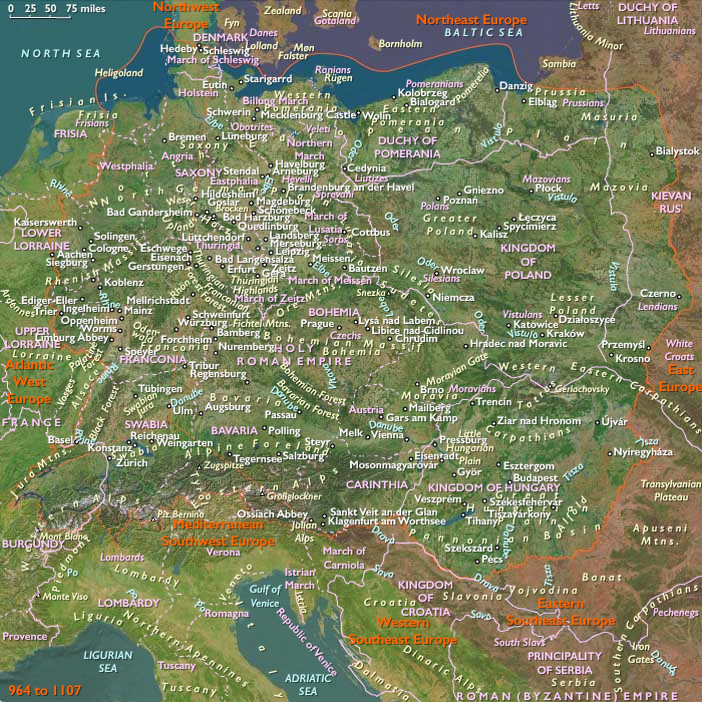
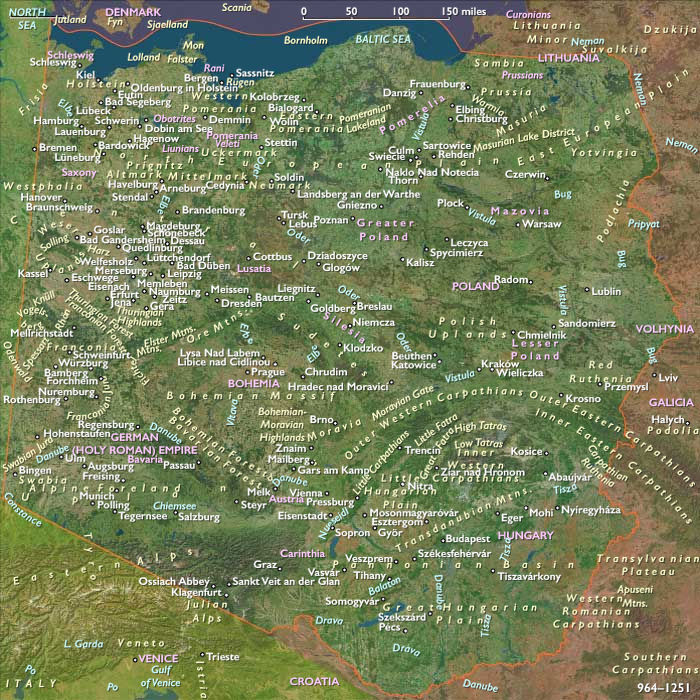
Henry continues from Aachen on to Saxony and holds imperial courts at Quedlinburg, …
…Meissen.
At the first, he had made his daughter Beatrice from his first marriage abbess, and at the second he had ended the strife between the dux Bomeraniorum and Casimir of Poland.
This is one of the earliest, or perhaps the earliest, recording of the name of Pomerania, whose duke, Zemuzil, brought gifts.
Years: 1046 - 1046
Locations
People
- Eckard II
- Godfrey III, Duke of Lower Lorraine
- Henry I of France
- Henry III, Holy Roman Emperor
- Henry VII of Bavaria
- Peter, King of Hungary
Groups
- Germans
- Hungarian people
- Flanders, County of
- Swabia, Duchy of
- Bavaria, Ottonian Duchy of
- German, or Ottonian (Roman) Empire
- Meissen, March of
- Lorraine, (second) Duchy of
- Lorraine (Lothier), Lower, (second) Duchy of