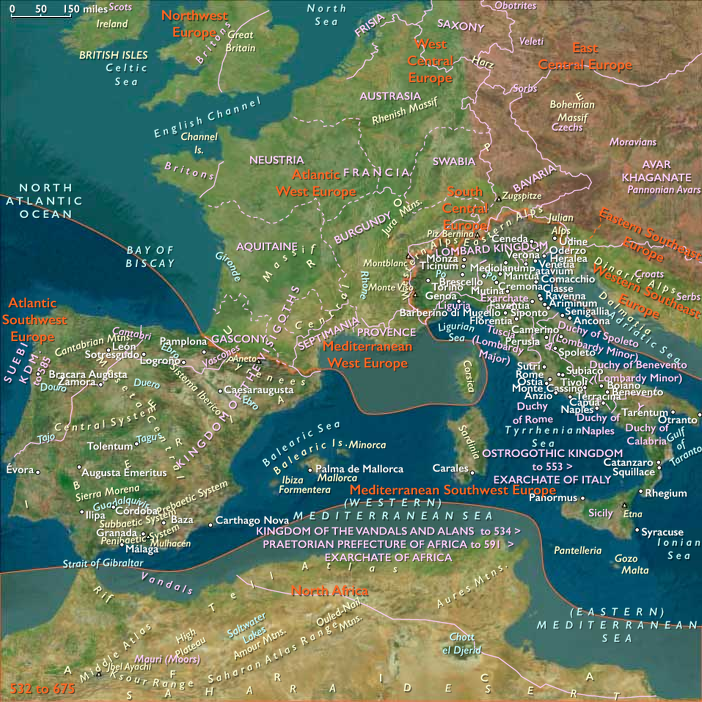
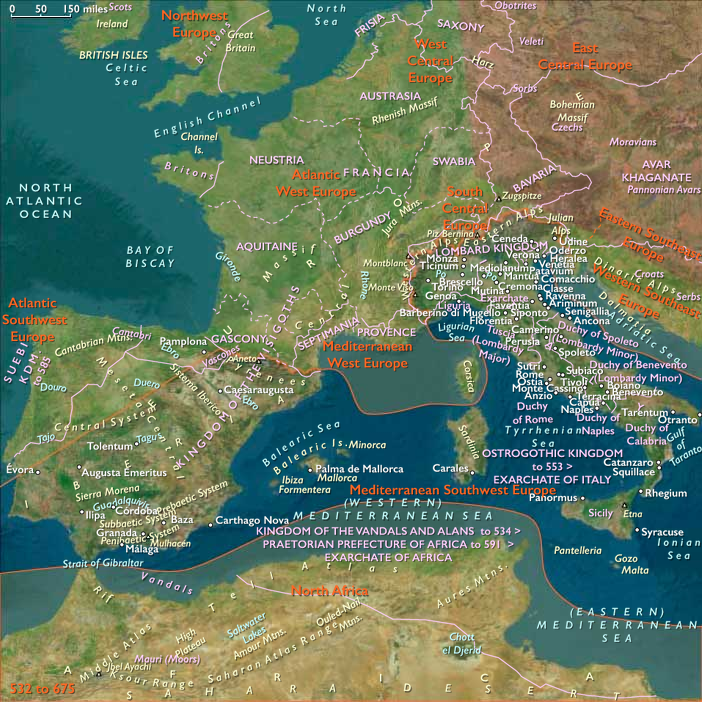
…Mérida.
Years: 550 - 550
…Mérida.
Locations
People
Groups
Topics
Commodoties
Subjects
Regions
Subregions
Related Events
Filter results
Showing 10 events out of 57628 total
Gao Huan's son Gao Yang forces Emperor Xiaojing of Eastern Wei to yield the throne to him in 550, ending Eastern Wei and establishing Northern Qi.
As Emperor Wenxuan, Gao Yang adopts a defensive policy towards the hostile northern tribes, building over a thousand miles of wall on the border.
Roman forces in the Balkans follow the Slavic invaders everywhere but do not dare to fight them, because the Slavs are too numerous.
In 550, the Sclaveni reach a point about forty miles (sixty-five kilometers) from Constantinople.
Procopius writes the Secret History around this time.
Covering roughly the same years as the first seven books of the History of Justinian's Wars, it appears to have been written after they were published.
Current consensus generally dates it to 550 or 558, or maybe even as late as 562.
The Secret History reveals an author who had become deeply disillusioned with the emperor Justinian and his wife, Empress Theodora, as well as Belisarius, his former commander and patron, and Antonina, Belisarius' wife.
The anecdotes claim to expose the secret springs of their public actions, as well as the private lives of the emperor, his wife and their entourage.
Justinian is portrayed as cruel, venal, prodigal and incompetent; as for Theodora, the reader is treated to the most detailed and titillating portrayals of vulgarity and insatiable lust combined with shrewish and calculating mean-spiritedness.
Discovered centuries later in the Vatican Library and published by Niccolò Alamanni in 1623 at Lyons, its existence was already known from the Suda, which referred to it as the Anekdota (Latin Anecdota, "unpublished writings").

Justinian appoints Bessas commander (magister militum) of Armenia and entrusts him with the war in Lazica (Georgia).
A pro-Persian revolt breaks out in 550 among the Abasgians, a people that neighbor Lazica to the north.
This provides an opportunity for a high-ranking Lazic noble, called Terdetes, who had quarreled with Gubazes, to betray to the Persians an important fort in the land of the Apsili, a tribe under Lazic suzerainty.
The Apsili retake the fort, but refuse to accept Lazic rule until persuaded to do so by the imperial general John Guzes.
Agila had come to power after the assassination of Theudigisel, who had ruled for less than two years.
However, opposition to his rule soon emerges.
First is …
…the revolt of the city of Córdoba, which Isidore of Seville suggests was due to local Roman Catholics objecting to his Arianism: in his account, Isidore mentions that Agila defiled the church of a local saint, Acisclus, by drenching the sepulcher "with the blood of the enemy and of their pack-animals", and attributes the death of Agila's son in the conflict—along with the majority of his army, and the royal treasury—to "the agency of the saints".
(Isidore of Seville, History of the Goths, chapter 47.
Translation by Guido Donini and Gordon B. Ford, Isidore of Seville's History of the Goths, Vandals, and Suevi, second revised edition (Leiden: E.J.
Brill, 1970), pp.
21.
Heather dates the beginning of this conflict to 550 (Peter Heather, The Goths (Oxford: Blackwell, 1996), pp.
278).
Agila himself retreats to …
In mid-sixth century Galicia, leprosy is a common affliction, as noted by Gregory of Tours in his Historia Francorum(written 573–579 CE). Among its victims is the son of Chararic, the Suebi king.
At this time, the Suebi follow Arian Christianity, but upon hearing of Saint Martin of Tours, Chararic vows to convert to the Chalcedonian faith if his son is cured. He sends for relics from Tours, and upon their arrival in Galicia, his son is miraculously healed through Saint Martin’s intercession.
Moved by this event, Chararic and his entire royal household formally embrace Chalcedonian Christianity, marking a significant religious shift within the Suebi kingdom.
Kentigern (later canonized, and known as St. Mungo) reputedly establishes a religious settlement in about 550 on the future site of Glasgow.
Chimborazo, a volcano in the region of present Ecuador, erupts in 550.
With an elevation of six thousand two hundred and sixty-eight meters, Chimborazo is the highest mountain in Ecuador and the Andes north of Peru; it is higher than any more northerly summit in the Americas.
The summit of Mount Everest reaches a higher elevation above sea level, but the summit of Chimborazo is widely reported to be the farthest point on the surface from Earth's center, with Huascarán a very close second.
The summit of the Chimborazo is the fixed point on Earth which has the utmost distance from the center—because of the oblate spheroid shape of the planet Earth which is "thicker" around the Equator than measured around the poles.
Rome’s imperial garrison of Isaurian soldiers, suffering from hunger and mistreatment from Justinian, have been given a choice by Totila: to open the gates of the city and give up and be paid a hefty sum, like the garrison before them in the second siege, or continue fighting for Justinian, who has not paid the men in years, and possibly die.
Some of the soldiers, while hesitant due to the possible consequences, decided to side with Totila and opened the gate for Totila’s men.
Totila’s men sweep through the city capturing, killing, and looting all but women, for Totila had given orders to spare and respect the Roman women.
Totila, expecting much of the nobles and garrison to flee as soon as the walls were overtaken, had set traps along the roadways to neighboring towns that were not yet under his control.
As he has guessed correctly, many Romans are caught by ambush while fleeing Rome.
With the capture of Rome, Totila decides to repopulate, rebuild, and defend Rome against all future attacks from Justinian.