Bayezid, immediately after obtaining the Ottoman throne, had had his younger brother strangled to avoid a plot.
He has recognized Stefan Lazarević, the son of Lazar, as the new Serbian leader (later despot), with considerable autonomy.
Bayezid arranges additional marriage alliances, having in 1389 taken as his sixth wife a daughter of John V Palaiologos by his wife, Helena Kantakouzenos.
In 1390, he takes as his seventh wife Hafisa Khanum, daughter of Amir Fakhr ud-din 'Isa Bey, Amir of Aydin; as his eighth wife Karamanoglu Khanum; as his ninth wife Sultan Khanum, daughter of Amir Sulaiman Shah Suli Bey, Amir of Dulkadir; and as his tenth wife (at Krushevatch Jami) Princess Despina Maria Olivera Khanum (b.
1372), daughter of the slain Prince Lazar Hrebeljanovic of Serbia, by his wife, Queen Militza, née Bulco.
Each of these marriages to Balkan princesses brings Christian followers and advisers into the Ottoman court, and it is under their influence that Bayezid will abandon the simple nomadic courts and practices of his predecessors and isolate himself behind elaborate court hierarchies and ceremonies borrowed primarily from the Greeks, setting a pattern that will be continued by his successors.
However, Bayezid is unable to take advantage of his father's victory to achieve further European conquest; in fact, he is compelled to restore the defeated vassals and return to Anatolia.
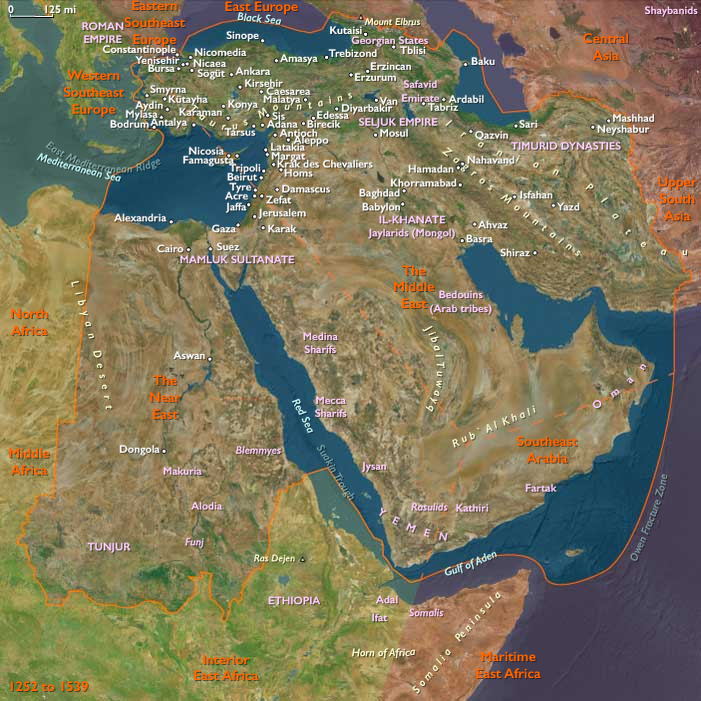
This return is precipitated by the rising threat of the Turkmen principality of Karaman, created on the ruins of the Seljuq empire of Anatolia which had its capital at Konya.
Bayezid's predecessors had avoided forceful annexation of Turkmen territory in order to concentrate on Europe.
They had, however, expanded peacefully through marriage alliances and the purchase of territories.
The acquisition of territory in central Anatolia from the emirates of Hamid and Germiyan had brought the Ottomans into direct contact with Karaman for the first time.
Murad had been compelled to take some military action to prevent it from occupying his newly acquired Anatolian territories but then had turned back to Europe, leaving the unsolved problem to his successor son.
Karaman had willingly cooperated with Serbia in inciting opposition to Ottoman rule among Murad's vassals in both Europe and Anatolia.
This opposition strengthens the Balkan Union that had been routed by the Ottomans at Kosovo and stimulates a general revolt in Anatolia that Bayezid is forced to meet by an open attack as soon as he is able.