
Menshikov’s power has been practically absolute during …
Years: 1727 - 1727
Menshikov’s power has been practically absolute during the short reign of Catherine, who dies just two years after Peter at the age of forty-three, .
He has promoted himself to the unprecedented rank of Generalissimo, and is the only Russian to bear a ducal title.
Upon finishing the construction of a sumptuous palace on the Neva Embankment in St. Petersburg (now assigned to the Hermitage Museum), Menshikov intends to make Oranienbaum a capital of his ephemeral duchy.
Pushkin in one of his poems alludes to Menshikov as "half-tsar".
On the whole he has ruled well, his difficult position serving as some restraint upon his natural inclinations.
He contrives to prolong his power after Catherine's death by means of a forged will and a coup d'etat.
While his colleague Peter Tolstoi would have raised Elizabeth Petrovna to the throne, Menshikov sets up the youthful Peter II, son of the tsarevich Alexius, with himself as dictator during the prince's minority.
During the reign of Catherine, Peter had been quite ignored; but just before her death it had become clear to those in power that the grandson of Peter the Great could not be kept out of his inheritance much longer.
The majority of the nation and three-quarters of the nobility are on his side, while his uncle, Emperor Charles VI, through the imperial ambassador at St. Petersburg, has persistently urged his claims.
The matter is arranged between Menshikov and Count Andrei Osterman; and on May 18, 1727, Peter II, according to the terms of the forged last will of Catherine I, is proclaimed sovereign autocrat.
Menshikov, lodging him in his own palace on the Vasilievsky Island, now aims at establishing himself definitely by marrying his daughter Mary to Peter, but the old nobility, represented by the Dolgorukovs and the Galitzines, unite to overthrow him, and on September 9, 1727, he is deprived of all his dignities and offices and expelled from the capital.
Subsequently he is deprived of his enormous wealth, stripped of the titles, and he and his whole family are banished to Berezov in Siberia, where he will die at fifty-six on November 12, 1729.
Locations
People
- Aleksandr Danilovich Menshikov
- Andrey Osterman
- Catherine I of Russia
- Charles VI, Holy Roman Emperor, King of the Romans (King of Germany)
- Dmitry Mikhaylovich Galitzine
- Elizabeth of Russia
- Peter II of Russia
- Pyotr Andreyevich Tolstoy
- Vasiliy Lukich Dolgorukov
Groups
Subjects
Regions
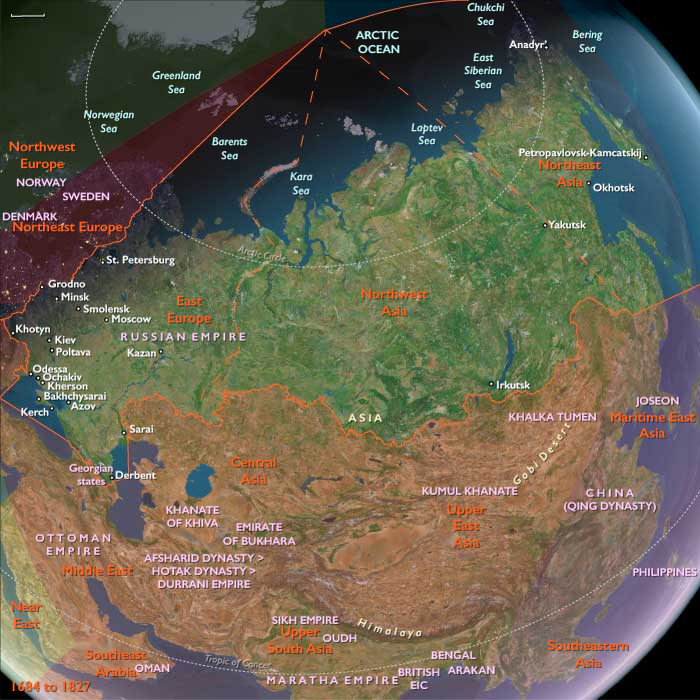
Subregions
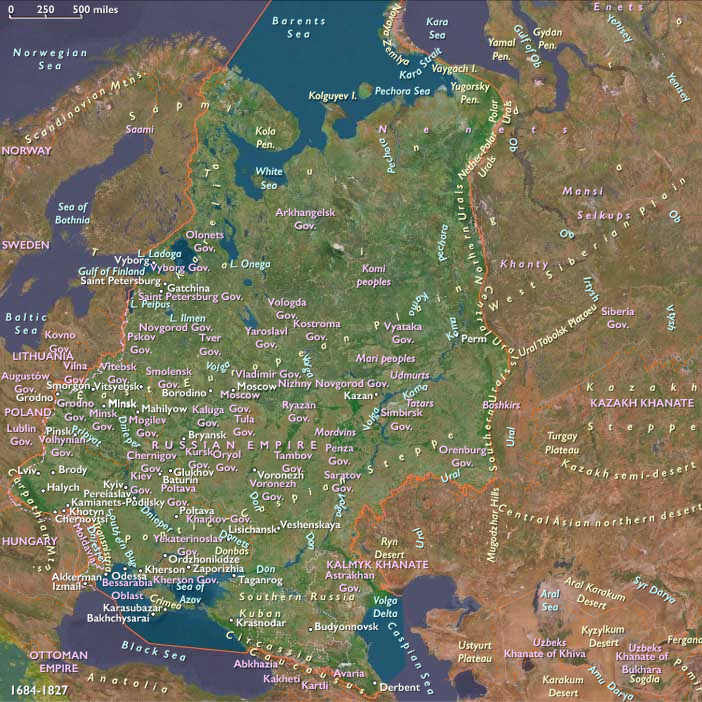
Years: 1727 - 1727
Locations
People
- Aleksandr Danilovich Menshikov
- Andrey Osterman
- Catherine I of Russia
- Charles VI, Holy Roman Emperor, King of the Romans (King of Germany)
- Dmitry Mikhaylovich Galitzine
- Elizabeth of Russia
- Peter II of Russia
- Pyotr Andreyevich Tolstoy
- Vasiliy Lukich Dolgorukov
Groups
Subjects
Regions
Subregions