Menophaneses, a general of Mithridates, sacks the …
Years: 88BCE - 88BCE
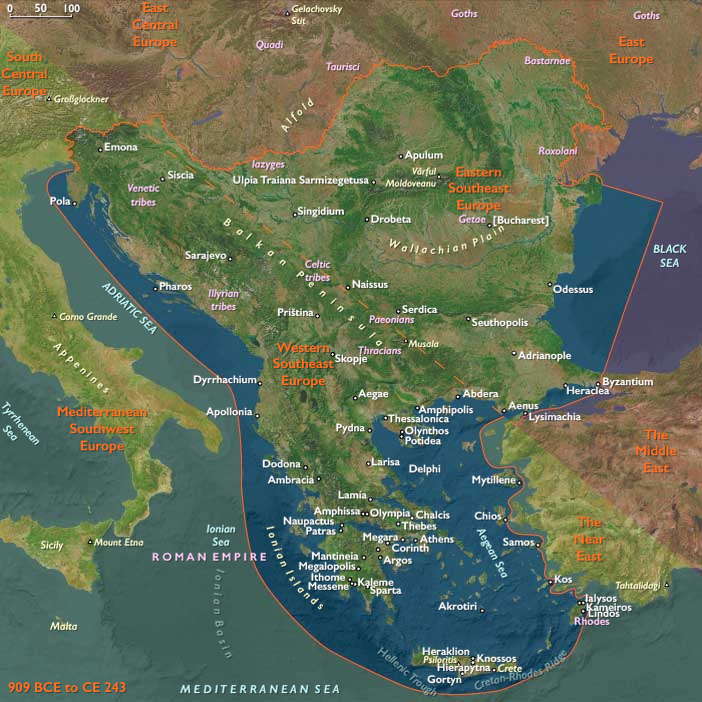
Menophaneses, a general of Mithridates, sacks the island of Delos in 88 for remaining faithful to Rome; thousands of people are slaughtered and the island largely depopulated.
Locations
People
Groups
- Rhodes, City-States of
- Roman Republic
- Athens, City-State of
- Greeks, Hellenistic
- Pontus, Kingdom of
- Bithynia, Kingdom of
- Greece, Roman
Topics
Commodoties
Subjects
Regions
Subregions
Related Events
Filter results
Showing 10 events out of 62806 total
Mithridates of Pontus, after protesting in vain to the Romans, finally declares war in 88, overrunning Bithynia and Cappadocia and invading Roman territory.
Tapping into local discontent with the Roman, he attracts the sympathy of the natives by arranging a general massacre of the Roman and Italian residents, planned scrupulously to take place on the same day, in several towns scattered over Asia Minor (eighty thousand are said to have perished), in order that the Greek cities, as his accessories in the crime, should feel irrevocably committed to the struggle against Rome.
Nicomedes and the Roman armies are defeated and flung back to the coasts of the Propontis and the Aegean and the Roman province of Asia comes under Pontian occupation.
The East is seen by the Romans as a province providing an abundance of gold and silver.
As such, two powerful Romans, Gaius Marius and the Consul Lucius Cornelius Sulla aim at command in the region.
Sulla flees the intrigues of Rome to Anatolia, where he commences the First Mithridatic War.
Tigranes supports Mithridates but is careful not to become directly involved in the war.
Ptolemy X Alexander, after gathering a mercenary force in Syria-Palestine, returns in 88, but when he plunders the temple-tomb of Alexander the Great in Alexandria to pay his troops, the infuriated populace of the city expels him again.
Fleeing with his queen Berenice to Lycia in Asia Minor, he is killed at sea between Lycia and Cyprus.
Ptolemy IX Lathyros returns from Cyprus to reclaim the throne.
Lacking a queen, he brings back his brother's widow Berenice, who is also his own daughter, and associates her on the throne with himself, though he soon becomes sole ruler.
The Egyptian natives, their rights extended by Ptolemy Alexander, press for further extensions.
A serious rebellion in 88, the year of his death, erupts in the region of Thebes in Upper Egypt with the aim of establishing a native dynasty.
The civil war in the Hasmonean kingdom has lasted six years and left fifty thousand Judeans dead.
After Jannaeus succeeded early in the war, the rebels had asked for Seleucid assistance, and Judean insurgents had joined forces with Demetrius III to fight against Jannaeus.
The Seleucid forces defeated Jannaeus at Shechem and forced him into exile in the mountains.
However, these Judean rebels ultimately decided that it was better to live under a terrible Jewish king than backtrack to a Seleucid ruler.
After six thousand Jews returned to Jannaeus, Demetrius was defeated.
The end of the war brings a sense of national solidarity against Seleucid influence.
Nevertheless, Jannaeus is uninterested in reconciliation within the Hasmonean state.
The aftermath of the war consists of popular unrest, poverty and grief over the fallen soldiers on both sides.
The greatest impact of the war is the victor’s revenge.
Josephus reports that Jannaeus brought eight hundred rebels to Jerusalem and had them crucified.
Even worse, Jannaeus had the throats of the rebel’s wives and children cut before their eyes as Jannaeus ate with his concubines.
Most of the Greek cities in western Asia Minor ally themselves with Mithridates VI of Pontus in his war against Rome for control of the East, although a few hold out against him, notably Rhodes, which Mithridates besieges unsuccessfully.
Mithridates also sends large armies into Greece, where Athens, under a revolutionary regime, has declared for Pontus; other cities also take his side.
Ptolemy Alexander II, together with his younger half-brother, is captured around the time of his father's death in 88 by Mithridates, who has just routed a Roman general and seized Cos, among other territories.
A Roman army is sent in 88 BCE to put down the emerging Asian power, Mithridates IV of Pontus, is defeated.
Sulla, forming important alliances by his marriage—his fourth—to Caecilia Metella in this year, initially receives command of the war against Mithridates, but Gaius Marius, although now an old man, still wants to lead the Roman armies.
Before leaving for the East, Sulla and his colleague Quintus Pompeius Rufus block legislation of the tribune Publius Sulpicius Rufus to ensure the rapid organization of the Italian allies within the Roman citizenship.
When Sulpicius finds an ally in Marius who will support the bill, he has his supporters riot.
Sulla returns to Rome from the siege at Nola to meet with Pompeius Rufus; however, Sulpicius' followers attack the meeting, forcing Sulla to take refuge in Marius' house, who then forces him to support Sulpicius' pro-Italian legislation.
Sulla's own son-in-law is killed in these riots.
After Sulla leaves Rome again for Nola, Sulpicius (after receiving a promise from Marius to wipe out his enormous debts) calls an assembly to reverse the Senate's decision on Sulla's command, transferring it to Marius.
Sulpicius also uses the assemblies to eject Senators from the Roman Senate until there are not enough senators to form a quorum.
Violence in the Forum ensues, some nobles try to lynch Sulpicius (as had been done to the brothers Gracchi, and to Saturninus) but fail in the face of his bodyguard of gladiators.
Sulla receives news of this at the camp of his victorious Social War veterans, waiting in the south of Italy to cross to Greece.
He announces the measures that had been taken against him, and his soldiers stone the envoys of the assemblies who come to announce that the command of the Mithridatic War had been transferred to Marius.
Sulla then takes six of his most loyal legions and marches on Rome.
This is an unprecedented event.
No general before him had ever crossed the city limits, the pomoerium, with his army.
Most of his commanders (with the exception of his kinsman through marriage Lucullus) refuse to accompany him.
Sulla justifies his actions on the grounds that the Senate had been neutered and the mos maiorum ("the way of the elders"/"the traditional way", which amounts to a Roman constitution though none of it is codified as such) had been offended by the Senate's negation of the rights of the year's consuls to fight the year's wars.
Armed gladiators are unable to resist organized Roman soldiers; and although Marius offers freedom to any slave that will fight with him against Sulla (an offer which Plutarch says only three slaves accepted), he and his followers are forced to flee the city, eventually to Africa.
Sulla consolidates his position, declares Marius and his allies hostes (enemies of the state), and addresses the Senate in harsh tones, portraying himself as a victim, presumably to justify his violent entrance into the city.
After restructuring the city's politics and strengthening the Senate's power, Sulla returns to his camp and proceeds with the original plan of fighting Mithridates in Pontus, setting off for Greece.

Sulla has served not only with brilliance as a general during the Social War, but also with immense personal bravery.
At Nola he is awarded a Corona Obsidionalis (Obsidional or Blockade Crown), also known as a Corona Graminea (Grass Crown).
This is the highest Roman military honor, awarded for personal bravery to a commander who saves a Roman legion or army in the field.
Unlike all other Roman military honors, it is awarded by acclamation of the soldiers of the rescued army, and consequently very few are ever awarded.
The crown, by tradition, is woven from grasses and other plants taken from the actual battlefield.
By 88 BCE, the war is largely over except for the Samnites, Rome’s ancient rivals, who still hold out.
It is likely that the war would have continued a lot longer had Rome not made concessions to their allies.
As a result of his success in bringing the Social War to a successful conclusion, Sulla is elected consul for the first time in 88 BCE, with Quintus Pompeius Rufus (soon his daughter's father-in-law) as his colleague.
Gaius Marius and his son flee from Rome to Africa after the triumph of Lucius Cornelius Sulla in 88 BCE.
Hiempsal II of Numidia receives them with apparent friendliness, his real intention being to detain them as prisoners.
Marius discovers this intention in time and makes good his escape with the assistance of the king's daughter.
Years: 88BCE - 88BCE
Locations
People
Groups
- Rhodes, City-States of
- Roman Republic
- Athens, City-State of
- Greeks, Hellenistic
- Pontus, Kingdom of
- Bithynia, Kingdom of
- Greece, Roman