
Menno van Coehoorn, born in the city …
Years: 1692 - 1692
June
Menno van Coehoorn, born in the city of Leeuwarden in the Dutch province of Friesland, had received an excellent military and general education, and at the age of sixteen had become a captain in the Dutch army.
During the Anglo-Dutch Wars, he had taken part in the defense of Maastricht in 1673 and in the siege of Grave in 1674, where he used the small mortars (called coehorns) invented by him to great effect against the French garrison.
Promoted to the rank of colonel for his gallant conduct at the battle of Seneffe (1674), he was also present at the Battle of Cassel (1677) and the Battle of Saint Denis (1678).
Having made a number of influential weaponry innovations in siege warfare and fortification techniques, Coehoorn is also known as the "Hollandish Vauban" (Hollandse Vauban), after his famous French counterpart Sébastien Le Prestre de Vauban.
Borrowing many of the details from the works of his Dutch predecessor Freytag, of Albrecht Dürer, and of the German engineer Speckle, he aims in general rather at the adaptation of his principles to the requirements of individual sites than at producing a geometrically and theoretically perfect fortress.
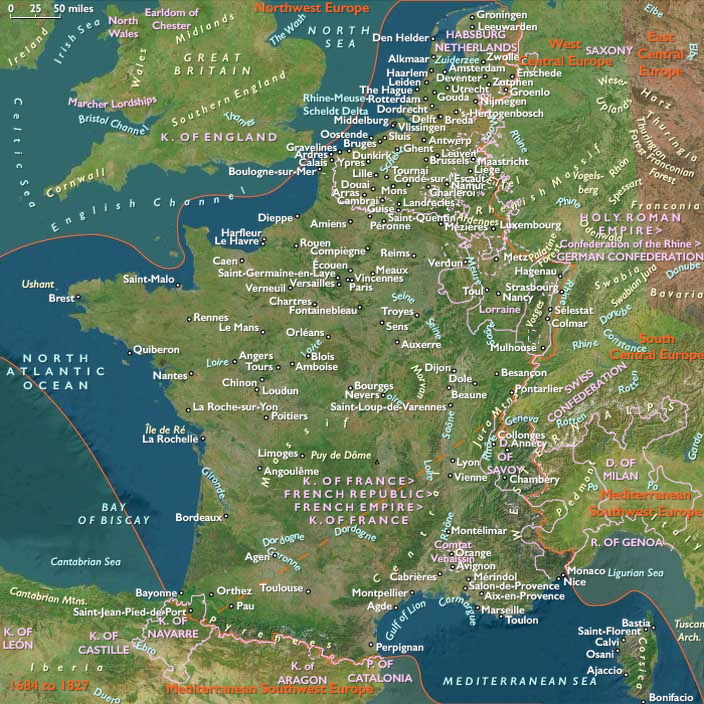
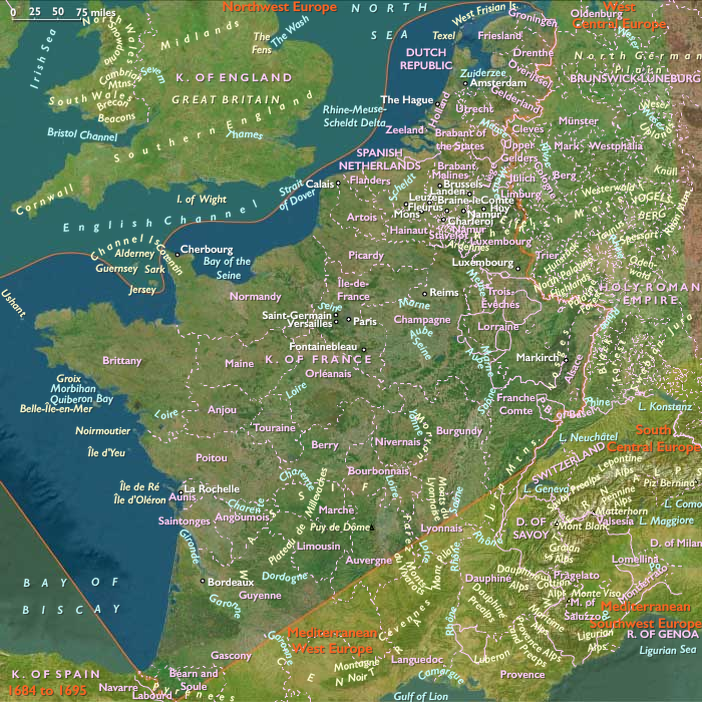
Serving as a brigadier in the War of the Grand Alliance, he had greatly distinguished himself at the battle of Fleurus, and he defends Namur, a fortress of his own creation, when it is besieged by the French in 1692.
French forces, guided by Vauban, had forced the town's surrender on June 5, but the citadel, staunchly defended by Coehoorn, manages to hold on until June 30 before capitulating, bringing an end to the thirty-six-day siege.
Locations
People
- François-Henri de Montmorency, duc de Luxembourg
- Leopold I
- Louis François, Duc de Boufflers, Comte de Cagny
- Louis XIV of France
- Sébastien Le Prestre, Seigneur de Vauban
- William III, Prince of Orange
Groups
- Austria, Archduchy of
- Bavaria, Wittelsbach Duchy of
- Saxony, Electorate of
- Palatinate, Electoral (Wittelsbach)
- Brandenburg, (Hohenzollern) Margravate of
- Sweden, (second) Kingdom of
- Spain, Habsburg Kingdom of
- Savoy, Duchy of
- Hesse-Kassel, Landgraviate of
- Netherlands, Southern (Spanish)
- Netherlands, United Provinces of the (Dutch Republic)
- France, (Bourbon) Kingdom of
- England, (Orange and Stewart) Kingdom of
- Grand Alliance
Topics
Commodoties
Subjects
Regions
Subregions
Related Events
Showing 10 events out of 25 total
Years: 1692 - 1692
June
Locations
People
- François-Henri de Montmorency, duc de Luxembourg
- Leopold I
- Louis François, Duc de Boufflers, Comte de Cagny
- Louis XIV of France
- Sébastien Le Prestre, Seigneur de Vauban
- William III, Prince of Orange
Groups
- Austria, Archduchy of
- Bavaria, Wittelsbach Duchy of
- Saxony, Electorate of
- Palatinate, Electoral (Wittelsbach)
- Brandenburg, (Hohenzollern) Margravate of
- Sweden, (second) Kingdom of
- Spain, Habsburg Kingdom of
- Savoy, Duchy of
- Hesse-Kassel, Landgraviate of
- Netherlands, Southern (Spanish)
- Netherlands, United Provinces of the (Dutch Republic)
- France, (Bourbon) Kingdom of
- England, (Orange and Stewart) Kingdom of
- Grand Alliance
Topics
Commodoties
Subjects
Regions
Subregions