Mehmet, upon winning the throne of the …
Years: 1413 - 1413
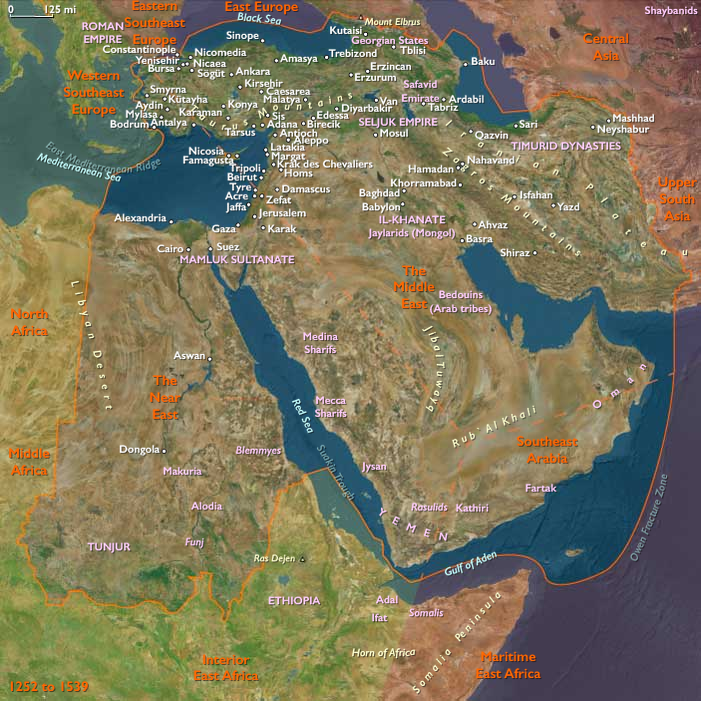
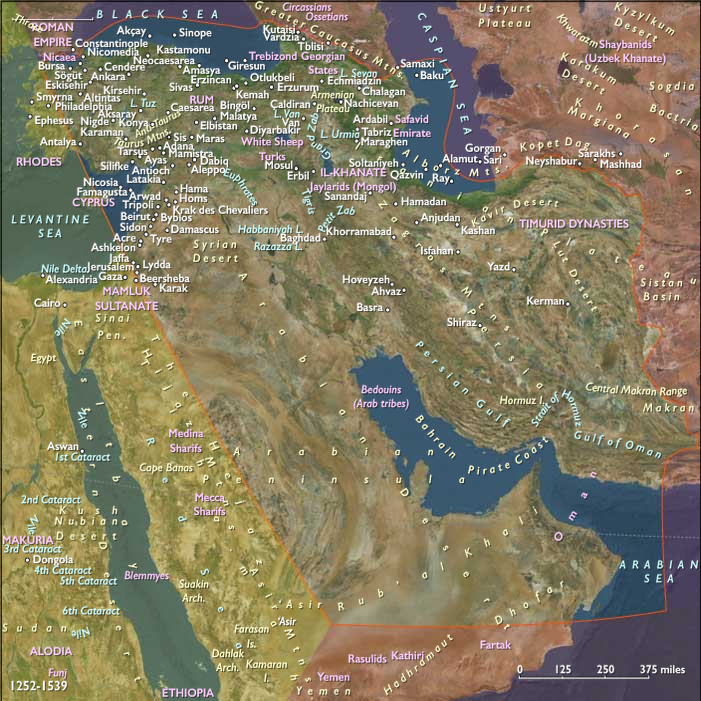
Mehmet, upon winning the throne of the Ottoman Empire from his brothers, banishes the Sufi preacher Bedreddin to the Ottoman city of Iznik.
Locations
People
Groups
Topics
Subjects
Regions
Subregions
Related Events
Filter results
Showing 10 events out of 42362 total
Hus produces his chief work, De ecclesia (1413), in which he proposes a restoration of apostolic simplicity in the life of the church.
Asserting the authority of Scripture over the church, he rejects the absolute authority of popes and councils.
Mûsa again besieges Constantinople.
An avenger appears, however, in the person of Mehmed, Bayezid's youngest son.
Backed by powerful non-Ottoman Turkish notables and allied to the Greeks, Mehmed helps to lift Mûsa's siege, wins the Janissaries to his cause, and fights Mustafa twice before …
…defeating him a third time at Camurlu, capturing him, and ordering his strangulation in 1413.
The University of Aix-en-Provence, founded on December 9, 1409 as a studium generale by Count of Provence Louis II of Anjou, is recognized by Papal Bull in 1413.
The decision to establish the university was, in part, a response to the already-thriving University of Paris.
Thus, the letters patent for the university had ben granted, and the government of the university had been created.
The Archbishop of Aix-en-Provence is appointed as the first chancellor of the university for the rest of his life.
Donatello, born in Florence, most likely in the year 1386, as the son of Niccolò di Betto Bardi, a member of the Florentine Wool Combers Guild, and had been educated in the house of the Martelli family.
He had apparently received his early artistic training in a goldsmith's workshop, then worked briefly in the studio of Lorenzo Ghiberti.
While undertaking study and excavations with Filippo Brunelleschi in Rome (1404–1407), work that had gained the two men the reputation of treasure seekers, Donatello had made a living by working at goldsmiths' shops.
Their Roman sojourn will prove decisive for the entire development of Italian art in the fifteenth century, for it was during this period that Brunelleschi had undertaken his measurements of the Pantheon dome and of other Roman buildings.
Brunelleschi's buildings and Donatello's sculptures are both considered supreme expressions of the spirit of this era in architecture and sculpture, and they will exercise a potent influence upon the artists of the age.
In Florence, Donatello had assisted Ghiberti with the statues of prophets for the north door of the Florence Baptistery, for which he had received payment in November 1406 and early 1408.
He had in 1409–1411, executed the colossal seated figure of Saint John the Evangelist (which until 1588 will occupy a niche of the old cathedral façade, and is now placed in the Museo dell'Opera del Duomo).
This work marks a decisive step forward from late Gothic Mannerism in the search for naturalism and the rendering of human feelings.
The face, the shoulders and the bust are still idealized, while the hands and the fold of cloth over the legs are more realistic.
Donatello has worked from 1411 to 1413 on a marble statue of St. Mark for the guild church of Orsanmichele, adapting the drapery to the body's movement to produce a figure of tremendous organic vitality and unity, and in the process rediscovering contrapposto.
Donatello now seeks to portray his figures as individual personalities rather than as types.

Ferdinand, after the death of his maternal uncle, king Martin I of Aragon (Martin II of Sicily), without surviving legitimate issue, had been chosen king of Aragon in 1412 to succeed him in the Compromise of Caspe.
The other candidate, count James II of Urgell, had revolted and Ferdinand dissolved the county of Urgell in 1413.
The later years of Henry IV’s reign have been marked by serious health problems.
He has a disfiguring skin disease and, more seriously, suffers acute attacks of some grave illness in June 1405, April 1406, June 1408, during the winter of 1408–09, December 1412; and finally in March 1413 a fatal bout.
Medical historians have long debated the nature of this affliction or afflictions.
The skin disease might have been leprosy (which did not necessarily mean precisely the same thing in the fifteenth century as it does to modern medicine), perhaps psoriasis, or some other disease.
The acute attacks have been given a wide range of explanations, from epilepsy to some form of cardiovascular disease.
Some medieval writers felt that he was struck with leprosy as a punishment for his treatment of Richard le Scrope, Archbishop of York, who had been executed in June 1405 on Henry's orders after a failed coup.
According to Holinshed, it had been predicted a that Henry would die in Jerusalem, and Shakespeare's play repeats this prophecy.
Henry had taken this to mean that he will die on crusade.
In reality, he dies in the "Jerusalem" chamber of the house of the Abbot of Westminster, on March 20, 1413, during a convocation of Parliament.
His executor, Thomas Langley, is at his side.
John the Fearless and the Cabochien Revolt (April 1413)
By 1413, John the Fearless, Duke of Burgundy, had secured strong popular support in Paris following his assassination of Louis, Duke of Orléans (1407). Seeking to further consolidate his power, he aligned himself with a radical faction of Parisians known as the Cabochiens, a group of wealthy but non-noble artisans and merchantsled by the butcher Simon Caboche (Simon the Cutler).
With John’s encouragement, the Cabochiens launched a violent uprising in April 1413, targeting Armagnac noblemen and their supporters, seizing key points of the city, and spreading terror throughout Paris.
I. The Cabochien Movement and Its Origins
- The Cabochiens emerged from the rising middle class of artisans, butchers, and merchants, who, despite their wealth, were excluded from noble privileges.
- They resented the aristocracy’s dominance in governance, making them natural allies of John the Fearless, who posed as a champion of the people.
- By mobilizing the Cabochiens, John sought to undermine the power of the Armagnacs while cementing Burgundian influence in Paris.
II. The Cabochien Uprising (April 1413)
- Encouraged by John the Fearless, the Cabochiens took to the streets in April 1413, wearing distinctive white caps and launching a wave of violence against Armagnac nobles.
- Key events of the revolt:
- April 27 – The Bastille is seized, further strengthening Burgundian control.
- Assassination of Pierre des Essarts, the Provost of Paris, an Armagnac supporter.
- Attack on the King’s Palace, where they penetrated the royal residence, demonstrating the weakness of the monarchy.
- The mob terrorized the city, systematically attacking Armagnac households, businesses, and allies.
III. Consequences and the Struggle for Power
- The revolt temporarily strengthened John’s position in Paris, as he positioned himself as the protector of the Cabochiens and their demands for reforms.
- However, the excesses of the uprising alienated much of the nobility, leading to a backlash against the Cabochiens and their Burgundian patrons.
- The revolt’s failure to secure long-term reforms led to its brutal suppression later that year, as the Armagnacs regained control of the government.
IV. Long-Term Impact and the Civil War
- The Cabochien Revolt deepened the divisions between the Armagnacs and the Burgundians, further escalating the civil war.
- Paris remained a battleground between the two factions, making the kingdom even more vulnerable to English intervention.
- The internal chaos contributed to Henry V’s invasion in 1415 and his decisive victory at the Battle of Agincourt, further weakening the French monarchy.
The Cabochien Revolt of 1413, orchestrated by John the Fearless, marked one of the most violent episodes in the Armagnac-Burgundian Civil War, as Paris became a city consumed by factional violence and political intrigue.
Henry V, on his ascension of the English throne in April 1413, restores the Percy family’s lands and titles and gives the remains of Richard II an honorable reburial.
The new king releases the imprisoned Edmund de Mortimer.
The Cabochien Ordinance and the Fall of the Cabochien Regime (May 1413)
During their brief control of Paris in 1413, the Cabochiens, with the backing of John the Fearless, Duke of Burgundy, attempted to impose major administrative reforms that would curb the power of the monarchy. These reforms, known as the Cabochienne Ordinance, were drafted by Burgundian advisors and forced upon King Charles VI. However, the extremism of the Cabochiens and Burgundians soon led to public backlash, ultimately resulting in their downfall.
I. The Cabochienne Ordinance: Burgundian-Backed Reform
- Although named after Simon Caboche, leader of the Cabochien faction, the ordinance was actually the work of John the Fearless' advisors.
- It sought to limit the authority of the monarchy and increase the power of the Estates General, giving them greater control over taxation and royal administration.
- The ordinance forced Charles VI to summon the Estates General in May 1413, where he was compelled to sign the reforms under Cabochien and Burgundian pressure.
II. Growing Public Backlash Against the Cabochiens
- Despite their initial popularity, the violent excesses of the Cabochiens alienated many Parisians.
- The unrest and lawlessness caused by the Cabochien rule, including assassinations and widespread intimidation, led to resentment among merchants and the lower classes.
- The Burgundian control of Paris, instead of stabilizing the situation, only deepened factional divisions, prompting a counter-reaction from the population.
III. The Revolt Against the Cabochiens
- By mid-1413, the Parisians began rising up against the Cabochiens, reversing the initial support they had enjoyed.
- The nobility and moderate factions within the city turned against the radical movement, aligning themselves with the Armagnacs, who were waiting for an opportunity to regain power.
- As a result, the Cabochien government collapsed, and its leaders were either executed or forced into exile.
IV. Consequences and the Resurgence of the Armagnacs
- The failure of the Cabochien revolt and its ordinances allowed the Armagnacs to retake control of the French government.
- John the Fearless, unable to maintain his grip on Paris, lost much of his political influence in the short term.
- The Cabochienne Ordinance was annulled, and the monarchy reasserted control, though the deeper struggles between the Armagnacs and Burgundians continued.
The Cabochien Ordinance of 1413, while an ambitious attempt at constitutional reform, ultimately collapsed due to the violence of its enforcers and the shifting tides of Parisian politics, further intensifying the Armagnac-Burgundian Civil War.