Mehmed heavily besieges the fortress of Krujë …
Years: 1465 - 1465
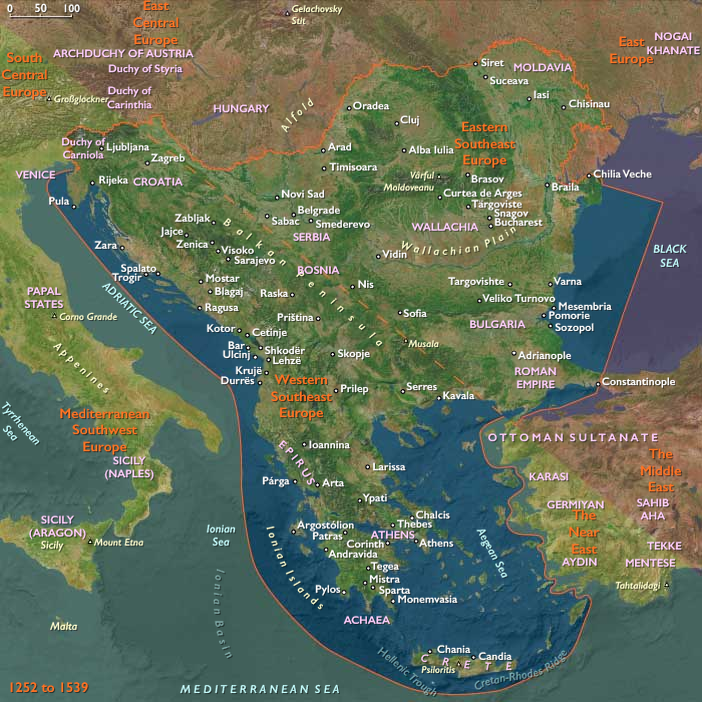
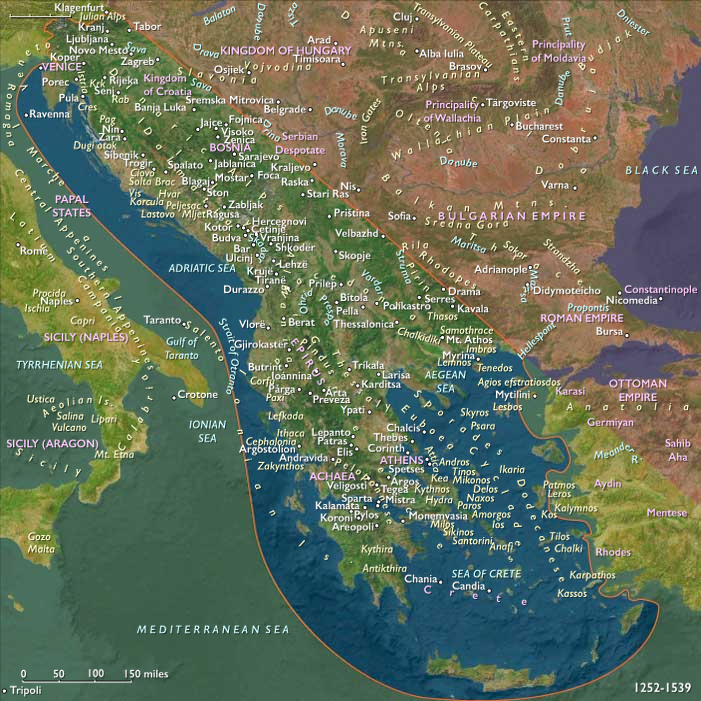
Mehmed heavily besieges the fortress of Krujë in 1465, devastating the Albanian countryside and costing Skanderbeg his Albanian allies, who desert him.
Skanderbeg nevertheless repulses the invasion.
Locations
People
Groups
Topics
Commodoties
Subjects
Regions
Subregions
Related Events
Filter results
Showing 10 events out of 17 total
The treaty that puts an end to the War of the Castilian Succession is signed in the Portuguese city of Alcáçovas on September 4, 1479.
The agreement is ratified by the King of Portugal on September 8, 1479, and by the Monarchs of Castile and Aragon in Toledo on March 6, 1480.
The treaty is also known as the Treaty of Alcáçovas-Toledo.
The war had ended with a victory of the Catholic Monarchs on land and a Portuguese victory on the sea.
The four peace treaties signed at Alcáçovas reflect this outcome: Isabella is recognized as Queen of Castile while Portugal attains hegemony in the Atlantic Ocean.
By this agreement, Afonso V renounces his aspirations to the throne of Castile, while Isabella and Ferdinand renounce any aspirations to the Portuguese throne.
The two Crowns divide their areas of influence in the Atlantic: Portugal gains control of most of the territories, with the exception of the Canary Islands (the islands of Gran Canaria, La Palma, and Tenerife are yet to be conquered).
Joanna la Beltraneja renounces all her Castilian titles, and is given the option of either marrying the heir of Isabella and Ferdinand, Prince John, or retiring to a convent.
Joanna chooses to do the latter, although she will remain active in politics until her death.
Isabella, Princess of Asturias, daughter of Isabella and Ferdinand, marries Afonso, Prince of Portugal, the heir to the Portuguese throne; the parents of the bride pay a large dowry that in practice represents war compensation obtained by Portugal.

Joanna of Castile: A Brilliantly Educated Infanta and Future Queen (1496)
Joanna of Castile (1479–1555), born in Toledo, was the third child and second daughter of Isabella I of Castile and Ferdinand II of Aragon. As a member of the House of Trastámara, she was not initially expected to inherit the thrones of Castile and Aragon, but fate would later make her one of the most powerful women in Europe.
A Rigorous Royal Education
Queen Isabella I ensured that Joanna and her sisters—Isabella, Maria, and Catherine—received an exceptional education, preparing them for diplomatic marriages and leadership roles.
Academic Studies
- Canon and civil law, genealogy and heraldry, grammar, history, mathematics, and philosophy.
- Exposure to classical literature, reading:
- Christian poets Juvencus and Prudentius.
- Church Fathers Saint Ambrose, Saint Augustine, Saint Gregory, and Saint Jerome.
- Roman statesman Seneca.
Language Mastery
- She excelled in Iberian Romance languages, including:
- Castilian, Leonese, Galician-Portuguese, and Catalan.
- Fluent in French and Latin, enabling her to communicate with European courts.
Courtly and Artistic Training
- Skilled in dancing, music, etiquette, drawing, and embroidery.
- Accomplished in clavichord, guitar, and monochord performance.
- Learned equestrian skills, hawking, and hunting, preparing her for courtly and diplomatic life.
Signs of Religious Skepticism (1495)
- By 1495, Joanna showed early signs of skepticism toward Catholic practices, which deeply alarmed her mother, Queen Isabella.
- Her lack of devotion and questioning of Christian rites was considered dangerous in an era of strict religious orthodoxy.
- Queen Isabella ordered that this be kept secret, fearing political repercussions and damage to Joanna’s marriage prospects.
A Dynastic Marriage: Betrothal to Philip the Handsome (1496)
-
At age 16, in 1496, Joanna was betrothed to Philip the Handsome, the 18-year-old son of Holy Roman Emperor Maximilian I and Mary of Burgundy.
-
This marriage was a key diplomatic alliance, strengthening ties between Spain and the Habsburg Empire, ensuring:
- Stronger ties between Spain and the Holy Roman Empire.
- Habsburg influence in the Iberian Peninsula.
- A united front against France, a rival to both Spain and the Habsburgs.
-
Joanna entered a proxy marriage at the Palacio de los Vivero in Valladolid, the same palace where her parents, Isabella and Ferdinand, had secretly wed in 1469.
A Future Beyond Expectation
- Although not originally expected to rule, Joanna would eventually inherit both Castile and Aragon, becoming Queen of Spain (1504) and titular Queen of Aragon (1516).
- Her marriage to Philip the Handsome would make her the matriarch of the powerful Habsburg dynasty, and mother of Emperor Charles V.
- Her life would take a dramatic and tragic turn, as she became known to history as "Joanna the Mad" (Juana la Loca) due to political intrigues and mental health controversies.
At 16, however, she was still a brilliant, educated, and politically significant infanta, about to embark on a marriage that would reshape the balance of European power for generations.
Joanna of Castile’s Departure for Flanders (August 22, 1496)
On August 22, 1496, Joanna of Castile, daughter of Isabella I of Castile and Ferdinand II of Aragon, set sail from Laredo, a northern Spanish port on the Bay of Biscay, to embark on her journey to Flanders in the Low Countries.
This journey marked the beginning of her marriage to Philip the Handsome, heir to the Habsburg domains, a union that would have major political consequences for Europe.
A Farewell to Her Family
- Joanna would never see her parents again after leaving Spain.
- She would also never see her siblings again, except for her youngest sister, Catherine of Aragon, whom she met in 1506 when Catherine was Princess Dowager of Wales, following the death of her first husband, Arthur, Prince of Wales.
Political and Dynastic Importance of the Journey
- Joanna’s marriage to Philip the Handsome was part of the Spanish-Habsburg alliance, strengthening ties between Spain and the Holy Roman Empire.
- This alliance was meant to:
- Counterbalance France, Spain’s greatest rival.
- Establish Spanish influence in Northern Europe.
- Solidify Habsburg control over key European territories.
Arrival in Flanders and Future Consequences
- Joanna arrived in Flanders in September 1496, where she would meet Philip the Handsome for the first time.
- Their marriage would eventually make Joanna the Queen of Castile (1504) and Aragon (1516), uniting Spain under Habsburg rule.
- Their son, Charles V, would become Holy Roman Emperor and King of Spain, ruling over a vast empire spanning Europe, the Americas, and Asia.
Joanna’s departure in 1496 marked the beginning of her tumultuous life in the Habsburg court, where she would experience political struggles, accusations of madness, and eventual confinement, forever shaping Spain’s dynastic future.
King Manuel I and the Forced Conversion of Portuguese Jews (1496–1497)
King Manuel I of Portugal (r. 1495–1521) was a deeply religious monarch, known for his missionary sponsorship, crusading ambitions, and grand architectural projects, such as the Monastery of Jerónimos. However, his reign also marked the forced conversion and expulsion of Jews and Muslims from Portugal, a dramatic shift from the relative tolerance under previous kings.
Initial Favorable Treatment of Jews Under Manuel I
- When Manuel ascended the throne in 1495, he initially had good relations with the Jewish community.
- One of his first acts as king was to release all Jews who had been imprisoned during the reign of his predecessor, John II.
- The Jewish population in Portugal was highly educated, contributing to finance, medicine, science, and commerce.
The Marriage Alliance That Changed Everything (1496)
- Manuel sought to marry Infanta Isabella of Aragon, the eldest daughter of Ferdinand and Isabella of Spain and heiress to the future unified Spanish throne.
- However, the Catholic Monarchs had expelled all Jews from Spain in 1492, and they refused to marry their daughter to a king who still tolerated Jews and Muslims.
- As a condition of the marriage, Manuel agreed to expel or forcibly convert all Jews and Muslims in Portugal.
The Decree of Expulsion and Forced Conversions (December 1496)
- In December 1496, Manuel issued an edict requiring all Jews to either convert to Christianity or leave Portugal.
- However, the decree imposed harsh conditions:
- Jews who chose to leave had to abandon their children, who would be taken and raised as Christians.
- They could only leave on ships designated by the king, giving the Crown complete control over their departure.
The Lisbon Port Trap: Forced Baptisms (1497)
- When Jews who had opted for expulsion arrived at the port of Lisbon, they were met by clerics and soldiers.
- Instead of allowing them to board ships, authorities used:
- Coercion, threats, and deception to force baptisms.
- Violence and physical force to prevent departures.
- Promises of safety if they accepted conversion.
- Most Jews were forcibly baptized, and their legal presence in Portugal "technically ended"—though many continued practicing Judaism in secret.
The Creation of the "New Christians"
- After the mass conversion of Jews, they and their descendants became known as "New Christians" (Cristãos-Novos).
- A grace period of 30 years was granted, during which no official inquiries into their faith were allowed.
- However, many Old Christians remained suspicious, leading to rising anti-Semitic sentiment and persecution.
- In 1536, under King John III, Portugal established the Portuguese Inquisition, targeting crypto-Jews ("Marranos") suspected of secretly practicing Judaism.
Consequences of Manuel I’s Policy
-
Portugal Lost a Skilled and Educated Population
- Many Jewish doctors, merchants, and scholars fled Portugal (often to the Ottoman Empire, Italy, and the Netherlands).
- Portugal’s scientific and economic progress suffered.
-
Crypto-Judaism and the Portuguese Inquisition
- Many converted Jews (Conversos) secretly practiced their faith, leading to accusations of heresy.
- By 1536, the Inquisition targeted these New Christians, leading to persecution, imprisonment, and executions.
-
The Marriage to Isabella and the End of Religious Tolerance
- Manuel’s marriage to Isabella in 1497 secured his ties to Spain but came at the cost of Portugal’s historic religious pluralism.
Conclusion: A Turning Point in Portuguese Religious Policy
- Manuel I, despite his initial tolerance, ultimately succumbed to political pressure from Spain, enforcing one of the largest forced conversions in Iberian history.
- While his reign led to Portugal’s Golden Age of Exploration, his religious policies resulted in suffering, exile, and the eventual establishment of the Portuguese Inquisition.
- The expulsion and forced conversion of Jews and Muslims marked the end of an era of relative coexistence in Portugal and set the stage for religious persecution in the following centuries.
Ferdinand and Isabella had become convinced by March 28, 1497, that Perkin Warbeck's significance was waning and war between England and Scotland must be avoided.
Doctor Puebla, in London, had been instructed to placate Henry VII, who had heard that Ayala was credulous in believing the Scottish account of the situation.
James IV still refuses to hand Perkin, his guest, to the English.
Henry VII considers the offers made at Jenyn Haugh by the Earl of Angus and Lord Home as inadequate and asks the Bishop of Durham to press James IV to surrender Perkin before negotiations for peace commence.
A tax imposed by Henry to support military action related to punishing Scotland for their aid in Warbeck’s revolt prompts objections by Thomas Flammock, a Cornish landowner of an old family, who also objects that only northern barons are obliged to defend the Scots frontier.
Flammock and townsman Michael Joseph, agreeing to lead Cornish protesters to London to lay their grievances and demands before Henry, enter Taunton with a vast mob, there killing its provost, then continues to …
…Wells.
Here acquiring a noble leader in Lord Audley, …
…the mob marches on London, where, on June 22, 1497 at Deptford Strand, Henry VII’s troops thoroughly defeat the rebels, seizing and executing Flammock, Joseph, and other leaders.
James relents soon after the meeting with the Bishop of Durham.
Now wishing to be rid of Warbeck, he provides a recently impounded French ship called the Cuckoo, captained by a reluctant hired Breton called Guy Foulcart, who in July 1497 returns Perkin in shame to Waterford.
The under-equipped Perkin once again attempts to lay siege to Waterford, but this time his effort lasts only eleven days before he is forced to flee Ireland, chased by four English ships.
According to some sources, by this time he was left with only one hundred and twenty men on two ships.
James IV, now when all seems settled, orders his artillery to be taken to the Scottish border, doubtless to Ayala's embarrassment.
The guns include Mons Meg, and Bishop Foxe's Norham Castle is the objective.
According to George Buchanan this followed the new provocation of a border incident.
James, perhaps close to exhausting his resources, abandons the siege and by August 12 returns to Edinburgh.
An English army led by the Earl of Surrey now arrives on the border and takes Ayton Castle near Berwick upon Tweed.
The historian Norman MacDougall suggests that after a standoff of a few days, James IV made a truce on August 20, 1497, during an interview with Sir William Tyler, Governor of Berwick, at Dunbar Castle.
Surrey's army begins to withdraw the next day, and James sends letters around Scotland canceling his requests for military support.