
Mehmed has sent messengers in all directions …
Years: 1462 - 1462
May
Mehmed has sent messengers in all directions to assemble an army.
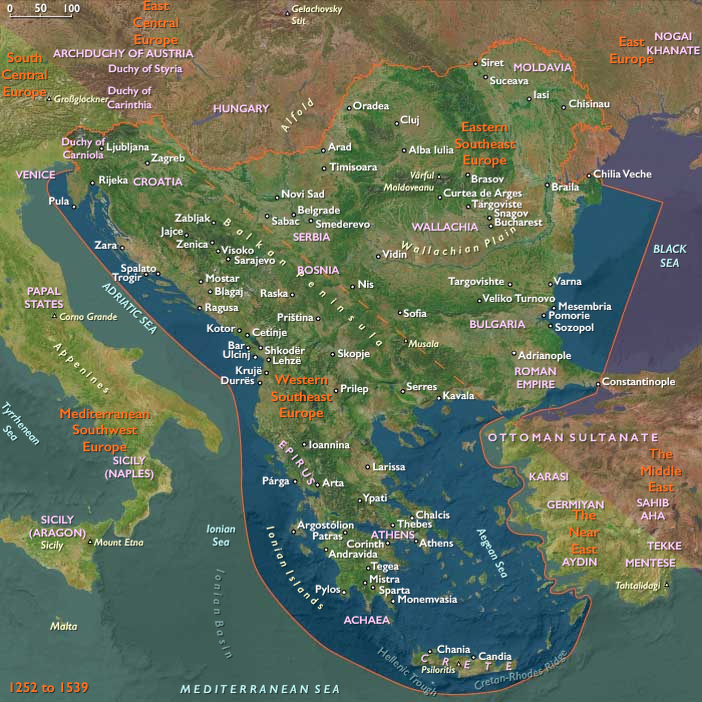
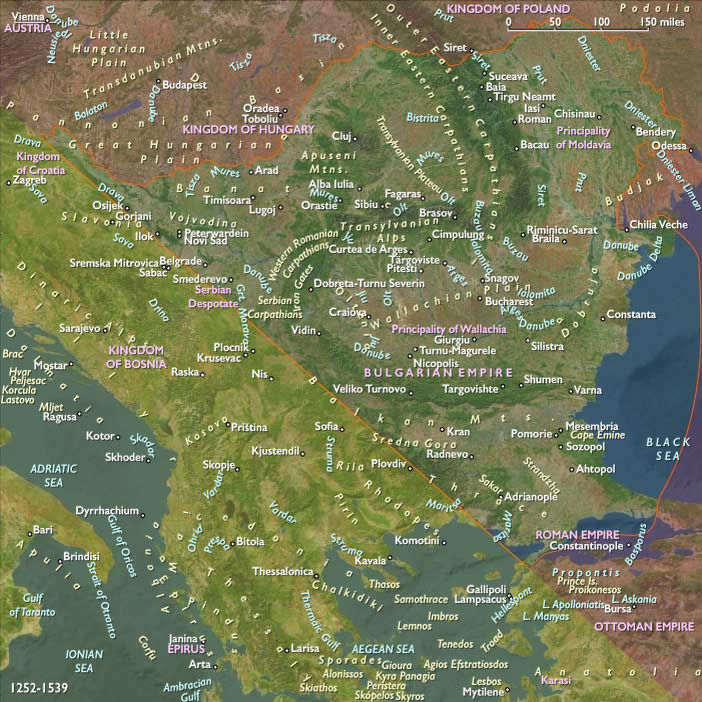
The sultan moves with his army from Constantinople on April 26 or May 17, 1462 with the objective of conquering Wallachia and annexing the land to his empire.
The Sultan himself writes in a letter addressed to one of his grand viziers, that he took one hundred and fifty thousand men with him.
The Greek historian Laonikos Chalkokondyles wrote of Mehmed's army as "huge, second in size only to the one that this sultan had led against Constantinople."
He estimated the force at two hundred and fifty thousand, while the Turkish historian Tursun Bey mentioned three hundred thousand.
The same numbers were put by an anonymous Italian chronicle found in Verona, believed to have been written by a certain merchant named Cristoforo Schiappa.
A letter of a Leonardo Tocco to Francesco I Sforza, duke of Milan, wrote that Mehmed had recruited four hundred thousand men from Rumelia and Anatolia, with forty thousand being constructers of bridges armed with axes.
These numbers are deemed exaggerations.
A more realistic number is the one given by Venetian envoy at Buda, Tommasi, who mentioned a regular force of sixty thousand and some thirty thousand irregulars.
These consistsof the janissaries (the elite troops); infantry soldiers; sipâhis (the feudal cavalry); saiales (the sacrificial units composed of enslaved men who would win their freedom if they survived); acings (the archers); silahdârs (the custodians of the sultan's weapons who also protect the flanks); azabs (the pikemen); beshlis (who handle the firearms); and the praetorian guard that serves as the sultan's personal bodyguards.
Vlad's half-brother, Radu the Handsome, who willingly serves the sultan, commands four thousand horsemen.
In addition to this, the Turks bring with them one hundred and twenty cannon, engineers and workers that will build roads and bridges, priests of Islam (ulema) and muezzin, who call the troops to prayer, astrologers who consult Mehmed and help im make military decisions; and women "reserved for the night pleasures of the men."
Chalcocondyles reports that the Danube shipowners were paid three hundred thousand gold pieces to transport the army.
In addition to this, the Ottomans use their own fleet, which consists of twenty-five triremes and one hundred and fifty smaller vessels.
Locations
People
- Francesco I Sforza
- Laonikos Chalkokondyles
- Mahmud Pasha Angelovic
- Mehmed II
- Radu cel Frumos
- Stephen III of Moldavia
- Vlad the Impaler
Groups
- Oghuz Turks
- Islam
- Bulgarians (South Slavs)
- Papal States (Republic of St. Peter)
- Romanians
- Christians, Roman Catholic
- Christians, Eastern Orthodox
- Hungary, Kingdom of
- Bulgaria, Ottoman
- Wallachia, Principality of
- Ottoman Empire
Topics
Commodoties
Subjects
Regions
Subregions
Related Events
Showing 10 events out of 41190 total
Years: 1462 - 1462
May
Locations
People
- Francesco I Sforza
- Laonikos Chalkokondyles
- Mahmud Pasha Angelovic
- Mehmed II
- Radu cel Frumos
- Stephen III of Moldavia
- Vlad the Impaler
Groups
- Oghuz Turks
- Islam
- Bulgarians (South Slavs)
- Papal States (Republic of St. Peter)
- Romanians
- Christians, Roman Catholic
- Christians, Eastern Orthodox
- Hungary, Kingdom of
- Bulgaria, Ottoman
- Wallachia, Principality of
- Ottoman Empire
Topics
Commodoties
Subjects
Regions
Subregions