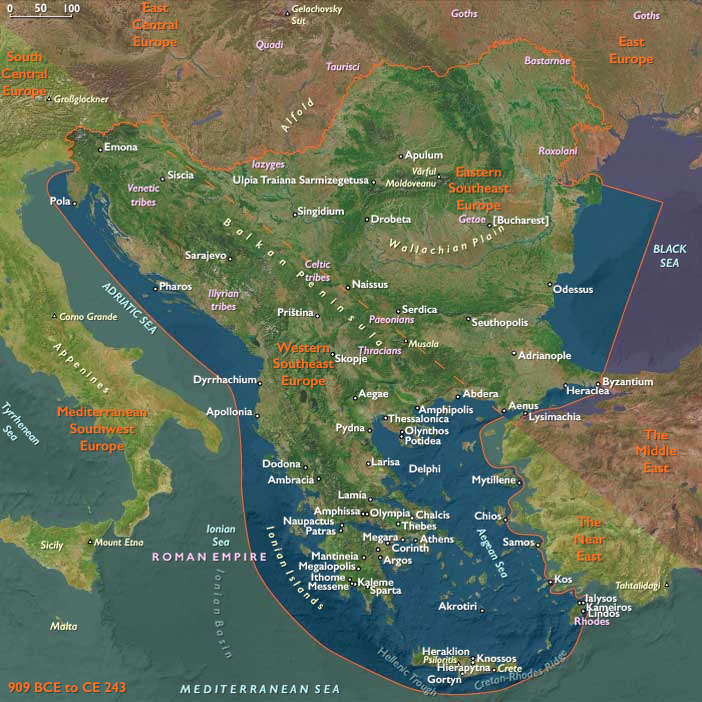
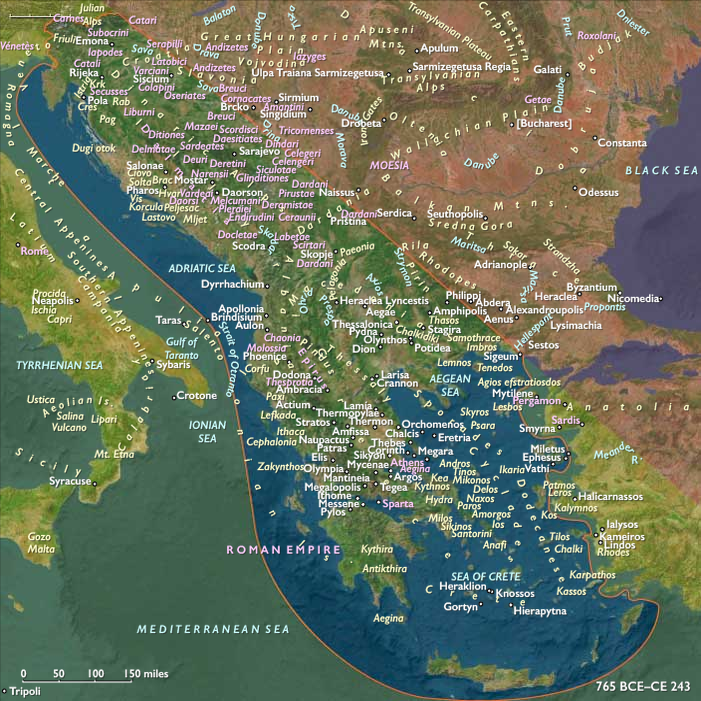
Megacles, Archon of Athens from 922 BCE …
Years: 897BCE - 886BCE
Megacles, Archon of Athens from 922 BCE to 892 BCE, is succeeded in office by Diognetus; both rulers are possibly legendary.
Locations
Groups
Topics
Commodoties
Subjects
Regions
Subregions
Related Events
Filter results
Showing 10 events out of 66620 total
The reigns of the sixth, seventh, eighth, and ninth kings of Zhou (Gong, Yi (Ji Jian), Xiao, and Yi (Ji Xie)), reigning from 922 to 878 BCE, are poorly documented.
The ninth king is said to have boiled the Duke of Qi in a cauldron, implying that the vassals were no longer obedient.
The Middle East, 897 to 886 BCE: Consolidation Under Tukulti-Ninurta II
Following the transformative reign of Adad-nirari II, the Neo-Assyrian Empire enters a brief yet significant period of consolidation under his successor, Tukulti-Ninurta II, who ascends to the Assyrian throne in 891 BCE. Inheriting an empire greatly expanded by his predecessor, Tukulti-Ninurta II focuses on solidifying Assyrian control and maintaining its established territories rather than undertaking extensive new conquests.
Strategic Military Actions and Regional Stability
Tukulti-Ninurta II undertakes carefully targeted military campaigns aimed at reinforcing Assyrian supremacy. His reign sees successful operations against the Syro-Hittite, Babylonian, and Aramean city-states and regions. These campaigns serve to reaffirm and stabilize Assyrian dominance over previously conquered territories, discouraging rebellion and fostering administrative cohesion across the empire.
Eastern Frontiers: Zagros Campaigns
Notably, Tukulti-Ninurta II directs his military attention eastward, toward the rugged terrain of the Zagros Mountains. These campaigns effectively subjugate newly arrived groups of Iranic peoples, potentially including the early Medes. By securing these eastern frontier regions, Tukulti-Ninurta II ensures a stable buffer zone, protecting the empire from incursions and establishing a solid foundation for future expansions in this direction.
Administrative Continuity
Building upon the linguistic and administrative reforms established earlier, Aramaic continues to serve alongside Akkadian as an official administrative language. This linguistic policy facilitates efficient governance over the empire's culturally diverse and geographically extensive territories.
Preparing for Further Expansion
Though Tukulti-Ninurta II's reign is brief, his strategic actions significantly bolster Assyrian stability and regional control, laying critical groundwork for subsequent imperial expansion. By the end of his rule, the Assyrian Empire stands securely positioned, its power firmly established in the Middle Eastern political landscape, ready for the ambitious campaigns of future rulers.
Tukulti-Ninurta II succeeds his father Adad-nirari II in 891 as king of Assyria.
During his brief reign, he consolidates the gains made by his father over the Syro-Hittites, Babylonians and Arameans, and successfully campaigns in the Zagros Mountains of Iran, subjugating the newly arrived Iranic peoples of the area, possibly including the Medes.
The Near East (897–886 BCE): Religious Reform, Strategic Alliances, and Dynastic Transitions
Dynastic Stability and Intrigue in Egypt
The reign of Osorkon I, who presides peacefully and prosperously over Egypt’s Twenty-second Dynasty, concludes around 887 BCE. Although Osorkon’s tomb has never been discovered, his extensive temple-building activities underscore the stability and cultural revival he fostered. His likely successor, Takelot I, ascends to the throne amidst uncertainty caused by evidence of a possible intervening reign by Heqakheperre Shoshenq II. Shoshenq II, possibly Osorkon's son by senior wife Queen Maatkare B or even another son of Shoshenq I, briefly asserts independent rule from Tanis. His short tenure, lasting approximately two years, is marked by the grandeur of his tomb, richly furnished with jewelry, a distinctive falcon-headed silver coffin, and a golden death mask, reflecting genuine royal authority rather than mere co-regency.
Religious Reformation and Military Strategy in Judah
In the Kingdom of Judah, King Asa (circa 913–873 BCE) advances significant religious reforms. He continues purging pagan practices, notably banning male cult prostitution and dismantling worship of the Canaanite goddess Asherah, actions that lead to the removal of his own grandmother, Queen Mother Maacah, from power due to her adherence to these practices.
Following thirty-five years of relative tranquility, Asa bolsters Judah’s defensive infrastructure, reinforcing fortifications originally established by his grandfather, Rehoboam. This period of stability is disrupted by military threats, notably an invasion led by Zerah the Ethiopian—possibly identified as either Pharaoh Osorkon I or Osorkon II—backed by Egyptian forces. Asa successfully repels Zerah’s numerically superior forces in the Valley of Zephath near Mareshah, securing Judah from further Egyptian aggression for generations.
Late in Asa’s reign, the Northern Kingdom of Israel, under King Baasha, constructs the strategic fortress of Ramah, placing direct pressure on Judah's capital, Jerusalem. In response, Asa strategically aligns with King Ben-Hadad I of Aram Damascus, incentivizing him to break peace with Baasha and attack northern Israelite cities. This maneuver forces Baasha to abandon Ramah, allowing Asa to dismantle the fortress and repurpose its materials to strengthen Judah’s border fortresses at Geba and Mizpah.
Persistent Conflict and Instability in Israel
Meanwhile, the Northern Kingdom of Israel experiences ongoing instability under the reign of King Baasha (circa 909–886 BCE). Having ascended through assassination and political violence, Baasha rules for twenty-three years, characterized by continued warfare against Judah and internal unrest. Biblical historians later describe Baasha negatively, emphasizing his role in perpetuating religious and political instability within Israel.
Summary of the Era
From 897 to 886 BCE, the Near East is defined by profound religious reforms and strategic geopolitical maneuvers in Judah, a stable yet transitional dynastic period in Egypt, and persistent turmoil within Israel. These developments collectively illustrate the complexities of the period, foreshadowing further regional transformations.
Baasha (who like all of the northern kings, “did what was evil in the sight of the Lord,” according to the interpretation of the Deuteronomists) reigns for twenty-three years.
Over the course of his long reign, Baasha has been at war with Asa of Judah.
Asa, according to the Bible, inaugurates religious reforms, such as banning male cult prostitutes and the worship of the Canaanite goddess Asherah, consort of El, that had been sponsored by his mother, Maachah, the queen regent.
After a period of intermittent warfare between Judah and Israel, Judah enters into an alliance with the growing kingdom of Aram Damascus, by which the latter attacks northern Israel, thus relieving pressure on Judah.
Asa of Judah, taking advantage of thirty-five years of peace, has revamped and reinforced the fortresses originally built by his grandfather Rehoboam.
An invasion by the Egyptian-backed chieftain Zerah the Ethiopian (who, given the time frame with Asa's reign, may either be Pharaoh Osorkon II or Osorkon I) and his million men and three hundred chariots is defeated by Asa's five hundred and eighty thousand men (these figures come from 2 Chronicles) in the Valley of Zephath, near Mareshah (2 Chronicles 14:9-15).
The Bible does not state whether Zerah was a pharaoh or a general of the army.
The Ethiopians were pursued all the way to Gerar, in the coastal plain, where they stopped out of sheer exhaustion.
The resulting peace will keep Judah free from Egyptian incursions until the time of Josiah, some centuries later.
In Asa's 36th year, King Baasha of Israel attacks the Kingdom of Judah (2 Chronicles 16:1; the Seder Olam and some later commentators take this as the thirty-sixth year since the division of the kingdom, not the thirty-sixth year of Asa's reign).
Baasha builds the fortress of Ramah on the border, less than ten miles from Jerusalem.
The result is that the capital is under pressure and the military situation is precarious.
Asa takes gold and silver from the Temple and sends them to Ben-Hadad I, king of Aram Damascus, in exchange for the Damascene king canceling his peace treaty with Baasha.
Ben-Hadad I attacks Ijon, Dan, and many important cities of the tribe of Naphtali, and Baasha is forced to withdraw from Ramah.
Asa tears down the unfinished fortress and uses its raw materials to fortify Geba and Mizpah, on his side of the border (2 Chronicles 16:1-7).
The reign of Osorkon I, who dies in 887 BCE, has been peaceful and uneventful.
His tomb has never been found.
Although Osorkon I is thought to have been directly succeeded by his son Takelot I, it is possible that another ruler, Heqakheperre Shoshenq II, intervened briefly between these two kings because Takelot I was a son of Osorkon I through Queen Tashedkhons, a secondary wife of this king.
In contrast, Osorkon I's senior wife was Queen Maatkare B, who may have been Shoshenq II's mother.
However, Shoshenq II could also have been another son of Shoshenq I since the latter was the only other king to be mentioned in objects from Shoshenq II's intact royal tomb at Tanis aside from Shoshenq II himself.
These objects are inscribed with either Shoshenq I's praenomen Hedjkheperre Shoshenq (though this is not certain as it requires reading the objects as a massive hierogylyphic text), or Shoshenq, Great Chief of the Meshwesh, which was Shoshenq I's title before he became king.
Since Derry's forensic examination of his mummy reveals him to be a man in his fifties upon his death, Shoshenq II could have lived beyond Osorkon's thirty-five-year reign and Takelot I's thirteen-year reign to assumed the throne for a few short years.
An argument against this hypothesis is the fact that most kings of the period were commonly named after their grandfathers, and not their fathers.
While the British scholar Kenneth A. Kitchen views Shoshenq II to be the High Priest of Amun at Thebes Shoshenq C, and a short-lived coregent of Osorkon I who predeceased his father, the well-respected German Egyptologist Jürgen von Beckerath in his seminal 1997 book, Chronologie des Pharaonischen Ägypten, maintains that Shoshenq II was rather an independent king of Tanis who ruled the Twenty-second Dynasty in his own right for about two years.
Von Beckerath's hypothesis is supported by the fact that Shoshenq II employed a complete royal titulary along with a distinct prenomen Heqakheperre and his intact tomb at Tanis was filled with numerous treasures including jeweled pectorals and bracelets, an impressive falcon-headed silver coffin and a gold face mask—items which indicate a genuine king of the Twenty-second Dynasty.
More significantly, however, no mention of Osorkon I's name was preserved on any ushabtis, jars, jewelry or other objects within Shoshenq II's tomb.
This situation would be improbable if he was indeed Osorkon I's son, and was buried by his father, as Kitchen's Chronology suggests.
These facts, taken together, imply that Sheshonq II ruled on his own accord at Tanis and was not a mere coregent.

A city on the site of present Guangzhou (formerly known as Canton), situated eighty miles (one hundred and thirty kilometers) inland from the South China Sea at the northern apex of the Pearl (Zhu, or Chu) River delta, which is built up by the West (Xi; Hsi), North (Bei; Pei), and East (Deng; Tung) rivers, may have been established as early as 887.
Guangzhou is today the third largest city in China and southern China's largest city.
As of the 2010 census, the city had a population of 12.78 million.
There are wars in the south during the reign of King Yi, the ninth sovereign of the Chinese Zhou Dynasty,twith the State of Chu and the southern branch of the Dongyi, a collective term for people in eastern China and in lands located to the east of ancient China.
King Yi of Zhou was preceded by his uncle, King Xiao of Zhou, who may have overthrown his father.
Estimated dates of King Yi’s reign are 885–878 BCE or 865–858 BCE.
King Yi, in the third year of his reign, sides with the Marquis of Ji in a dispute with Duke Ai of Qi and executes the latter by boiling him to death in a large cauldron.
King Yi installs Duke Ai's younger half-brother Jing on the throne of Qi; he is later known as Duke Hu of Qi.
The Middle East, 885 to 874 BCE: Expansion and Brutality Under Ashurnasirpal II
The Neo-Assyrian Empire enters a dramatically expansive era with the accession of Ashurnasirpal II in 883 BCE, succeeding his father Tukulti-Ninurta II. Recognizing the limitations of Assyria’s poor agricultural base to sustain a growing population, Ashurnasirpal embarks on aggressive military campaigns to plunder neighboring regions, solidifying a growing imperial ideology rooted in the supremacy of the god Ashur.
Military Conquests and Imperial Control
Ashurnasirpal II strategically shifts from reliance on tributary client states to direct Assyrian administration by appointing Assyrian governors, drastically reducing the risk of rebellion. His military strategy, characterized by brutality, terrorizes enemies into submission. This approach is exemplified in the suppression of a revolt in the city of Suru in Bit-Halupe, where captured rebels suffer gruesome punishments as a stark warning to others.
Expansion to the Mediterranean
By 877 BCE, Ashurnasirpal’s campaigns have reached the Mediterranean coast, marking a significant milestone as an Assyrian army touches these shores for the first time. He imposes tribute upon Phoenician city-states without destroying them, exploiting their access to valuable resources such as Lebanese cedar, iron, gold, and silver—materials crucial to Assyria’s military and architectural ambitions.
Kalhu (Nimrud): A New Imperial Capital
In 879 BCE, Ashurnasirpal relocates his capital to Kalhu (Nimrud), situated in modern-day Iraq north of Baghdad. Here, he employs thousands of enslaved captives to construct grand palaces, temples, and public buildings. The opulence of these constructions, notably the North-West Palace, stands as a testament to Assyrian wealth and artistry.
Ashurnasirpal’s palaces feature elaborate alabaster reliefs depicting the king’s military prowess, hunting achievements, and divine favor. Each relief contains inscriptions—known as the Standard Inscription—detailing the king’s lineage, military successes, imperial boundaries, and the founding of Kalhu.
Cultural Influence and Legacy
Assyria’s dominance significantly impacts neighboring regions. In Cyprus, particularly in Salamis, archaeological evidence from the Late Bronze Age III and Early Iron Age reveals significant Phoenician presence, indicated by children’s burials in Canaanite jars, highlighting the interconnected nature of Mediterranean trade networks influenced by Assyrian expansion.
Archaeological Discoveries
The grandeur of Ashurnasirpal II’s reign is rediscovered in the 1840s by British archaeologist A.H. Layard, who excavates the North-West Palace in Nimrud. Today, these alabaster reliefs are preserved and displayed in prestigious museums worldwide, including the British Museum in London, providing lasting insights into the power and splendor of the Neo-Assyrian Empire under Ashurnasirpal II.