
West Europe (909 BCE – 819 CE): …
Years: 909BCE - 819
West Europe (909 BCE – 819 CE): From Roman Gaul to Frankish Christendom
Regional Overview
From the Pyrenees to the Low Countries, West Europe evolved across two millennia from a patchwork of Celtic tribes and Roman provinces into the western half of Charlemagne’s empire.
Its dual geography—Mediterranean Gaul to the south and Atlantic Gaul to the north—gave the region both a seaward reach and a continental core.
The Rhône, Loire, and Seine bound these worlds together, channeling grain, wine, salt, and ideas between coast and hinterland.
By the early ninth century, these linked river kingdoms had become the agricultural and cultural heart of Latin Christendom.
Geography and Environment
West Europe straddled two climatic zones.
-
The Mediterranean south enjoyed mild, dry summers and fertile terraces suited to vines and olives.
-
The Atlantic north experienced wetter, temperate seasons ideal for cereals and pastures.
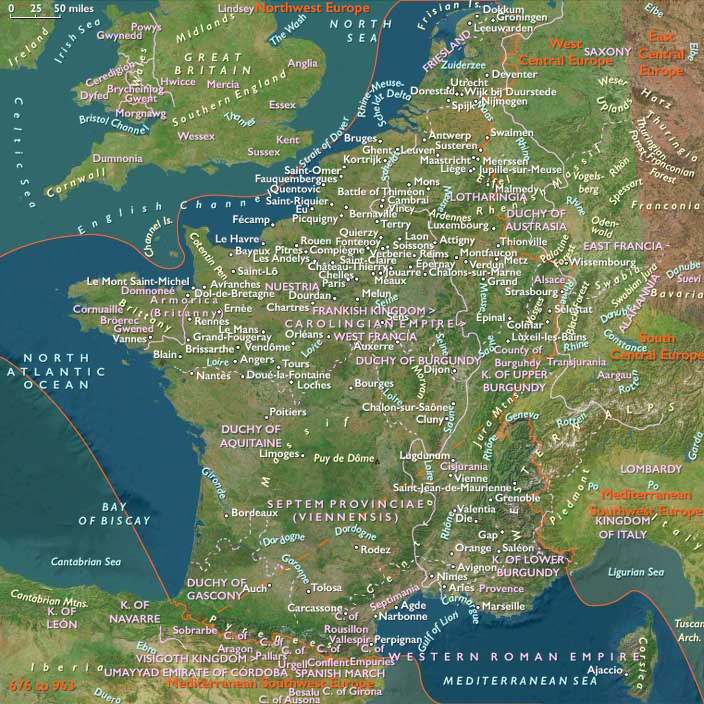
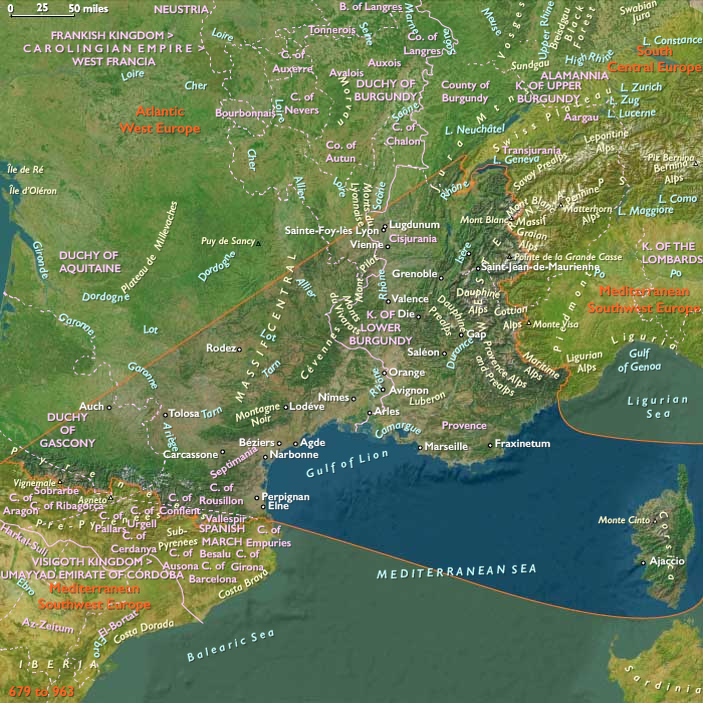
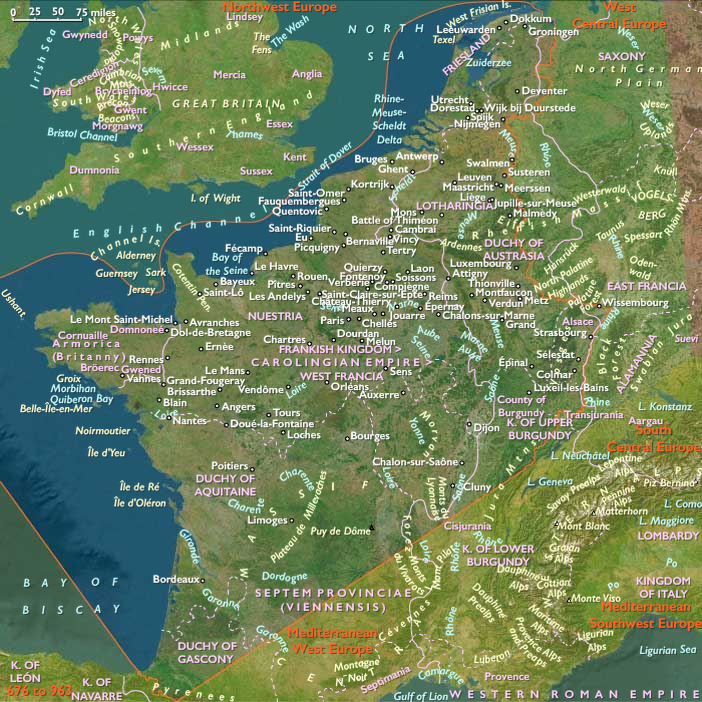
The Pyrenees, Massif Central, and Jura defined the interior highlands, while the Rhône, Loire, Seine, Scheldt, and Meuse carved navigable corridors through them.
These rivers—and the Rhône–Saône axis especially—linked the Mediterranean ports of Arles and Marseille to the Rhineland and North Sea, making Gaul Europe’s natural trade hinge.
Societies and Political Developments
Celtic Tribes and Roman Provinces
In the first millennium BCE, Celtic polities such as the Arverni and Aedui dominated the uplands and river plains.
Rome’s conquest under Julius Caesar (1st c. BCE) integrated Gaul into the empire, founding coloniae at Lugdunum (Lyon), Narbo Martius (Narbonne), Arelate (Arles), and Burdigala (Bordeaux).
Southern Gaul (Gallia Narbonensis) flourished as a Romanized province of cities, amphitheaters, and vineyards, while northern Gaul became the empire’s frontier breadbasket.
Late Antiquity and the Franks
After Rome’s collapse (5th c. CE), the Franks, Visigoths, and Burgundians divided the region.
By the late 6th century, the Merovingian Franks unified much of Gaul under kings who ruled from Paris, Metz, and Soissons.
The Carolingians, rising from Austrasia, consolidated power during the 8th century; under Charlemagne, the western provinces—stretching from the Atlantic to the Rhône and from the Pyrenees to the Meuse—became the imperial nucleus of the Holy Roman Empire (coronation 800 CE).
The Marca Hispanica and Septimania guarded the Pyrenean borderlands against Islamic Iberia, while coastal cities like Marseille reconnected the Franks to Mediterranean trade.
Regional Balances
-
In the Mediterranean south, Provençal bishoprics and monastic schools preserved classical learning; cities such as Arles and Marseille maintained continuity with Rome’s maritime world.
-
In the Atlantic north, riverine capitals—Paris, Rouen, Tours, Ghent, Bruges, Bordeaux—became centers of commerce and early urban revival.
-
The Low Countries developed intensive agriculture and proto-industrial craft traditions, foreshadowing their later prominence.
Economy and Trade
Agrarian wealth anchored every phase of development.
Wheat, rye, oats, and wine covered the valleys; olive groves and salt pans lined the Mediterranean coast.
Livestock and wool supplied northern markets; fisheries and coastal saltworks added export staples.
Under Rome, trade flowed along the Rhône–Saône–Rhine system and through Atlantic ports; after the Carolingian revival, monasteries and fairs renewed this network.
Mediterranean West Europe exchanged oil, wine, and ceramics with Italy and North Africa, while Atlantic West Europe traded textiles, timber, and metals with Britain and Scandinavia.
Technology and Material Culture
Roman legacies—roads, aqueducts, amphitheaters—remained visible and often repurposed.
By the Carolingian age, innovations such as the heavy plow, horse collar, and three-field rotation began to transform northern agriculture.
In the south, terrace farming and irrigation canals sustained Mediterranean crops.
Water mills, revived in both regions, mechanized grain processing and textile fulling.
Shipwrights along the Channel and Mediterranean refined clinker-built and carvel-hulled vessels that would later underpin European maritime expansion.
Belief and Symbolism
Christianization followed Roman roads and monastic frontiers.
Bishoprics at Arles, Lyon, Paris, Tours, and Reims anchored ecclesiastical authority; pilgrim routes multiplied, many converging toward the emerging cult of Saint James at Compostela.
Monasteries such as Saint-Martin of Tours, Corbie, and Lérins became scriptoria preserving Latin literature.
By the 8th–9th centuries, Carolingian reform fused Roman, Gallican, and Germanic traditions into a unified Christian culture—its manuscripts, sculpture, and chant defining early medieval art.
Adaptation and Resilience
West Europe’s strength lay in its environmental and institutional diversity.
When one zone faltered—Mediterranean trade disrupted or northern harvests failed—the other could compensate.
River navigation and coastal shipping offered redundancy against overland hazards; monasteries functioned as food reserves and safe havens during war or famine.
Frankish administrative pragmatism and local autonomy in towns and monasteries allowed flexible recovery from external shocks, whether Saracen raids or climatic downturns.
Regional Synthesis and Long-Term Significance
By 819 CE, West Europe had matured into the western half of Latin Christendom:
-
The Mediterranean South retained classical urbanism, monastic scholarship, and ties to the wider Mediterranean.
-
The Atlantic North drove agrarian and commercial growth through its river valleys and ports.
-
The Carolingian polity bound them into one imperial system, governed from the Rhineland but nourished by the produce and trade of Gaul.
The natural division between Mediterranean and Atlantic spheres thus reveals their complementarity: one maritime and urban, the other agrarian and riverine, together forming a single continuum of innovation and exchange.
From this equilibrium emerged the cultural and economic foundations of medieval Western Europe—a civilization whose unity, like its geography, was sustained by the flow of rivers to the sea.
Groups
- Corsica et Sardinia (Roman province)
- Christianity, Chalcedonian
- Corsica, Medieval
- Roman Empire, Eastern: Leonid dynasty
- Roman Empire, Eastern: Justinian dynasty
- Lombards (Italy), Kingdom of the
- Roman Empire, Eastern: Non-dynastic
- Roman Empire, Eastern: Heraclian dynasty
- Roman Empire, Eastern: Non-dynastic
- Roman Empire, Eastern: Heraclian dynasty
- Roman Empire, Eastern: Non-dynastic
- Roman Empire, Eastern: Isaurian dynasty
- Francia (Carolingians)
- Córdoba, Umayyad Emirate of
- Italy, Carolingian Kingdom of
- Marca Hispanica
- Frankish, or Carolingian (Roman) Empire
Commodoties
- Weapons
- Domestic animals
- Grains and produce
- Textiles
- Ceramics
- Strategic metals
- Salt
- Beer, wine, and spirits
- Manufactured goods
- Spices
Subjects
Regions
Subregions
Years: 909BCE - 819
Groups
- Corsica et Sardinia (Roman province)
- Christianity, Chalcedonian
- Corsica, Medieval
- Roman Empire, Eastern: Leonid dynasty
- Roman Empire, Eastern: Justinian dynasty
- Lombards (Italy), Kingdom of the
- Roman Empire, Eastern: Non-dynastic
- Roman Empire, Eastern: Heraclian dynasty
- Roman Empire, Eastern: Non-dynastic
- Roman Empire, Eastern: Heraclian dynasty
- Roman Empire, Eastern: Non-dynastic
- Roman Empire, Eastern: Isaurian dynasty
- Francia (Carolingians)
- Córdoba, Umayyad Emirate of
- Italy, Carolingian Kingdom of
- Marca Hispanica
- Frankish, or Carolingian (Roman) Empire
Commodoties
- Weapons
- Domestic animals
- Grains and produce
- Textiles
- Ceramics
- Strategic metals
- Salt
- Beer, wine, and spirits
- Manufactured goods
- Spices
Subjects
Regions
Subregions