
Mediterranean West Europe (189–46 BCE): Roman Expansion …
Years: 189BCE - 46BCE
Mediterranean West Europe (189–46 BCE): Roman Expansion and Gallic Resistance
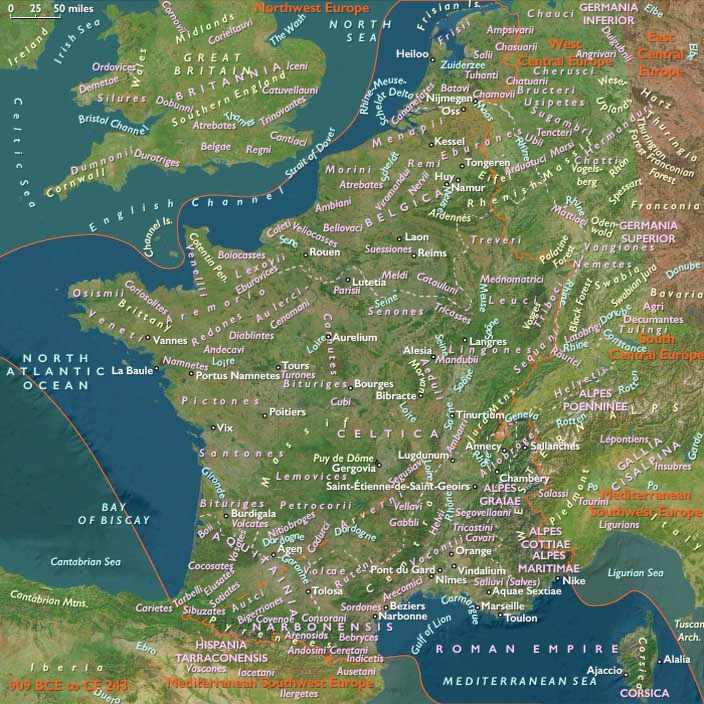
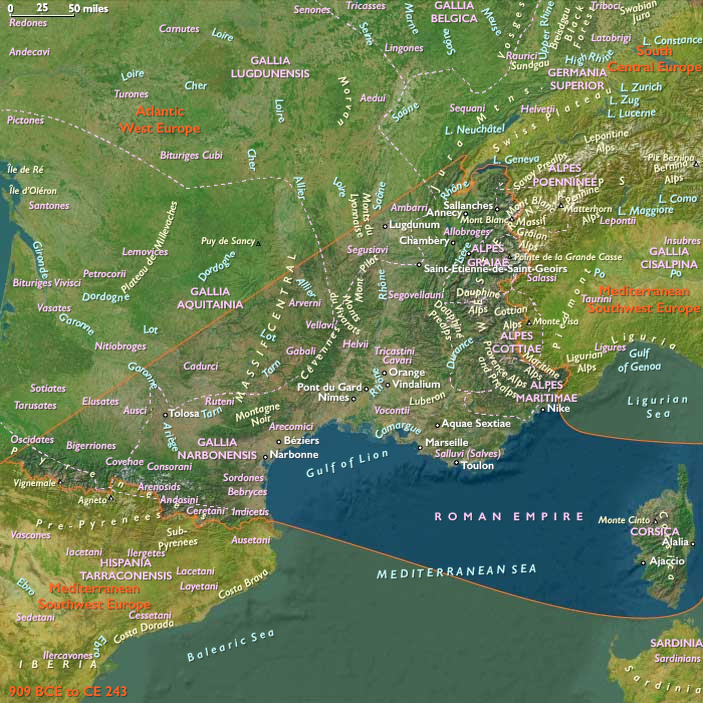
Between 189 and 46 BCE, Mediterranean West Europe—comprising southern France (below an imaginary line from approximately 43.03476° N, 1.17208° W to 46.45234° N, 6.07689° E), Corsica, and Monaco—experiences major shifts characterized by Roman expansion, Gallic resistance, and significant cultural integration. This era sees the Roman consolidation of power, profound changes to local societies, and pivotal historical confrontations.
Roman Conquest and Provincial Integration
Around 125 BCE, the Romans conquer southern Gaul, establishing control over the strategically vital coastal region. They name this territory Provincia Nostra ("Our Province"), which gradually evolves into the modern name Provence. This annexation marks a critical moment, integrating southern Gaul into Rome’s extensive Mediterranean network, thereby facilitating economic growth, infrastructure development, and cultural exchange.
The Helvetii Migration and Battle of Bibracte
The Helvetii, one of the significant Celtic tribes inhabiting the Swiss plateau, experience continuous pressure from Germanic incursions. In 58 BCE, the Helvetii decide to abandon their homeland and migrate westward into Gaul. Julius Caesar, perceiving their movement as a threat to Roman interests, confronts and decisively defeats them at the Battle of Bibracte in eastern Gaul. This victory compels the Helvetii to retreat to their original territories, underscoring Roman determination to secure the stability and security of their expanding empire.
Caesar’s Gallic Wars and the Revolt of Vercingetorix
Julius Caesar’s conquest of Gaul between 58 and 50 BCE fundamentally transforms the region. The Romans encounter fierce resistance, notably in 52 BCE when the Gallic chieftain Vercingetorix leads a significant uprising against Roman dominance. Although Vercingetorix’s forces initially achieve considerable successes, Caesar ultimately suppresses the revolt at the decisive Siege of Alesia. This victory cements Roman authority throughout Gaul and signals a turning point, transitioning from conquest to sustained provincial governance.
Cultural Exchange and Romanization
As Roman control solidifies, southern Gaul undergoes profound Romanization, marked by the introduction of Roman law, language, urban planning, and administrative systems. Cities such as Massalia (Marseille), already a significant Greek colony, flourish under Roman influence, becoming central hubs for trade and cultural exchange. Indigenous Gallic elites increasingly adopt Roman customs, infrastructure, and administrative practices, facilitating deeper integration into the Roman Empire.
Corsica and Monaco: Peripheral Stability
Corsica and Monaco remain peripheral but strategically significant within Roman maritime routes. Although experiencing limited direct colonization, they benefit from increased maritime commerce and economic connections fostered by Roman dominance. Corsica, in particular, sees modest infrastructural and economic development, further integrating into broader Mediterranean trade networks.
Long-Term Implications
By 46 BCE, Mediterranean West Europe has undergone substantial transformation. The period witnesses the definitive incorporation of southern Gaul into the Roman sphere, Gallic cultural resilience, and the establishment of critical economic and administrative frameworks. These developments lay the groundwork for the region's extensive integration within the Roman Empire, profoundly shaping its future historical trajectory.
People
Groups
- Celts
- Greeks, Classical
- Massalia (Ionian Greek) city-state of
- Gauls
- Roman Republic
- Helvetii
- Gallia Narbonensis (Roman province)
- Gallo-Roman culture
Topics
Commodoties
Subjects
Regions
Subregions
Years: 189BCE - 46BCE
People
Groups
- Celts
- Greeks, Classical
- Massalia (Ionian Greek) city-state of
- Gauls
- Roman Republic
- Helvetii
- Gallia Narbonensis (Roman province)
- Gallo-Roman culture
Topics
Commodoties
Subjects
Regions
Subregions