
Mediterranean West Europe (45 BCE–CE 99): Consolidation …
Years: 45BCE - 99
Mediterranean West Europe (45 BCE–CE 99): Consolidation of Roman Authority and Early Imperial Prosperity
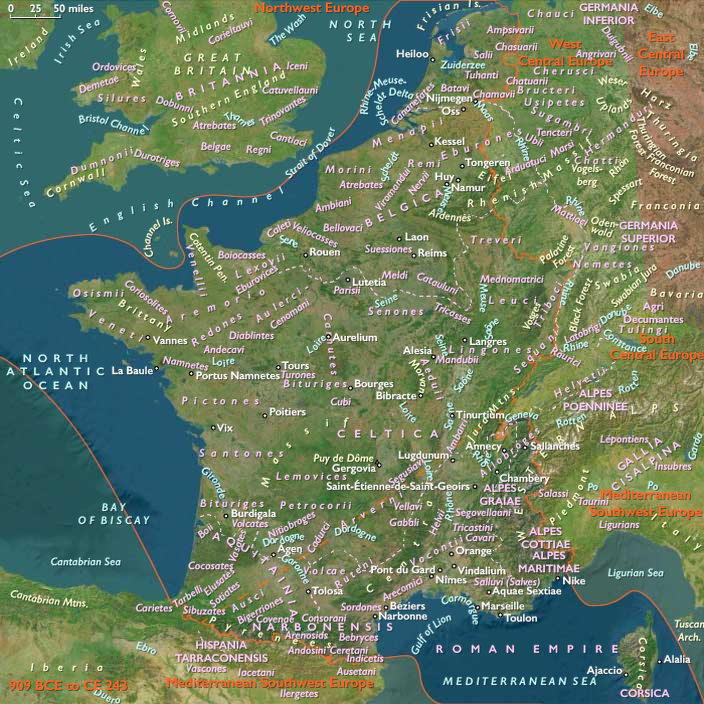
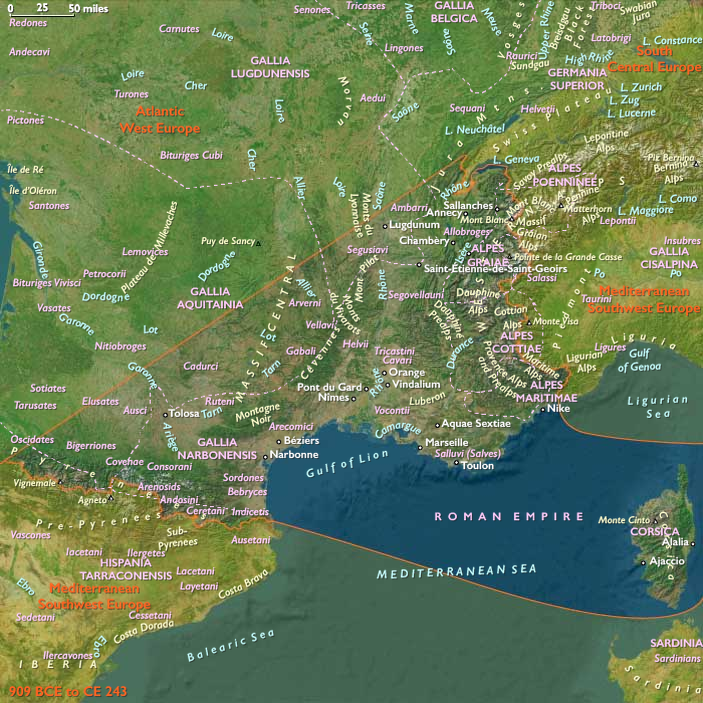
Between 45 BCE and CE 99, Mediterranean West Europe—comprising southern France (below an imaginary line from approximately 43.03476° N, 1.17208° W to 46.45234° N, 6.07689° E), Corsica, and Monaco—experiences the consolidation and deepening of Roman authority, widespread Romanization, and economic and cultural flourishing under the early Roman Empire. This era sees the region transition from conquered territory to integral provincial centers within the empire, benefiting from stability, infrastructure growth, and vibrant trade networks.
Establishment of Roman Administration
Following Julius Caesar’s conquest of Gaul, the period beginning 45 BCE marks the firm establishment of Roman administrative structures. Emperor Augustus (27 BCE–CE 14) reorganizes Gaul into well-defined provinces, notably the Provincia Narbonensis, enhancing governance, taxation efficiency, and legal consistency. Roman cities such as Narbo Martius (Narbonne) and Massalia (Marseille) become significant administrative hubs.
Romanization and Urban Development
Southern Gaul undergoes extensive Romanization, embracing Roman urban planning, architecture, and lifestyle. Prominent Roman towns emerge, featuring forums, amphitheaters, aqueducts, and roads that stimulate commerce and communication. Cities like Nemausus (Nîmes), Arelate (Arles), and Arausio (Orange) experience substantial development, becoming cultural and economic focal points within the region.
Economic Prosperity and Trade Networks
The Pax Romana facilitates considerable economic prosperity and trade expansion. Mediterranean West Europe integrates tightly into extensive Roman trade networks, exchanging local products—such as wine, olive oil, grain, and pottery—with goods from across the empire. Maritime trade flourishes through ports like Massalia, fostering vibrant connections with Rome, Iberia, North Africa, and the eastern Mediterranean.
Corsica and Monaco: Integration and Stability
Corsica experiences steady but moderate Roman integration, primarily serving as an agricultural supplier to mainland provinces. The island's stability under Roman rule allows modest economic growth and improved infrastructure, including roads and harbor enhancements. Monaco, though small, benefits from its strategic coastal position within Roman trade routes, supporting local maritime activities.
Cultural Developments and Local Identity
Roman influence profoundly shapes local cultural practices. The adoption of Latin, Roman religious customs, and civic institutions fosters a blended Gallic-Roman identity. This era witnesses the assimilation of indigenous elites into Roman provincial aristocracy, cementing their loyalty and facilitating Roman governance.
Long-Term Legacy
By CE 99, Mediterranean West Europe has fully transformed into a prosperous and culturally integrated region of the Roman Empire. Infrastructure improvements, administrative stability, and robust trade networks established during this era lay enduring foundations, significantly influencing the area's subsequent historical and cultural evolution.
People
Groups
- Celts
- Greeks, Classical
- Massalia (Ionian Greek) city-state of
- Gauls
- Roman Republic
- Helvetii
- Gallia Narbonensis (Roman province)
- Gallo-Roman culture
- Roman Principate (Rome)
- Gallia Lugdunensis (Roman province)
- Gallia Aquitania (Roman province)
- Roman Empire (Rome): Julio-Claudian dynasty
- Roman Empire (Rome): Flavian dynasty
- Roman Empire (Rome): Nerva-Antonine dynasty
Topics
Commodoties
Subjects
Regions
Subregions
Related Events
Showing 10 events out of 62463 total
Years: 45BCE - 99
People
Groups
- Celts
- Greeks, Classical
- Massalia (Ionian Greek) city-state of
- Gauls
- Roman Republic
- Helvetii
- Gallia Narbonensis (Roman province)
- Gallo-Roman culture
- Roman Principate (Rome)
- Gallia Lugdunensis (Roman province)
- Gallia Aquitania (Roman province)
- Roman Empire (Rome): Julio-Claudian dynasty
- Roman Empire (Rome): Flavian dynasty
- Roman Empire (Rome): Nerva-Antonine dynasty
Topics
Commodoties
Subjects
Regions
Subregions