
Mediterranean West Europe (244–387 CE): Imperial Challenges, …
Years: 244 - 387
Mediterranean West Europe (244–387 CE): Imperial Challenges, Christianization, and Cultural Transformations
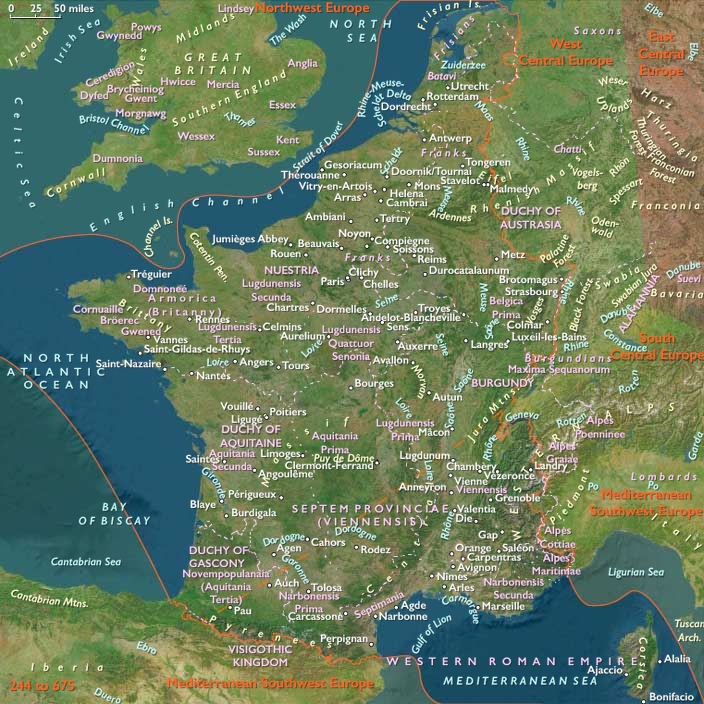
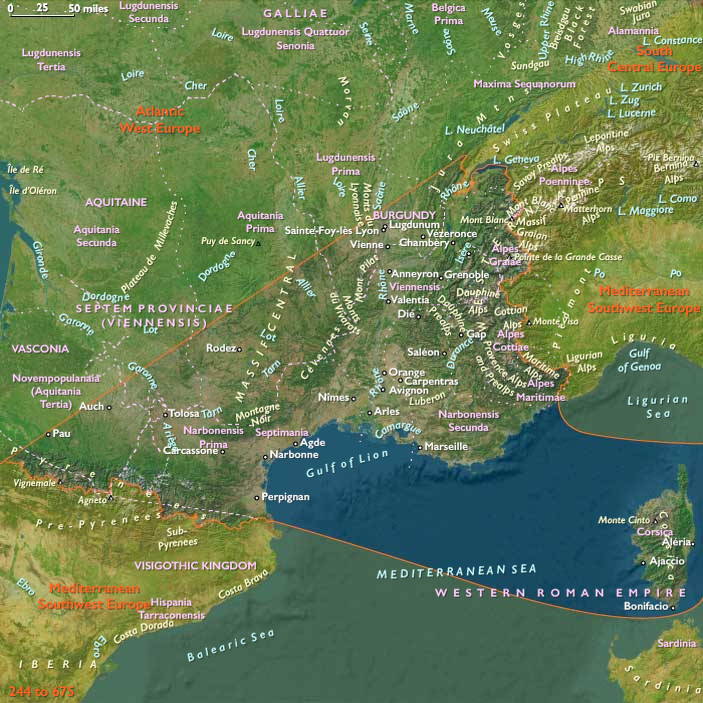
Between 244 and 387 CE, Mediterranean West Europe—encompassing southern France (below an imaginary line from approximately 43.03476° N, 1.17208° W to 46.45234° N, 6.07689° E), Corsica, and Monaco—undergoes significant transformations amid imperial challenges, the spread of Christianity, and shifting cultural dynamics. The stability of previous centuries gradually gives way to internal tensions and external threats, influencing regional society profoundly.
Economic Pressures and Administrative Strains
Throughout this era, Mediterranean West Europe faces increased economic pressures due to higher taxation and administrative burdens imposed by the central Roman government. Economic disparities grow between wealthy urban elites and rural populations, leading to localized unrest and challenges to Roman governance. Major cities like Massalia (Marseille), Nemausus (Nîmes), and Arelate (Arles) continue to flourish, though increasingly taxed by economic demands from Rome.
Military Tensions and Defensive Measures
External threats, particularly Germanic incursions and piracy, necessitate enhanced military defenses and fortifications throughout the region. Coastal defenses around cities such as Massalia and Monaco are strengthened to protect vital maritime trade routes. The presence of Roman legions in the region becomes more pronounced, marking a shift towards increased militarization and defensive readiness.
Spread of Christianity
This era witnesses the significant expansion of Christianity across southern France and Corsica. Initially limited to urban centers, Christianity rapidly permeates rural areas as well. Early Christian communities establish churches and episcopal sees, notably in prominent cities like Arles, which emerges as a significant Christian hub. By the late fourth century, Christian leaders like Hilary of Poitiers and Martin of Tours influence the region profoundly, advocating for religious reform and the establishment of monastic traditions.
Cultural and Religious Transformations
Cultural life during this period reflects increasing Christian influence while still accommodating traditional Roman practices. Pagan temples begin to decline, repurposed as Christian churches or abandoned. Religious and cultural festivals evolve, combining Roman traditions with emerging Christian observances. This blending creates a unique cultural landscape that shapes the region's identity.
Administrative Reforms and Regional Autonomy
In response to growing challenges, the Roman administration implements structural reforms aimed at improving governance efficiency and local responsiveness. Provinces within Mediterranean West Europe gain greater administrative autonomy, allowing local officials more direct control over regional matters. These changes help maintain stability despite mounting pressures, preserving the region's economic and social coherence.
Prelude to Late Antiquity
By 387 CE, Mediterranean West Europe stands at the threshold of Late Antiquity, having experienced profound transformations economically, socially, and religiously. The spread of Christianity, increasing administrative autonomy, and evolving defensive strategies position the region uniquely for the transitions that will follow in subsequent centuries, laying a complex foundation for future historical developments.
People
Groups
- Polytheism (“paganism”)
- Gauls
- Gallia Narbonensis (Roman province)
- Gallo-Roman culture
- Gallia Lugdunensis (Roman province)
- Gallia Aquitania (Roman province)
- Germans
- Christians, Early
- Roman Empire (Rome): Non-dynastic
- Roman Empire: Tetrarchy
- Roman Empire: Constantinian dynasty (Nicomedia)
- Christianity, Nicene
- Roman Empire: Constantinian dynasty (Constantinople)
- Roman Empire: Valentinian dynasty (Rome)
Topics
Subjects
Regions
Subregions
Years: 244 - 387
People
Groups
- Polytheism (“paganism”)
- Gauls
- Gallia Narbonensis (Roman province)
- Gallo-Roman culture
- Gallia Lugdunensis (Roman province)
- Gallia Aquitania (Roman province)
- Germans
- Christians, Early
- Roman Empire (Rome): Non-dynastic
- Roman Empire: Tetrarchy
- Roman Empire: Constantinian dynasty (Nicomedia)
- Christianity, Nicene
- Roman Empire: Constantinian dynasty (Constantinople)
- Roman Empire: Valentinian dynasty (Rome)
Topics
Subjects
Regions
Subregions