
Southwest Europe (909 BCE – 819 CE): …
Years: 909BCE - 819
Southwest Europe (909 BCE – 819 CE): From Roman Seas to Mountain Kingdoms
Regional Overview
Between the wine-dark coasts of the western Mediterranean and the storm-swept bays of the Atlantic, Southwest Europe bridged the worlds of classical empire and early medieval kingdom.
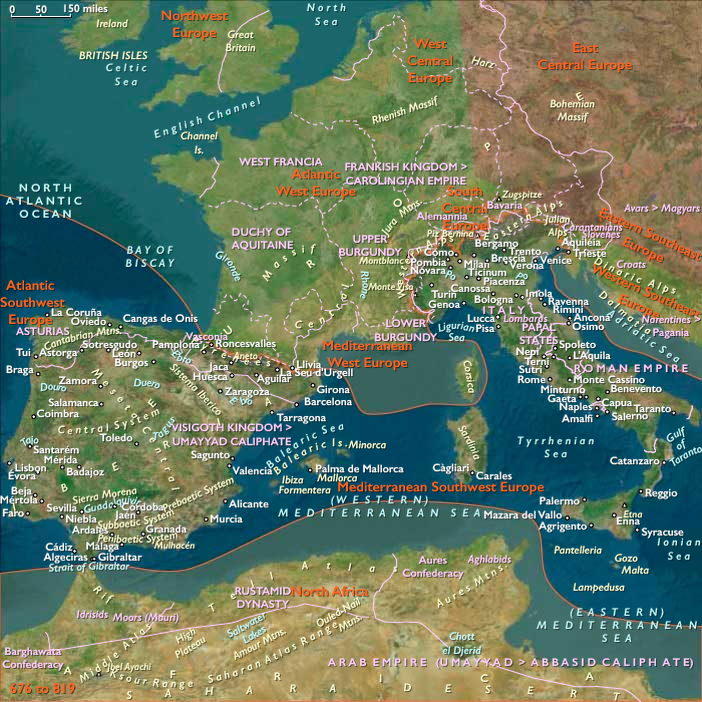
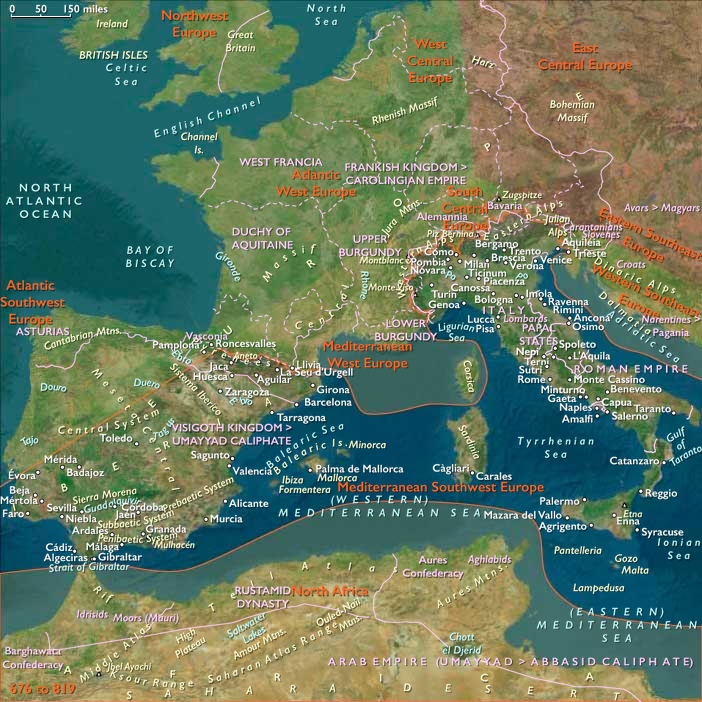
From the Po Valley and Sicilian ports to the Cantabrian uplands and Galician headlands, it was a region of deep historical layering — Roman legacies enduring beneath Lombard strongholds, Visigothic courts, and the early Christian monarchies of Iberia.
By the early ninth century CE, the Mediterranean and Atlantic spheres were diverging yet intertwined: one turning toward the Byzantine–Islamic maritime system, the other toward Carolingian and Asturian frontiers that would shape Europe’s western destiny.
Geography and Environment
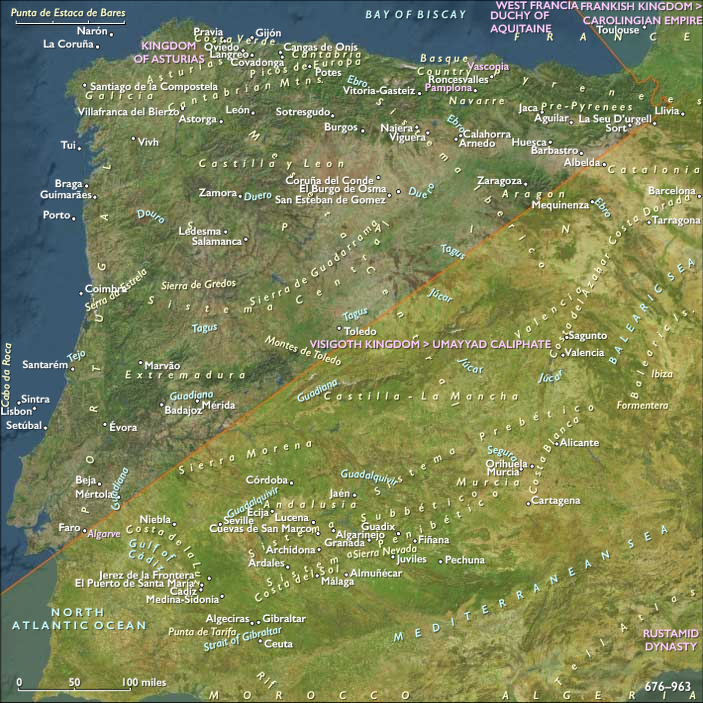
Southwest Europe is defined by its dual maritime faces — the Mediterranean littoral of Italy, Sicily, Sardinia, and southeastern Iberia, and the Atlantic–Cantabrian rim of northern Spain and Portugal.
Volcanic uplands, mountain arcs (the Apennines and Cantabrians), and fertile basins like the Po Valley and Douro formed alternating belts of abundance and refuge.
A Mediterranean climate dominated the south and east: wet winters, hot summers, and dependable harvests of grain, vines, and olives.
Along the Atlantic, milder and wetter conditions favored forests, pastures, and fisheries.
Rivers — Po, Tiber, Douro, Tagus, and Ebro — were arteries of settlement and trade, linking inland towns to their maritime outlets.
Societies and Political Developments
Mediterranean Core: From Empire to Maritime Republics
In Italy and the central Mediterranean, the dissolution of Roman order yielded a mosaic of powers.
Byzantine administrators retained control over southern Italy, Sicily, and Malta, while Lombard duchies dominated the interior.
Ports such as Naples, Venice, and Palermo emerged as autonomous or semi-autonomous nodes in the seaborne networks that connected Europe to the Byzantine and Islamic worlds.
Further west, Visigothic Hispania maintained tenuous unity until the early eighth century, when the Umayyad conquest (711 CE) reshaped Iberia’s Mediterranean coast.
Atlantic Uplands: Christian Refuge and Frontier Consolidation
North of the Ebro, the Kingdom of Asturias consolidated resistance in the mountain bastions of Galicia and León.
Its rugged geography favored small, defensible communities and itinerant courts rather than expansive bureaucracy.
Along the Galician and Portuguese coasts, fishing villages and riverine settlements survived upheaval by turning outward — trading timber, salt, and grain northward to Brittany and the Channel.
These Atlantic zones preserved older Roman and Celtic traditions while integrating Christian monasticism and the emerging pilgrimage cult of St. James, whose shrine at Compostela would later knit western Christendom together.
Economy and Trade
The region’s economy remained diverse and regionally specialized.
-
Mediterranean Southwest Europe continued the Roman pattern of intensive agriculture: grain, vines, olives, and citrus along irrigated lowlands, complemented by pottery, glassware, textiles, and metalwork in coastal workshops.
-
Maritime commerce bound the Tyrrhenian and Adriatic cities to North Africa, the Levant, and Byzantine Greece, exchanging oil, wine, salt, and spices.
-
In Atlantic Southwest Europe, mixed farming and transhumant pastoralism supported highland communities, while fisheries, salt pans, and shipyards sustained coastal trade.
The Rhone and Po valleys served as inland corridors to Central Europe, while the Douro and Tagus linked Iberia’s uplands to the Atlantic.
Technology and Material Culture
Roman engineering remained the skeleton of the landscape: aqueducts, roads, and terraced farms continued in use long after imperial authority waned.
In the Lombard and Byzantine zones, stone fortifications and church complexes dominated townscapes.
Shipbuilding flourished: Mediterranean galleys with lateen sails and Atlantic cogs adapted to rougher seas both expanded in sophistication.
Water mills powered flour production in Alpine and Galician valleys, while terraced vineyards and olive groves reclaimed slopes once abandoned during late antiquity.
Belief and Symbolism
Christianity unified this fragmented world while expressing regional diversity.
The Papacy in Rome and the monasteries of Monte Cassino and Cluny (just beyond this region’s northern edge) revitalized learning and administration.
In Iberia, Christian identity crystallized through resistance to Islamic rule; monasteries in Asturias and Galicia became bastions of literacy and art.
Across the Mediterranean coasts, Byzantine mosaics and basilicas echoed Rome’s sacred heritage, while Sicilian and Sardinian churches absorbed eastern iconography.
In all lands, sacred geography — from the pilgrim roads of Compostela to the tombs of saints and martyrs — replaced imperial capitals as centers of meaning.
Adaptation and Resilience
The fusion of agricultural stability, maritime trade, and religious cohesion gave Southwest Europe remarkable resilience.
The Mediterranean cities adapted through commerce and diplomacy, sustaining continuity amid invasion; the Atlantic uplands relied on self-sufficiency, kinship, and geography to survive as Christian enclaves.
Environmental flexibility — terrace farming, irrigation, diversified herding — ensured survival through droughts and political shocks alike.
Regional Synthesis and Long-Term Significance
By 819 CE, Southwest Europe embodied the meeting of three worlds:
-
The Byzantine–Mediterranean East, linked through Italian ports and island fortresses;
-
The Islamic South, newly established in Iberia and Sicily;
-
The Frankish and Christian North, consolidating in the Pyrenees and the Loire.
This region’s mountain refuges, fortified coasts, and enduring cities preserved Roman infrastructures while incubating new cultural forms — Christian monastic learning, Lombard law, and seafaring enterprise.
It was here, along these seas and uplands, that Europe’s western Mediterranean civilization survived the disintegration of empire and prepared for the revival of the medieval Mediterranean world that would follow.
Groups
- Roman Kingdom
- Roman Republic
- Roman Principate (Rome)
- Lombards (West Germanic tribe)
- Roman Empire (Rome): Julio-Claudian dynasty
- Roman Empire (Rome): Flavian dynasty
- Roman Empire (Rome): Nerva-Antonine dynasty
- Roman Empire (Rome): Severan dynasty
- Roman Empire (Rome): Non-dynastic
- Roman Empire: Tetrarchy
- Roman Empire: Constantinian dynasty (Nicomedia)
- Christianity, Nicene
- Roman Empire: Constantinian dynasty (Constantinople)
- Roman Empire: Valentinian dynasty (Rome)
- Roman Empire: Theodosian dynasty (Constantinople)
- Roman Empire, Western (Milan)
- Roman Empire, Western (Ravenna)
- Christianity, Chalcedonian
- Roman Empire, Eastern: Leonid dynasty
- Visigothic Kingdom of Spain
- Roman Empire, Eastern: Justinian dynasty
- Sicily, Roman (Byzantine)
- Lombards (Italy), Kingdom of the
- Roman Empire, Eastern: Non-dynastic
- Roman Empire, Eastern: Heraclian dynasty
- Naples, Duchy of
- Umayyad Caliphate (Damascus)
- Roman Empire, Eastern: Non-dynastic
- Roman Empire, Eastern: Heraclian dynasty
- Roman Empire, Eastern: Non-dynastic
- Roman Empire, Eastern: Isaurian dynasty
- Venice, Duchy of
- Papal States (Republic of St. Peter)
- Córdoba, Umayyad Emirate of
- Roman Empire, Eastern: Nikephorian dynasty
- Roman Empire, Eastern: Non-dynastic
Commodoties
- Glass
- Grains and produce
- Textiles
- Ceramics
- Strategic metals
- Slaves
- Beer, wine, and spirits
- Manufactured goods
- Spices
Subjects
Regions
Subregions
Years: 909BCE - 819
Groups
- Roman Kingdom
- Roman Republic
- Roman Principate (Rome)
- Lombards (West Germanic tribe)
- Roman Empire (Rome): Julio-Claudian dynasty
- Roman Empire (Rome): Flavian dynasty
- Roman Empire (Rome): Nerva-Antonine dynasty
- Roman Empire (Rome): Severan dynasty
- Roman Empire (Rome): Non-dynastic
- Roman Empire: Tetrarchy
- Roman Empire: Constantinian dynasty (Nicomedia)
- Christianity, Nicene
- Roman Empire: Constantinian dynasty (Constantinople)
- Roman Empire: Valentinian dynasty (Rome)
- Roman Empire: Theodosian dynasty (Constantinople)
- Roman Empire, Western (Milan)
- Roman Empire, Western (Ravenna)
- Christianity, Chalcedonian
- Roman Empire, Eastern: Leonid dynasty
- Visigothic Kingdom of Spain
- Roman Empire, Eastern: Justinian dynasty
- Sicily, Roman (Byzantine)
- Lombards (Italy), Kingdom of the
- Roman Empire, Eastern: Non-dynastic
- Roman Empire, Eastern: Heraclian dynasty
- Naples, Duchy of
- Umayyad Caliphate (Damascus)
- Roman Empire, Eastern: Non-dynastic
- Roman Empire, Eastern: Heraclian dynasty
- Roman Empire, Eastern: Non-dynastic
- Roman Empire, Eastern: Isaurian dynasty
- Venice, Duchy of
- Papal States (Republic of St. Peter)
- Córdoba, Umayyad Emirate of
- Roman Empire, Eastern: Nikephorian dynasty
- Roman Empire, Eastern: Non-dynastic
Commodoties
- Glass
- Grains and produce
- Textiles
- Ceramics
- Strategic metals
- Slaves
- Beer, wine, and spirits
- Manufactured goods
- Spices
Subjects
Regions
Subregions