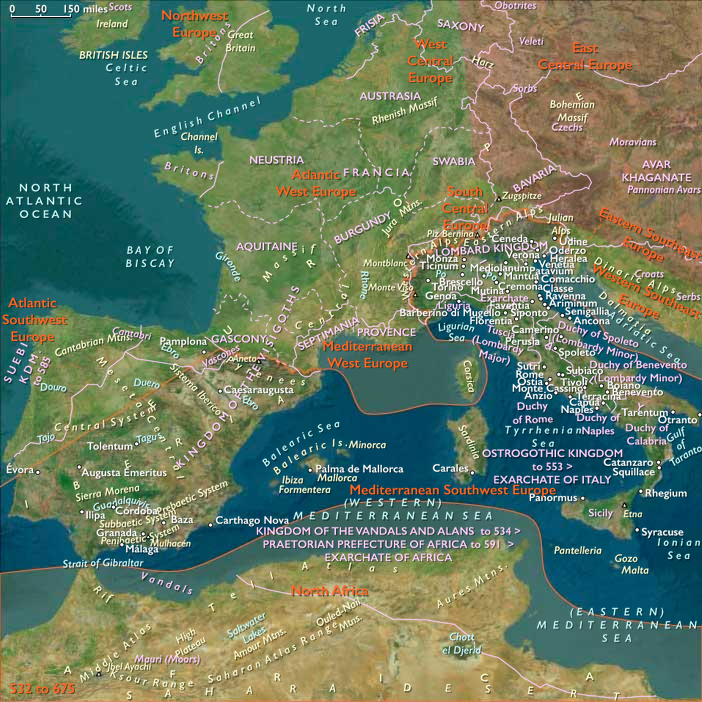
Mediterranean Southwest Europe (640–651 CE): Byzantine Pressures, …
Years: 640 - 651
Mediterranean Southwest Europe (640–651 CE): Byzantine Pressures, Lombard Consolidation, and Ecclesiastical Challenges
The era 640–651 CE in Mediterranean Southwest Europe is marked by intensified Byzantine struggles against Lombard advances in Italy, internal ecclesiastical debates, and growing challenges posed by external geopolitical developments, including the early impact of Islamic expansion in the Mediterranean basin.
Byzantine-Lombard Conflicts and Fragmented Authority
Throughout this era, Byzantine authorities centered at the Exarchate of Ravenna increasingly struggle against sustained Lombard military pressure. Lombard King Rothari (r. 636–652 CE) consolidates his kingdom’s territories, notably formalizing Lombard law through the issuance of the Edictum Rothari in 643 CE—an important legal compilation marking a significant development in medieval European law. Byzantine control remains confined largely to coastal enclaves, isolated cities, and the strategic corridor connecting Rome and Ravenna.
Lombard Legal and Administrative Developments
Under Rothari, the Lombard Kingdom achieves enhanced internal stability through the codification of customary Germanic law. This codification, the Edictum Rothari, greatly clarifies and consolidates Lombard governance, creating stronger legal and social cohesion among the Lombard populace in Italy. The edict preserves Lombard identity while also enabling smoother interactions with Roman traditions and institutions.
Ecclesiastical Challenges: Monothelitism Controversy
The period sees the rise of the Monothelitism controversy, a doctrinal debate regarding the nature of Christ's will. Pope Theodore I (r. 642–649 CE) firmly opposes Monothelitism, asserting orthodox Chalcedonian positions and strongly criticizing Patriarch Paul II of Constantinople for supporting the doctrine. This theological conflict heightens tensions between Rome and Constantinople, exacerbating existing political and religious divides within the broader Christian world.
External Pressures: Early Islamic Expansion
This era also coincides with the initial phases of Islamic expansion across North Africa and into the Mediterranean basin. By 647 CE, Muslim forces conduct raids into territories such as Sicily and southern Italy, signaling the beginning of a new external threat that will significantly shape the region’s geopolitical dynamics in subsequent decades. These incursions underscore the vulnerabilities of Byzantine holdings and foreshadow profound changes for Mediterranean geopolitics.
Papal Leadership Amid Challenges
Despite these challenges, papal leadership remains a stabilizing force within Rome and the broader region. Pope Theodore I actively strengthens orthodox doctrine, asserting ecclesiastical authority and reinforcing Rome's spiritual leadership amid doctrinal disputes and geopolitical instability.
Legacy of the Era
The era 640–651 CE significantly shapes Mediterranean Southwest Europe's medieval trajectory. Lombard legal codification under Rothari provides enduring foundations for governance in Italy, while Byzantine territorial constraints and theological divisions weaken imperial authority. Concurrently, early Islamic incursions introduce a new and lasting geopolitical challenge. Collectively, these developments set critical conditions for future medieval political, religious, and cultural dynamics.
Related Events
Showing 10 events out of 56578 total
Years: 640 - 651
People
Groups
- Arab people
- Christianity, Chalcedonian
- Roman Empire, Eastern: Justinian dynasty
- Rome, Duchy of
- Lombards (Italy), Kingdom of the
- Spoleto, Lombard Duchy of
- Benevento, Lombard Duchy of
- Ravenna, Exarchate of
- Islam
- Christians, Monotheletist
Subjects
Regions
Subregions