
Mediterranean Southwest Europe (189 BCE–46 BCE): Roman …
Years: 189BCE - 46BCE
Mediterranean Southwest Europe (189 BCE–46 BCE): Roman Expansion and the End of the Republic
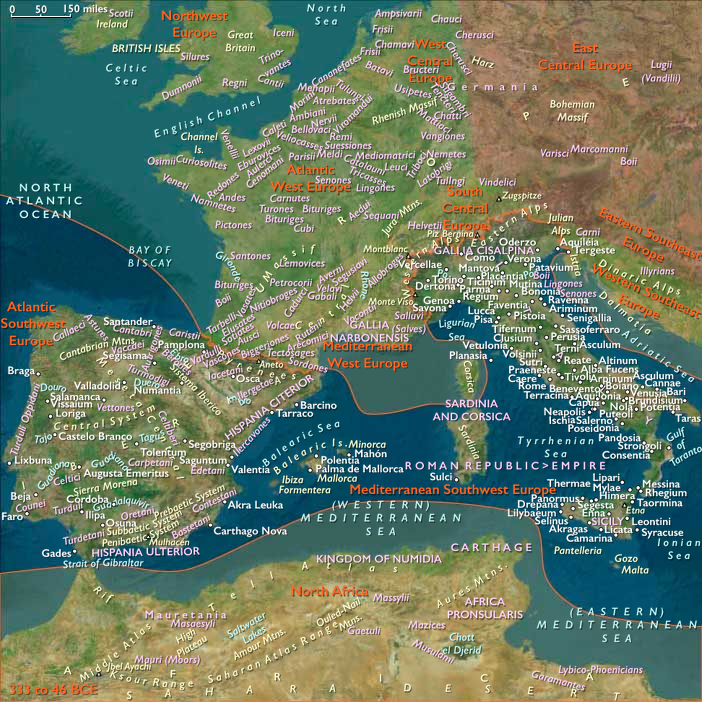
The age 189 BCE to 46 BCE is characterized by Rome's expansion and consolidation of power throughout Mediterranean Southwest Europe, marked by significant military conflicts, colonization, and internal political upheaval culminating in the collapse of the Roman Republic.
Rome’s Dominance and Greco-Roman Integration
Following Rome's victory against Seleucid king Antiochus III around 189 BCE, the Roman Republic asserts itself as the dominant power across the Mediterranean basin. Rome notably rewards its supporters such as Pergamon and Rhodes, while punishing opponents like the Aetolians, thereby altering the balance of power in favor of its allies and signaling the start of an era characterized by the fusion of Greek and Roman political and cultural elements.
Roman Expansion and Conflict in Hispania
From 181 to 179 BCE, the First Celtiberian War is fought between Rome and the Celtiberian tribes of Hispania Citerior, highlighting Rome’s increasing involvement in Iberian affairs. Rome’s aggressive colonization and military presence trigger continuous resistance among the indigenous populations, laying groundwork for future conflicts such as the prolonged and challenging Numantine War (154–133 BCE), initiated by rebellions among the Celtiberian tribes around Numantia.
Socio-Political Reform and Unrest
The internal struggles of Rome intensify significantly in the late second century BCE, epitomized by the reform efforts of the Gracchi brothers. Attempting to address vast socio-economic disparities through land reform legislation, both brothers ultimately face assassination, revealing deep-rooted tensions between the plebeians and the ruling patrician elite, and highlighting the vulnerability of the Roman political system.
Military Crises and Civil Wars
Rome endures several severe military and internal crises in the late second and early first centuries BCE. The catastrophic Roman defeat at the Battle of Arausio in 105 BCE against the migrating Cimbri and Teutones triggers a major military reform under Gaius Marius. This reform significantly reshapes the Roman army, paving the way for Roman victories at Aquae Sextiae (102 BCE) and Vercellae (101 BCE).
Meanwhile, internal conflicts intensify, as evidenced by Sulla’s civil wars (88–82 BCE), the Social War (90–88 BCE), and subsequent confrontations such as the rebellions led by Marcus Aemilius Lepidus and the insurgency of Sertorius in Hispania (80–72 BCE). These struggles underscore the Republic’s escalating internal instability.
Julius Caesar and the Collapse of the Republic
The final decades of this era are dominated by the political and military ascent of Julius Caesar, culminating in Caesar’s Civil War (49–45 BCE). Caesar’s crossing of the Rubicon River in 49 BCE symbolizes the irreversible rupture of Roman political order, sparking a conflict against the senatorial faction led by Pompey the Great.
After pivotal victories at Pharsalus, the Battle of the Nile in Egypt, and at Thapsus in Africa, Caesar consolidates unprecedented political power. His dictatorship marks the definitive end of the Republic, transitioning Rome toward imperial governance.
Colonization and Cultural Developments
Throughout this era, Roman colonization continues, notably in northern Italy. The region around modern Como, inhabited by the Celtic Orobii tribe, becomes a Roman colony, exemplifying Rome’s strategic and cultural assimilation in newly conquered territories.
Researchers have also detected cobalt in glass found in the ruins of Pompeii, indicating sophisticated Roman manufacturing techniques and trade networks, further reflecting the region's economic and technological advancement during this period.
Legacy
The period from 189 BCE to 46 BCE significantly reshapes Mediterranean Southwest Europe, marking Rome’s transformation from a powerful Republic to the cusp of imperial dominion. Political turmoil, military expansion, socio-economic reforms, and cultural integration during these critical centuries forge the region’s historical legacy and lay foundations for the forthcoming Roman Empire.
People
- Antiochus III the Great
- Gaius Gracchus
- Gaius Marius
- Julius Caesar
- Lucius Cornelius Sulla
- Lucius Sergius Catalina
- Marcus Aemilius Lepidus (consul 78 BCE)
- Pompey
- Quintus Sertorius
- Tiberius Gracchus
Groups
- Rhodes, City-States of
- Orobii
- Roman Republic
- Aetolian League
- Cimbri
- Teutons
- Pergamon (Pergamum), Kingdom of
- Hispania Citerior (region of Hispania)
Topics
- Roman colonization
- Celtiberian War, First
- Numantine War
- Roman Republic, Crisis of the
- Aquae Sextiae, Battle of
- Vercellae, Battle of
- Social War (91–88 BCE)
- Sulla's first civil war
- Sulla's second civil war
- Roman Civil War, Great, or Caesar's Civil War
- Alexandria, Siege of
- Pharsalus, Battle of
- Nile, Battle of the
- Zela, Battle of
- Thapsus, Battle of
Subjects
Regions
Subregions
Years: 189BCE - 46BCE
People
- Antiochus III the Great
- Gaius Gracchus
- Gaius Marius
- Julius Caesar
- Lucius Cornelius Sulla
- Lucius Sergius Catalina
- Marcus Aemilius Lepidus (consul 78 BCE)
- Pompey
- Quintus Sertorius
- Tiberius Gracchus
Groups
- Rhodes, City-States of
- Orobii
- Roman Republic
- Aetolian League
- Cimbri
- Teutons
- Pergamon (Pergamum), Kingdom of
- Hispania Citerior (region of Hispania)
Topics
- Roman colonization
- Celtiberian War, First
- Numantine War
- Roman Republic, Crisis of the
- Aquae Sextiae, Battle of
- Vercellae, Battle of
- Social War (91–88 BCE)
- Sulla's first civil war
- Sulla's second civil war
- Roman Civil War, Great, or Caesar's Civil War
- Alexandria, Siege of
- Pharsalus, Battle of
- Nile, Battle of the
- Zela, Battle of
- Thapsus, Battle of
Subjects
Regions
Subregions