
Mediterranean Southwest Europe (57–46 BCE): Caesar's Civil …
Years: 57BCE - 46BCE
Mediterranean Southwest Europe (57–46 BCE): Caesar's Civil War and the Collapse of the Republic
The era 57–46 BCE marks one of the most critical periods in the history of the Roman Republic, dominated by the turmoil and transformation brought about by Caesar's Civil War. This conflict, fundamentally political and military, pits Julius Caesar and his supporters—the Populares—against the conservative faction of the Senate—the Optimates—led militarily by Pompey the Great.
Outbreak of Civil War and Caesar’s Dictatorship
The conflict erupts in 49 BCE, after prolonged political tensions between Caesar and the Senate culminate in Caesar’s dramatic crossing of the Rubicon River, symbolically declaring war against Rome itself. Pompey and most senators flee Rome, regrouping in Greece and other parts of the Republic.
In Rome, Caesar rapidly consolidates power, assuming the role of dictator and appointing Mark Antony as his Master of the Horse. After presiding briefly over his election to a second consulate alongside Publius Servilius Vatia, Caesar resigns the dictatorship after eleven days, though retaining supreme authority through military dominance.
Pompey's Defeat and Death in Egypt
Caesar pursues Pompey to Egypt, arriving in Alexandria shortly after Pompey’s assassination at the hands of the court of Ptolemy XIII. Caesar aligns himself with Cleopatra VII, Ptolemy’s sister and rival, becoming embroiled in the Alexandrine civil war. After surviving a challenging siege, Caesar decisively defeats Ptolemy’s forces at the Battle of the Nile in 47 BCE, establishing Cleopatra firmly as ruler of Egypt.
Despite never marrying due to Roman legal constraints—Roman law only recognizes marriages between Roman citizens—Caesar maintains a significant relationship with Cleopatra, who later visits Rome, residing in Caesar’s villa across the Tiber. Caesar and Cleopatra’s union is historically notable, and Caesar is believed to have fathered a son, Caesarion, with her.
Caesar’s Campaigns and Dictatorship
Caesar’s authority continues to solidify. After his victory in Egypt, he swiftly moves to Asia Minor, defeating King Pharnaces II of Pontus at the Battle of Zela with remarkable speed, famously summarized by his phrase, "Veni, vidi, vici" ("I came, I saw, I conquered").
Returning westward, Caesar decisively confronts and defeats the last remnants of Pompey’s senatorial allies at the Battle of Thapsus in Africa in 46 BCE, where key opponents such as Metellus Scipio and Cato the Younger perish—Scipio in battle and Cato by suicide.
Following Thapsus, Caesar is appointed dictator for ten years, securing unprecedented control over the Roman Republic, effectively signaling the Republic's transition into a period of singular authority.
Expansion and Colonization
Meanwhile, Roman colonization efforts continue. Como, situated in the Lombardy region of northern Italy near Lake Como and historically inhabited by the Celtic Orobii tribe, becomes a Roman colony during this period, indicative of Rome’s continuing expansion and consolidation of its northern territories.
Legacy of the Era
The period 57–46 BCE profoundly reshapes the Roman Republic. Caesar’s victories not only eradicate the immediate political and military opposition but also lay the foundation for a fundamental transformation of Roman governance. Caesar’s ascendance and extended dictatorship directly precipitate the demise of the Republic, paving the way for imperial rule and permanently altering Rome’s historical trajectory.
People
- Cato the Younger
- Cicero
- Cleopatra VII
- Julius Caesar
- Lucius Sergius Catalina
- Mark Antony
- Pharnaces II
- Pompey
- Ptolemy XIII Theos Philopator
- Publius Servilius Vatia Isauricus
- Quintus Caecilius Metellus Pius Scipio Nasica
Groups
Topics
- Roman colonization
- Roman Republic, Crisis of the
- Roman Civil War, Great, or Caesar's Civil War
- Alexandria, Siege of
- Nile, Battle of the
- Zela, Battle of
- Thapsus, Battle of
Subjects
Regions
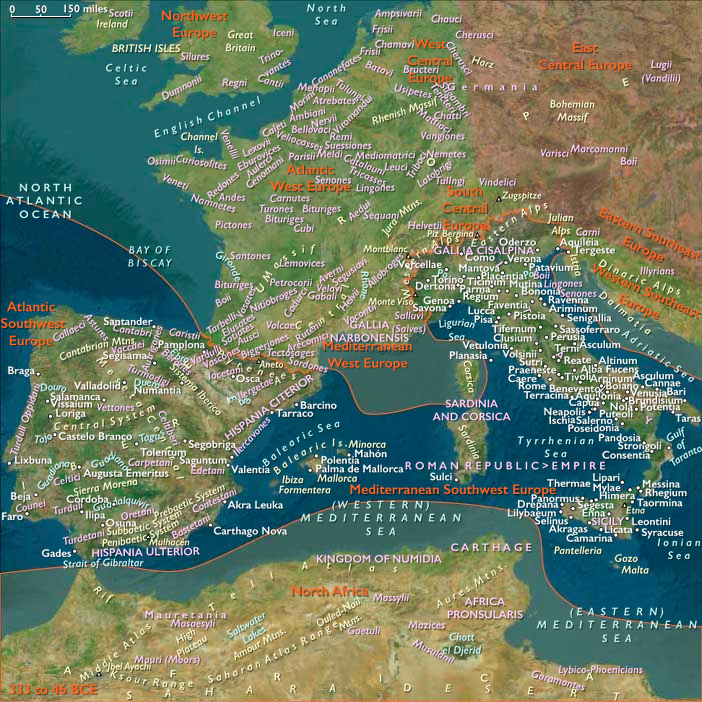
Subregions
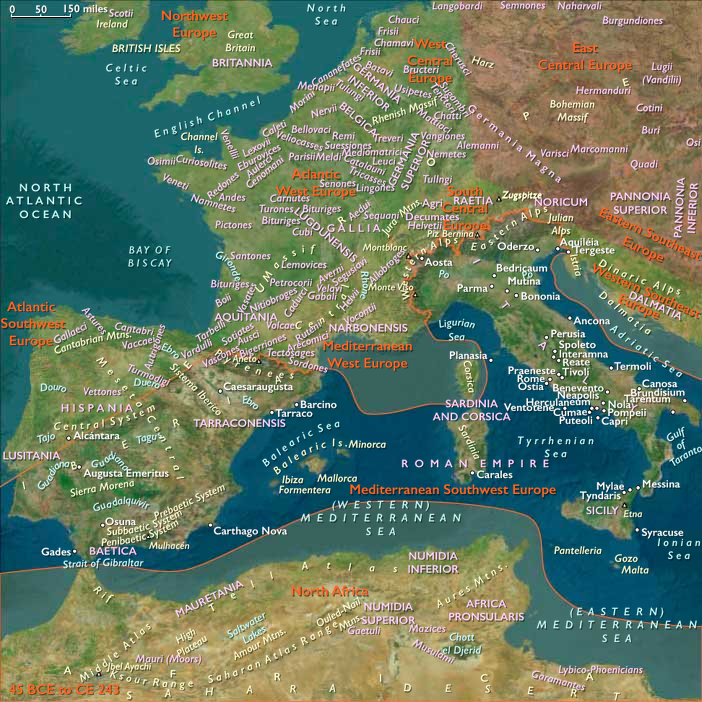
Years: 57BCE - 46BCE
People
- Cato the Younger
- Cicero
- Cleopatra VII
- Julius Caesar
- Lucius Sergius Catalina
- Mark Antony
- Pharnaces II
- Pompey
- Ptolemy XIII Theos Philopator
- Publius Servilius Vatia Isauricus
- Quintus Caecilius Metellus Pius Scipio Nasica
Groups
Topics
- Roman colonization
- Roman Republic, Crisis of the
- Roman Civil War, Great, or Caesar's Civil War
- Alexandria, Siege of
- Nile, Battle of the
- Zela, Battle of
- Thapsus, Battle of
Subjects
Regions
Subregions