
Mediterranean Southwest Europe (525–514 BCE): Conflict, …
Years: 525BCE - 514BCE
Mediterranean Southwest Europe (525–514 BCE):
Conflict, Philosophy, and Cultural Flourishing
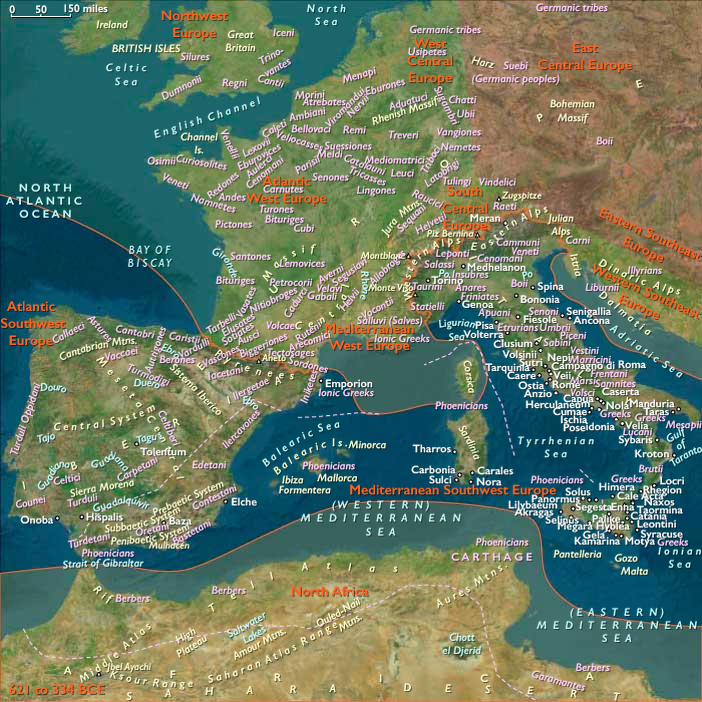
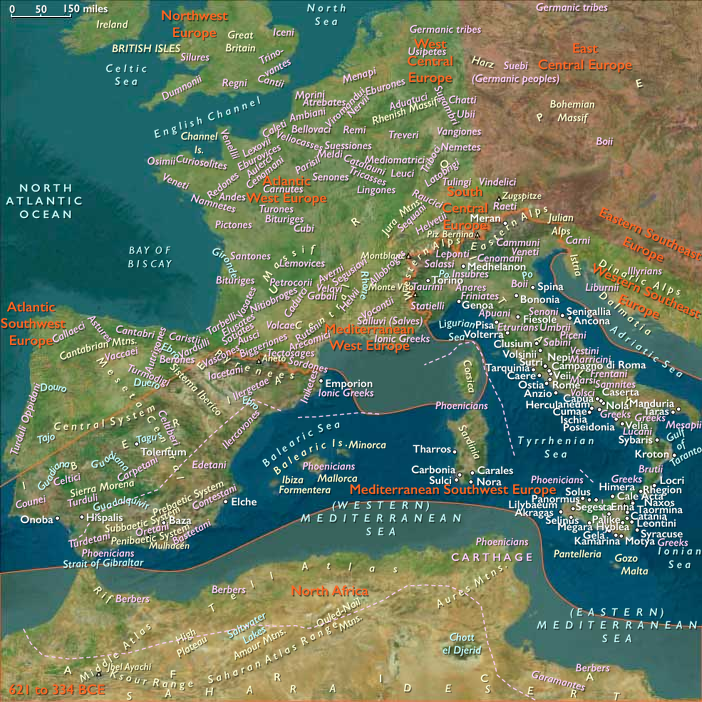
The period 525–514 BCE sees Mediterranean Southwest Europe marked by intense rivalry between Greek cities and the expanding Etruscans, the profound influence of Pythagorean philosophy, and the continued growth and urbanization of Greek colonies.
Greek Triumph Over the Etruscans
In 524 BCE, the Greek cities of southern Italy and Sicily decisively confront and defeat the ambitious Etruscans near Cumae, a prominent Greek settlement. This victory, led by Aristodemus of Cumae, significantly curtails Etruscan expansion and solidifies Greek influence and control in the region. The conflict underscores the intensifying competition for dominance and trade control in Mediterranean Southwest Europe.
Pythagorean Philosophy in Croton
Around 525 BCE, the philosopher Pythagoras relocates from Samos to the city of Croton in Magna Graecia, where he establishes a philosophical and religious school. The Pythagorean community rapidly grows, attracting numerous followers who adopt a disciplined and ascetic lifestyle, emphasizing vegetarianism, spiritual purity, and rigorous study.
Pythagoras teaches that the soul is immortal, separable from the body, and capable of reincarnation until achieving ultimate purification. Central to Pythagorean thought are mathematical ratios—particularly the musical intervals of 4:3, 3:2, and 2:1—which form the fundamental principles of the cosmos. Besides mathematics, the Pythagorean School advances knowledge in medicine and astronomy, profoundly impacting intellectual traditions in Greek and later Western culture.
Cultural and Urban Expansion of Poseidonia
By 540 BCE, the Greek colony of Poseidonia (later known as Paestum), established by settlers from Sybaris, achieves notable prosperity and urban expansion. Archaeological evidence from this period indicates the significant development of roads, temples, and civic structures, underscoring Poseidonia’s growing importance as an economic and cultural center within the wider network of Greek colonies in Italy.
Legacy of the Era
The era 525–514 BCE highlights significant shifts in power dynamics, intellectual advancements, and urban development within Mediterranean Southwest Europe. The Greek victory at Cumae marks a turning point against Etruscan expansion, while the spread of Pythagorean philosophy profoundly influences intellectual thought and culture. Simultaneously, the prosperity and infrastructural growth in Poseidonia exemplify the ongoing success and influence of Greek colonization efforts in the region.
People
Groups
- Italy, classical
- Greeks, Classical
- Magna Graecia
- Sybaris (Achaean Greek) city-state of
- Croton (Achaean Greek) city-state of
- Etruria
Topics
Subjects
Regions
Subregions
Related Events
Showing 10 events out of 65761 total
Years: 525BCE - 514BCE
People
Groups
- Italy, classical
- Greeks, Classical
- Magna Graecia
- Sybaris (Achaean Greek) city-state of
- Croton (Achaean Greek) city-state of
- Etruria
Topics
Subjects
Regions
Subregions