
Mediterranean Southwest Europe (388–531 CE): Imperial Decline, …
Years: 388 - 531
Mediterranean Southwest Europe (388–531 CE): Imperial Decline, Barbarian Ascendancy, and Cultural Transformation
The age 388–531 CE in Mediterranean Southwest Europe encompasses profound shifts, including the final decline of Western Roman imperial authority, the rise of Germanic kingdoms, and significant religious and cultural transformations. These events deeply influence the historical trajectory of the region, laying the foundations of medieval Europe.
Division and Decline of the Roman Empire (388–411 CE)
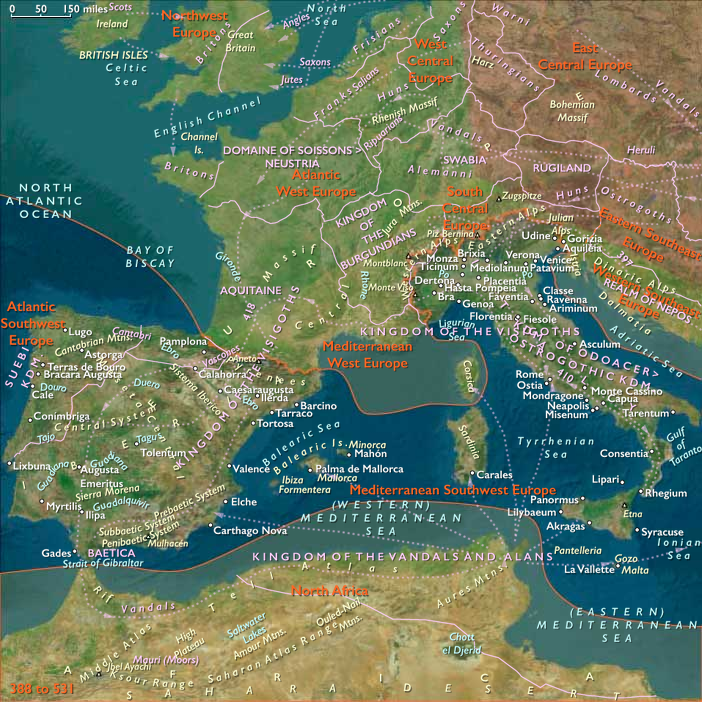
In 395 CE, the Roman Empire definitively splits into Western and Eastern halves, marking a turning point. The Western Empire, weakened by internal strife and external invasions, progressively dissolves. Emperor Honorius (r. 395–423 CE) struggles against invasions, commissioning his sister, Galla Placidia, and her husband, the Visigothic king Ataulf, to stabilize Iberia. Their efforts partially restore order, with the Visigoths settling permanently in Spain, subduing the Suevi, and pushing the Vandals into North Africa.
Visigothic Kingdom and Ecclesiastical Authority (412–447 CE)
The Visigoths, highly Romanized, establish their capital at Toledo by 484 CE, governing in the emperor's name as imperial patricians. Despite their relatively small numbers—approximately 300,000 among four million Hispano-Romans—their elite status significantly shapes regional politics.
Ecclesiastical institutions, especially the Council of Bishops, emerge as stabilizing forces amid declining civil governance. Bishops, possessing both civil and religious authority, effectively maintain order, reinforcing Christianity’s growing influence as a social and political force.
Ostrogothic Ascendancy and Cultural Flourishing (448–459 CE)
In Italy, Ostrogothic king Theodoric the Great emerges as a dominant figure, leading his Goths against Odoacer in 489 CE and establishing the Ostrogothic Kingdom by 493 CE. Theodoric's rule blends Roman administrative practices with Gothic leadership, ushering in stability and cultural revival, exemplified by artistic masterpieces like the mosaics in Ravenna’s mausoleum of Galla Placidia.
Late Imperial Decline, Visigothic Expansion, and Vandal Incursions (460–471 CE)
Between 456 and 460 CE, Vandals under Genseric briefly occupy coastal cities in Corsica and Sardinia, an occupation formalized by Emperor Majorian. Roman authority, weakened under emperors Majorian and Anthemius, struggles to maintain territorial integrity, but General Marcellinus, possibly supported by Pope Hilarius, regains control of these territories by 466 CE.
Simultaneously, Visigoths under King Euric consolidate power in southern Gaul and Iberia, gradually dismantling Roman administrative structures and paving the way toward medieval feudalism. Amid political upheaval, Christianity remains a powerful stabilizing and cultural force.
The Fall of Western Rome and Renewed Vandal Expansion (472–483 CE)
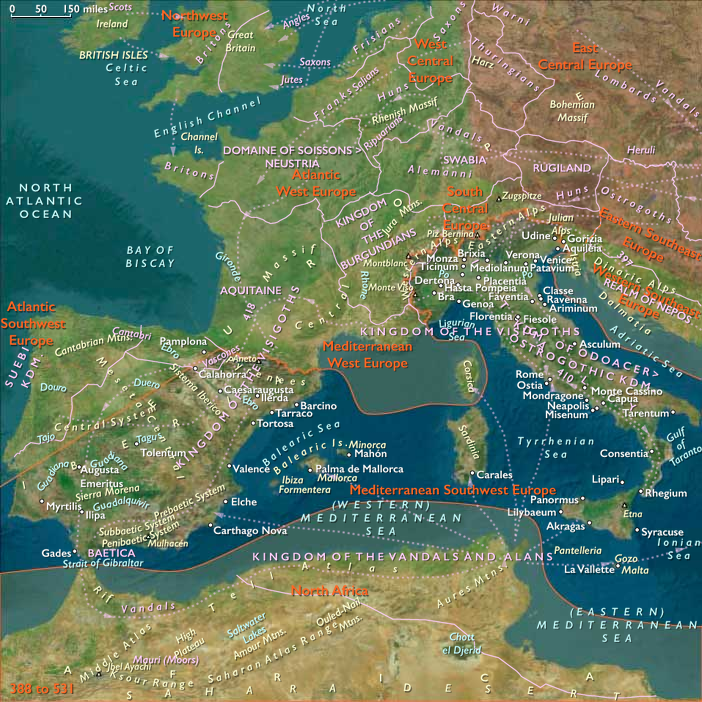
In 476 CE, the Western Roman Empire formally collapses with the deposition of Emperor Romulus Augustulus by the Germanic chieftain Odoacer. Concurrently, Visigothic King Euric expands his dominion, firmly establishing the Visigothic Kingdom across southern Gaul and Iberia.
Between 474 and 482 CE, Sardinia again falls under Vandal rule, possibly led by Huneric. Their control secures maritime trade routes between North Africa and the Mediterranean. Sardinian cities, notably Olbia, suffer destructive raids, reflecting the island’s strategic importance.
Theodoric’s Conquest, Ostrogothic Kingdom, and Vandal Administration (484–495 CE)
From 489 CE, Theodoric leads the Ostrogoths into Italy, defeating Odoacer by 493 CE and establishing the Ostrogothic Kingdom centered at Ravenna. Concurrently, Vandals maintain a structured administrative system in Sardinia, overseen by a praeses from Caralis, supported by procurators and tax officials. The territory is divided among crown lands and Vandal warriors, though local Sardinian-Roman landowners retain estates through payments, and Barbagia maintains semi-autonomous status.
Visigothic Consolidation and Frankish Rivalry (496–507 CE)
Under Alaric II, the Visigoths enact the Breviary of Alaric (506 CE), codifying Roman law for their subjects. However, rising tensions with the Franks culminate in Alaric’s defeat and death at the Battle of Vouillé (507 CE), forcing Visigoths into a defensive position within Iberia.
Stabilization and Reorganization (508–531 CE)
After Vouillé, the Visigothic Kingdom under Amalaric stabilizes, solidifying power in Iberia. In Italy, Theodoric’s Ostrogothic Kingdom experiences continued stability, economic prosperity, and cultural vitality, reflected in architectural achievements like the Basilica of Sant’Apollinare Nuovo and Theodoric’s Mausoleum.
Cultural and Economic Continuity
Despite fragmentation, local economies adapt successfully, with robust agricultural production and active regional trade. Christianity shapes cultural norms, education, and artistic expression, preserving Roman traditions within evolving medieval contexts.
Germanic Influence and Legacy
The Suevi maintain a modest kingdom in northwestern Iberia, while the Vandals, despite limited numbers, imprint their legacy on southern Spain (Andalusia) and Sardinia, influencing regional names and historical memory.
Legacy of the Age
The era 388–531 CE signifies a critical transformation from classical Roman civilization to early medieval Europe. Visigothic and Ostrogothic kingdoms, empowered ecclesiastical structures, and cultural adaptations profoundly shape the region’s future identity. This period's enduring legacies include Roman-derived legal systems, ecclesiastical dominance, linguistic shifts (Romance languages), and foundational medieval political structures.
People
- Alaric II
- Amalaric
- Anthemius
- Ataulf
- Galla Placidia
- Majorian
- Marcellinus
- Pope Hilarius
- Theoderic the Great
Groups
- Franks
- Vandals (East Germanic tribe)
- Suebi (Suevi), Realms of the
- Roman Empire: Valentinian dynasty (Rome)
- Roman Empire: Theodosian dynasty (Constantinople)
- Ostrogoths, Realms of the
- Visigoths, Realm of the
- Roman Empire, Western (Milan)
- Visigothic Kingdom of Toulouse
- Vandals and the Alans, Kingdom of the
- Christianity, Chalcedonian
- Sardinia, Vandal
- Francia (Merovingians)
- Ostrogoths, Italian Kingdom of the
Topics
- Fall of the Western Roman Empire
- Rome, Visigothic Sack of
- Rome, Sack of (455)
- Rome, Fall of
- Vouillé, Battle of
Subjects
Regions
Subregions
Years: 388 - 531
People
- Alaric II
- Amalaric
- Anthemius
- Ataulf
- Galla Placidia
- Majorian
- Marcellinus
- Pope Hilarius
- Theoderic the Great
Groups
- Franks
- Vandals (East Germanic tribe)
- Suebi (Suevi), Realms of the
- Roman Empire: Valentinian dynasty (Rome)
- Roman Empire: Theodosian dynasty (Constantinople)
- Ostrogoths, Realms of the
- Visigoths, Realm of the
- Roman Empire, Western (Milan)
- Visigothic Kingdom of Toulouse
- Vandals and the Alans, Kingdom of the
- Christianity, Chalcedonian
- Sardinia, Vandal
- Francia (Merovingians)
- Ostrogoths, Italian Kingdom of the
Topics
- Fall of the Western Roman Empire
- Rome, Visigothic Sack of
- Rome, Sack of (455)
- Rome, Fall of
- Vouillé, Battle of
Subjects
Regions
Subregions