
Mediterranean Southwest Europe (472–483 CE): The …
Years: 472 - 483
Mediterranean Southwest Europe (472–483 CE): The Fall of Western Rome, Visigothic Kingdom, and Renewed Vandal Expansion
The era 472–483 CE in Mediterranean Southwest Europe is marked by the definitive end of Western Roman imperial authority, the establishment and expansion of the Visigothic kingdom, and continued cultural transformations shaped by Christianity and emerging barbarian rule.
End of Western Roman Imperial Authority
In 476 CE, the Western Roman Empire formally collapses with the deposition of Emperor Romulus Augustulus by the Germanic chieftain Odoacer. Odoacer assumes control as King of Italy, signaling a decisive shift from Roman imperial governance to barbarian rule and fragmented authority across Mediterranean Southwest Europe.
Consolidation of Visigothic Power under Euric
During this period, Visigothic King Euric (r. 466–484 CE) expands and consolidates his authority over vast areas of southern Gaul and Iberia. Euric’s governance firmly establishes the Visigothic Kingdom as a dominant political entity, adapting Roman administrative traditions to serve new Germanic rulers.
Renewed Vandal Occupation of Sardinia
Between 474 and 482 CE, Sardinia falls once again under Vandal control, possibly led by Genseric or his son Huneric. During these campaigns, Olbia, one of Sardinia's most prosperous cities, is violently attacked from the sea, resulting in severe destruction, including the ruin of its port and significant damage to buildings, as evidenced by discovered fragments of collapsed frescoes. An intriguing archaeological find from this event is a Visigothic spearhead, likely used during the looting. Sardinia's possession secures crucial maritime trade routes between the Vandal kingdom in North Africa and the broader Mediterranean, underscoring the island's strategic importance.
Economic Transformation and Regionalization
The collapse of central Roman authority accelerates economic decentralization and regionalization. Local economies increasingly rely on self-sufficient agriculture and regional trade networks as traditional Roman economic structures—such as taxation systems and centralized currency—give way to localized economic control.
Cultural Continuity and Christian Influence
Christianity continues to thrive as the dominant cultural and spiritual force. The Church provides crucial continuity amidst political change, actively shaping social norms, educational practices, and artistic expression. Ecclesiastical leadership further strengthens, stepping into roles previously occupied by weakened imperial institutions.
Artistic and Architectural Developments
The region continues to produce exceptional works of art and architecture, particularly in major urban centers like Ravenna and Rome. Churches and religious institutions maintain high standards of craftsmanship and artistic expression, preserving classical traditions within a distinctly Christianized context.
Legacy of the Era
The era 472–483 CE marks a profound historical transition from imperial Roman governance to Germanic rule, definitively reshaping political, social, and cultural landscapes. The fall of Western Rome and the rise of the Visigothic Kingdom set the stage for medieval Europe, significantly influencing the region’s identity and laying foundations for future developments in Mediterranean Southwest Europe.
People
Groups
- Christianity, Nicene
- Roman Empire, Western (Ravenna)
- Visigothic Kingdom of Toulouse
- Vandals and the Alans, Kingdom of the
- Sardinia, Vandal
- Odoacer (Italy), Kingdom of
Topics
Subjects
Regions
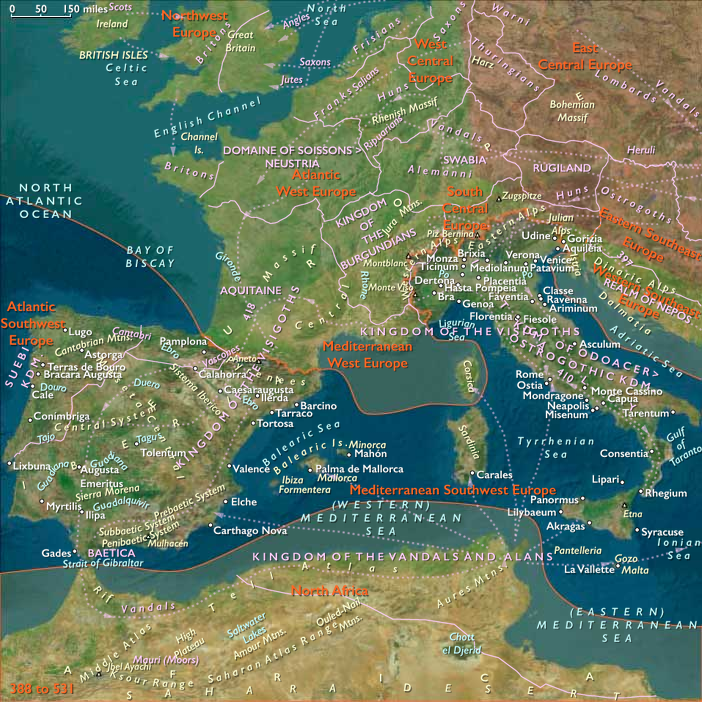
Subregions
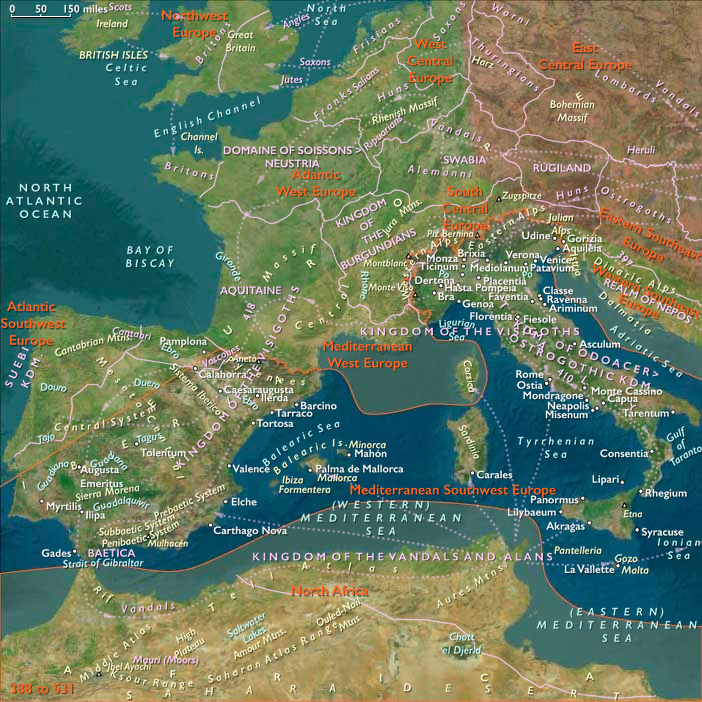
Years: 472 - 483
People
Groups
- Christianity, Nicene
- Roman Empire, Western (Ravenna)
- Visigothic Kingdom of Toulouse
- Vandals and the Alans, Kingdom of the
- Sardinia, Vandal
- Odoacer (Italy), Kingdom of
Topics
Subjects
Regions
Subregions