
Mediterranean Southwest Europe (460–471 CE): Late Imperial …
Years: 460 - 471
Mediterranean Southwest Europe (460–471 CE): Late Imperial Decline and Visigothic Expansion
The era 460–471 CE in Mediterranean Southwest Europe is characterized by deepening imperial decline, increasing Visigothic territorial ambitions, and the ongoing shift from Roman central authority toward regional governance under barbarian rule.
Visigothic Power under King Theodoric II and Euric
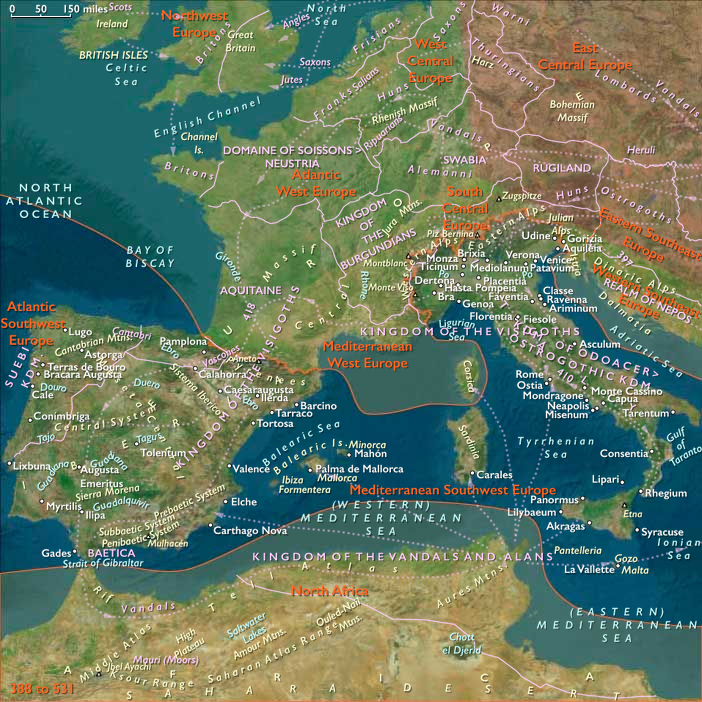
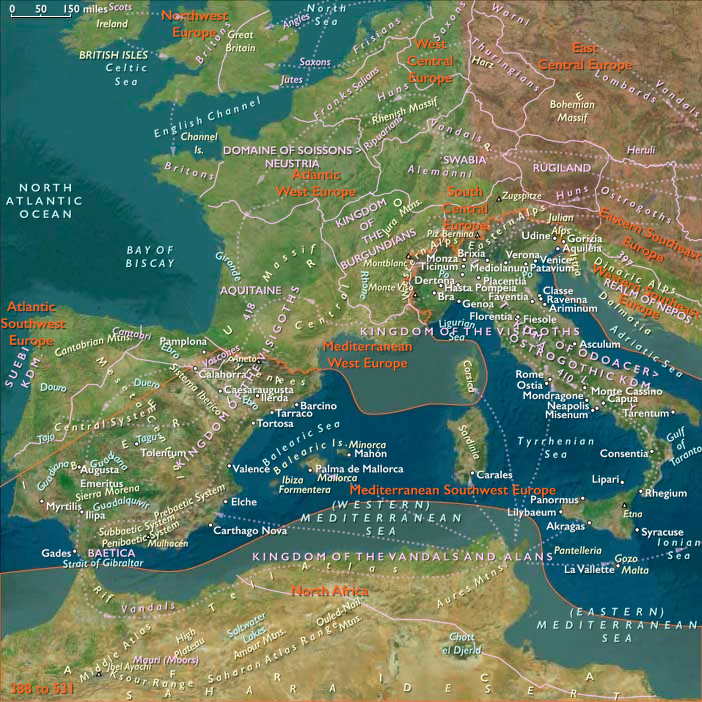
During this period, the Visigoths under King Theodoric II (r. 453–466 CE) and subsequently King Euric (r. 466–484 CE) significantly expand their influence in southern Gaul and much of Iberia. Euric, particularly ambitious and politically adept, consolidates Visigothic authority, aggressively pushing Roman administrative structures to the periphery and establishing what will soon emerge as a fully autonomous Visigothic kingdom.
Vandal Occupation of Corsica and Sardinia
Between about 456 and 460 CE, the Vandals under Genseric briefly occupy coastal cities in Corsica and Sardinia, an occupation formalized through an agreement with the Roman emperor Majorian. However, this presence is short-lived: in 466 CE, the Roman general Marcellinus, possibly encouraged by Pope Hilarius, successfully regains control of these territories. These events illustrate the ongoing Roman efforts and struggles to maintain territorial integrity amidst escalating barbarian pressures.
Roman Imperial Weakness and Fragmentation
The Western Roman Empire, under emperors such as Majorian (r. 457–461 CE) and Anthemius (r. 467–472 CE), increasingly struggles with internal factionalism, military revolts, and external threats. Despite valiant efforts to reassert imperial authority and reclaim lost territories, their reigns are marked by limited success and persistent instability.
Economic and Social Transitions
Economically, the region undergoes significant transitions as imperial taxation and monetary systems collapse, replaced gradually by localized economies under barbarian and regional aristocratic control. This shift results in a more fragmented socio-economic landscape, laying the foundation for medieval feudal structures.
Christian Ecclesiastical Strength and Cultural Continuity
Amid political and economic upheaval, the Church remains an essential stabilizing institution. Bishops and local religious leaders assume greater authority, influencing both local governance and broader cultural traditions. Artistic expressions continue to reflect Christian themes, demonstrating the lasting vitality and resilience of Mediterranean Southwest Europe's cultural traditions.
Artistic and Architectural Legacy
Cities such as Ravenna continue to produce significant architectural and artistic works, notably exquisite mosaics and ecclesiastical buildings reflecting a blend of Roman and early medieval artistic styles. These achievements underscore the ongoing cultural vibrancy and sophisticated craftsmanship of the period.
Legacy of the Era
The era 460–471 CE further accelerates the transformation of Roman authority into localized, predominantly Visigothic rule. This period significantly shapes the region's political structure, economic practices, and cultural identity, marking a definitive step toward the medieval world and away from classical Roman traditions.
People
Groups
- Christianity, Nicene
- Roman Empire, Western (Ravenna)
- Visigothic Kingdom of Toulouse
- Vandals and the Alans, Kingdom of the
- Sardinia, Vandal
Subjects
Regions
Subregions
Years: 460 - 471
People
Groups
- Christianity, Nicene
- Roman Empire, Western (Ravenna)
- Visigothic Kingdom of Toulouse
- Vandals and the Alans, Kingdom of the
- Sardinia, Vandal
Subjects
Regions
Subregions