
Mediterranean Southwest Europe (393–382 BCE): Gallic Invasion …
Years: 393BCE - 382BCE
Mediterranean Southwest Europe (393–382 BCE): Gallic Invasion and Roman Resilience
The era 393–382 BCE in Mediterranean Southwest Europe is defined by significant Celtic invasions, the critical weakening of Etruscan power, and the profound trauma and recovery of Rome following its sack by Gallic tribes.
Decline of Etruscan Influence
During this era, Etruscan territory significantly shrinks, primarily due to continuous challenges by the Latin League in central Italy. The weakened state of Etruria creates vulnerabilities that invite external threats, setting the stage for the catastrophic Gallic incursion.
Celtic Invasion under Brennus
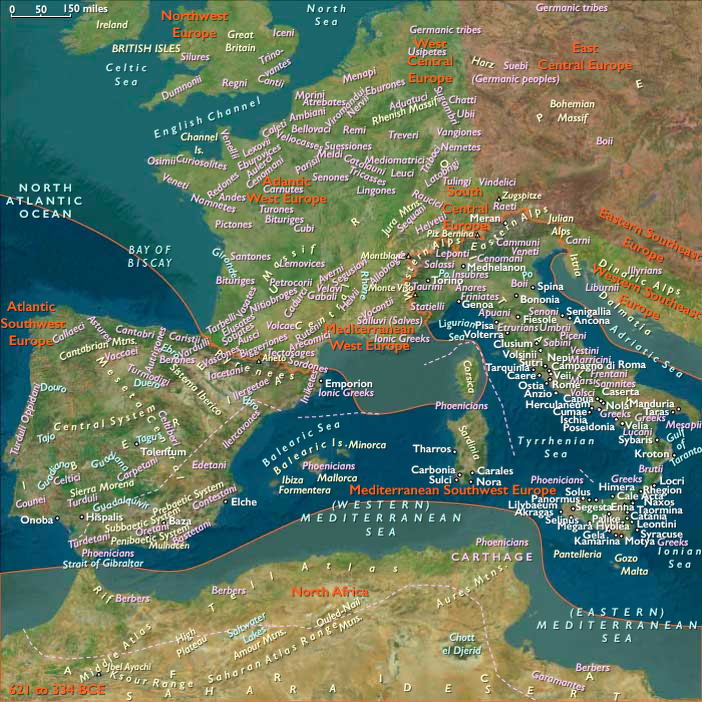
In about 400 BCE, the Celtic Senones, led by their chieftain Brennus, cross the Alps, decisively defeating Etruscan forces near Clusium (Chiusi) in 391 BCE. In desperation, Clusium appeals to Rome for assistance, prompting a Roman diplomatic delegation to negotiate a Gallic withdrawal. However, a diplomatic insult occurs, inciting the Gallic force to attack Rome directly.
The Sack of Rome (390 BCE)
In July 390 BCE, the Gauls inflict a devastating defeat upon the Romans at the Battle of the Allia River, leaving Rome defenseless. Subsequently, Brennus' forces storm and occupy Rome, capturing the entire city except for the fortified Capitoline Hill, where Romans maintain a tenuous resistance.
According to tradition, an attempted nighttime assault by the Gauls on the Capitoline fails because the sacred geese of Juno alert Roman defenders to the threat. However, the occupation remains catastrophic: many buildings—mostly wooden structures—are burned, and widespread looting and violence characterize the city's sacking.
Roman Recovery and the Legend of Camillus
Unable to dislodge Roman defenders from the Capitoline Hill and facing threats to their northern territories from the Italian Venetii, the Gauls ultimately negotiate their withdrawal. Roman dictator Marcus Furius Camillus secures their departure by agreeing to pay a ransom of one thousand pounds of gold. Famously, when Roman officials accuse the Gauls of rigging the scales used to measure the gold, Brennus theatrically places his sword upon the scale, proclaiming "Vae victis"—"Woe to the vanquished."
Renewed Roman Expansion
Following this disaster, Rome remarkably rebounds, leveraging its resilience to reassert dominance in central Italy. By 387 BCE, Rome successfully captures the Etruscan cities of Sutri and Nepi, and in 384 BCE, further extends its control by seizing Caere and its strategic port, Pyrgi.
Legacy of the Era
The era 393–382 BCE dramatically reshapes Mediterranean Southwest Europe. It marks a critical transition characterized by the sharp decline of Etruscan power, the temporary yet traumatic Gallic sack of Rome, and Rome's extraordinary capacity for resilience and territorial recovery. These events significantly influence subsequent historical developments in the region, cementing Roman determination and laying foundational narratives of defiance and recovery central to Roman identity.
People
Groups
- Veneti, Adriatic
- Italy, classical
- Celts
- Etruria
- Latin League
- Gauls
- Roman Republic
- Senones of Gallia Cisalpina
Topics
- Iron Age Europe
- Roman-Etruscan Wars, Early
- Rome, Celtic Sack of
- Roman–Gallic wars
- Allia, Battle of the
Commodoties
Subjects
Regions
Subregions
Related Events
Showing 10 events out of 64919 total
Years: 393BCE - 382BCE
People
Groups
- Veneti, Adriatic
- Italy, classical
- Celts
- Etruria
- Latin League
- Gauls
- Roman Republic
- Senones of Gallia Cisalpina
Topics
- Iron Age Europe
- Roman-Etruscan Wars, Early
- Rome, Celtic Sack of
- Roman–Gallic wars
- Allia, Battle of the
Commodoties
Subjects
Regions
Subregions